How Split PDFs Improve Document Management in Professional Workflows?
Mon, 17 August 2026
Inspirational journeys
Follow the stories of academics and their research expeditions
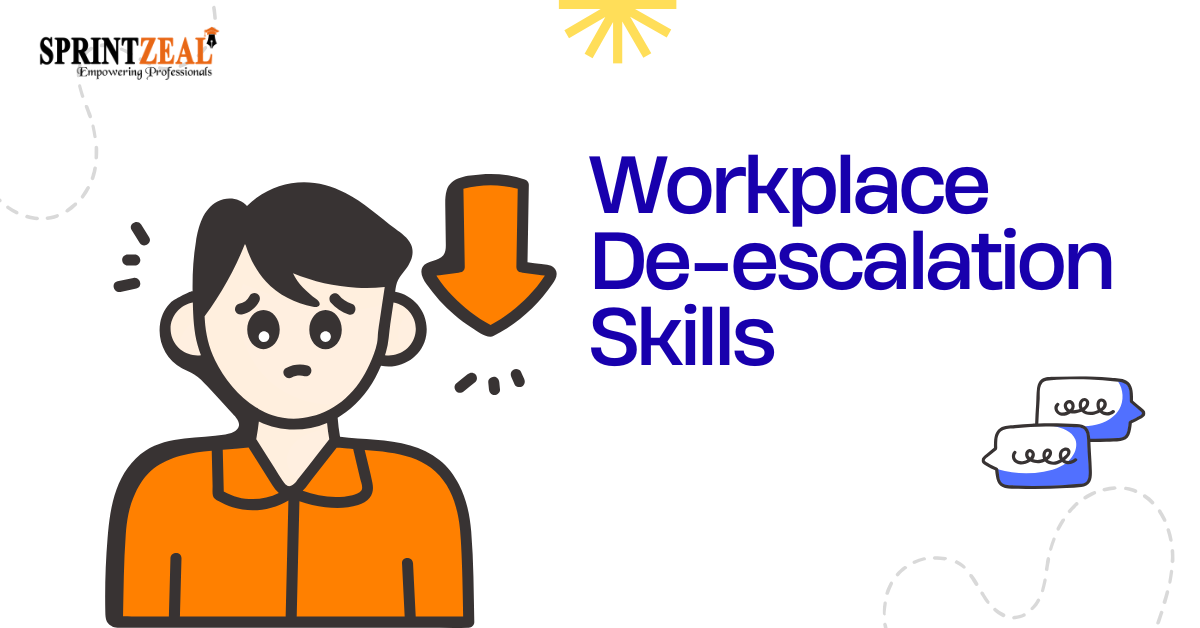
Every workplace has friction. Deadlines slip, priorities collide, someone gets passed over for a promotion, a customer loses patience at the front desk. Most of it burns off on its own. But some of it doesn't, and the moments that tip from tension into open hostility tend to be the ones nobody prepared for.
That gap between "normal disagreement" and "situation out of control" is where de-escalation skills live. And for managers, team leads, HR partners, and anyone in a customer-facing role, it is one of the most undervalued capabilities on the org chart.
The price of unmanaged conflict is rarely a single line item. It shows up as turnover, as absenteeism, as the two people on your team who quietly stopped collaborating six months ago. It shows up in the customer who never came back after a tense exchange nobody bothered to log.
Research on workplace conflict has consistently found that employees spend a meaningful share of their working hours dealing with disputes rather than doing their jobs. Multiply that across a department and the cost stops being abstract. Add the cost of replacing an employee who left because their manager could not handle a difficult conversation, and the number climbs fast.
There is a safety dimension too. In healthcare, education, retail, social services, and public-facing roles generally, verbal aggression is not a rare event. Staff in these environments regularly report incidents that escalated past the point where anyone felt in control. Those incidents leave a mark on the people involved long after the shift ends.
The most common misconception about conflict is that some people are naturally good at it. Certain people are calmer under pressure, sure. But de-escalation is not charisma. It is a set of learnable behaviors, and it works because it interrupts a predictable pattern.
When someone is escalating, their capacity for reasoning is dropping. Arguing with them, correcting their facts, or asserting authority tends to accelerate the spiral rather than stop it. What actually works is counterintuitive to most managers, who are trained to solve problems quickly and move on.
Here is what effective de-escalation actually looks like in practice.
You cannot calm someone down while you are activated. Your tone, posture, and speed of speech are contagious in both directions. Slowing your own breathing and dropping your volume slightly is not a soft skill flourish, it is the mechanism by which the other person's nervous system starts to follow yours down.
Physical proximity raises the temperature. So does interrupting. Step back, let the person finish, and resist the urge to fill silence. Most people escalating want to be heard more than they want to be agreed with.
"So the report went out without your sign-off and you found out from a client." That is not agreement. It is proof of listening. Reflection lowers the perceived need to escalate, because escalation is often just an attempt to be understood at a higher volume.
Once temperature drops, you can address content. Not before. Managers who try to reach resolution during peak activation almost always fail and often make things worse.
Not every situation is de-escalatable. Some require you to disengage, involve security, or escalate to HR. Knowing that line in advance, rather than improvising it under stress, is part of the skill.
Most managers learn conflict handling by getting it wrong a few times. That is an expensive curriculum, and the lessons are inconsistent. Someone who happened to face a difficult employee early in their career may have picked up habits that work in one context and fail badly in another.
Structured training solves for that. Programs built around scenario practice rather than theory give people the chance to rehearse the hard moments in a low-stakes setting, get feedback, and build the muscle memory that holds up when adrenaline is running. Organizations that invest in workplace de-escalation training tend to see the benefit not in dramatic incidents avoided, but in the everyday temperature of the place dropping. Meetings get more honest. Escalations to HR go down. People stop routing around each other.
The best programs are tailored to the environment. De-escalating an angry patient's family member in a hospital corridor is not the same as managing a heated disagreement between two senior engineers. Training that ignores that distinction tends not to transfer.
If you are responsible for developing leaders in your organization, treat conflict competence as a core requirement rather than a remedial fix applied after an incident.
A few practical moves:
Conflict is not a sign that something is broken. It is a sign that people care about outcomes and see them differently. The problem is not that disagreements happen, it is that most organizations leave their handling to chance and hope the right person is in the room.
De-escalation training changes that. It gives your people a shared method, a shared vocabulary, and the confidence to stay in a hard conversation instead of avoiding it or escalating it. For managers, that is not a nice-to-have. It is the difference between a team that works through friction and one that quietly comes apart.

Mon, 17 August 2026
Fri, 14 August 2026

Fri, 31 July 2026
Thu, 30 July 2026

Wed, 29 July 2026

Wed, 29 July 2026
Thu, 23 May 2024

Tue, 04 March 2025

Thu, 29 May 2025

© 2026 Sprintzeal Americas Inc. - All Rights Reserved.

 USA : +1315-322-7821
 UK : +44 7700 174870
 IND : +919036108287
 AUS : +61 480 005 455