How Certified Professionals Turn a Credential Into Career Momentum
Wed, 21 October 2026

Inspirational journeys
Follow the stories of academics and their research expeditions
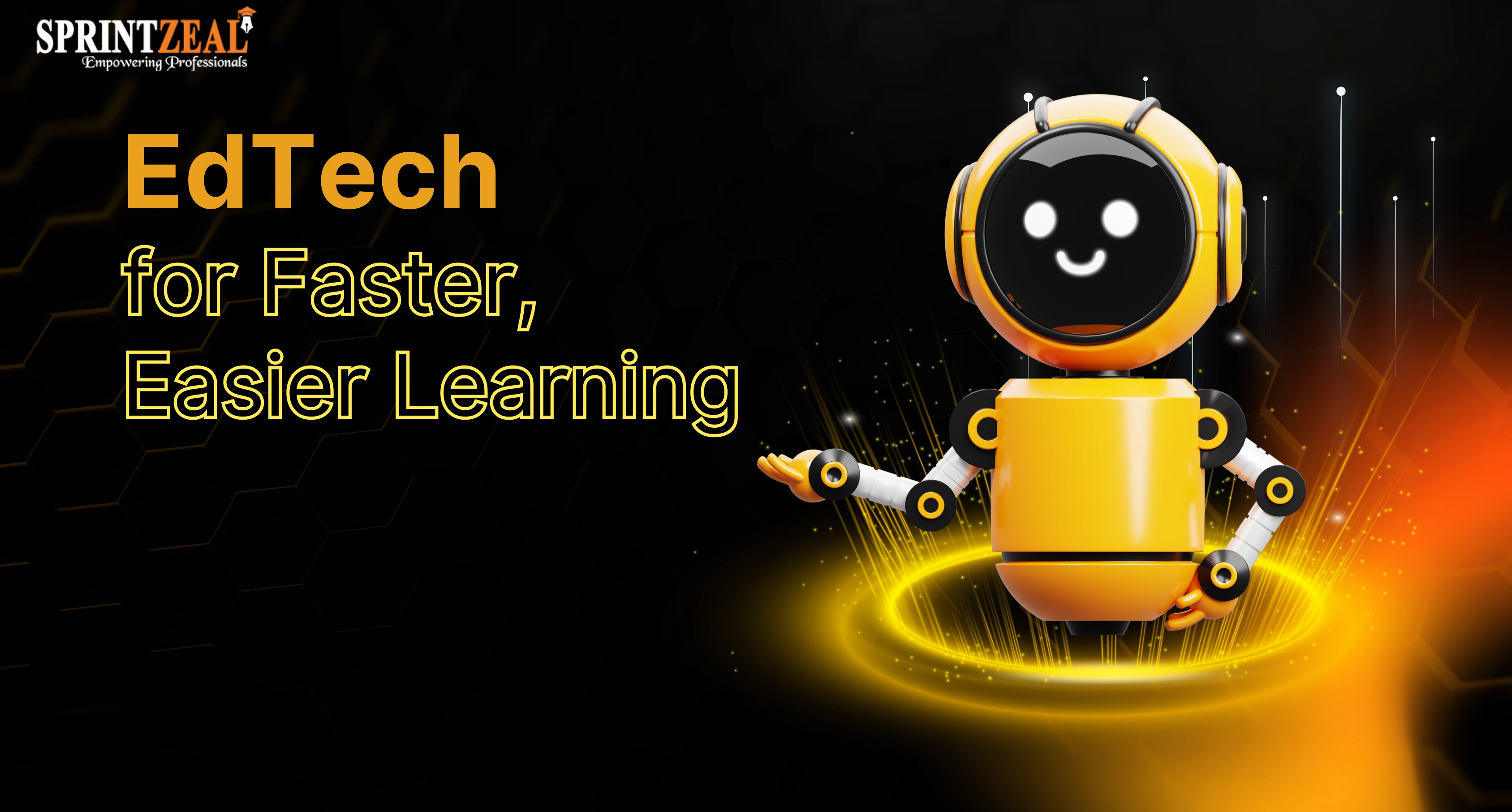
Education has always evolved with the times. From chalk and blackboards to overhead projectors and now to artificial intelligence powered platforms, the way students absorb information has changed dramatically.
But what we are seeing today is not just a shift in tools. It is a fundamental change in how learning actually happens. EdTech, short for educational technology, is quietly rewriting the rules of studying, and students who embrace it are finding that they can learn more in less time and with far less frustration.
Let us be honest about how most students used to study. You would sit down with a thick textbook, read through dense paragraphs, highlight half the page in yellow, and then stare at your notes the night before an exam hoping something would stick.
It was passive, inefficient, and honestly pretty demoralizing. Hours of effort would go in, and retention would still be shockingly low.
The problem was never the student. The problem was the method. Passive reading and re-reading is one of the weakest ways to commit information to memory. Science has known this for decades. But without better tools, most students had no real alternative.
What modern EdTech does brilliantly is take what cognitive science already knows about learning and bake it directly into the tools students use every day.
Concepts like spaced repetition, active recall, interleaving, and retrieval practice are no longer just theories sitting in academic journals. They are now features built into apps and platforms that millions of students use on their phones and laptops.
Take spaced repetition as an example. The idea is simple. Instead of cramming everything the night before, you review material at gradually increasing intervals.
Your brain is forced to retrieve the information just as it is about to forget it, which strengthens the memory each time. Apps that use this system calculate the perfect moment to show you something again, so you are not wasting time reviewing things you already know well.
One of the biggest shifts in student behavior over the last few years is how people are treating their notes. Notes used to be the end product of a study session.
You wrote them down and then maybe looked at them again before a test. Now, students are using their notes as raw material for something much more powerful.
Platforms like RemNote have made it incredibly easy to make flashcards from notes as part of the note-taking process itself. Instead of writing something down and moving on, students can instantly turn key ideas into active study material.
This means the act of taking notes becomes the beginning of the learning process rather than just a record of what the teacher said. It is a small change in habit that makes a massive difference in how much information actually gets retained.
One of the most powerful things EdTech brings to the table is personalization. Traditional classrooms move at one pace for everyone.
If you grasp a concept quickly, you still have to wait for the rest of the class. If you struggle with something, the lesson moves on anyway. It is a system built around averages, which means it rarely works perfectly for anyone.
Adaptive learning platforms change this completely. They track how a student performs on different types of questions and adjust the difficulty and focus accordingly. Development teams like Binary Studio have been instrumental in building the backend infrastructure that powers many of these adaptive learning platforms, ensuring they scale reliably as student user bases grow.
If you are flying through geography but struggling with calculus, the platform notices and gives you more practice where you need it most. This kind of targeted learning means students are not spending time on things they already know. Every minute of study time is working harder.
Another major reason students struggled with traditional studying is that it was simply boring. Reading the same notes over and over again is not just ineffective. It is genuinely dull, and a distracted brain learns almost nothing.
EdTech platforms have tackled this by making learning feel more interactive and even enjoyable. Gamification elements like streaks, points, leaderboards, and progress badges tap into the brain's reward system.
When students feel a sense of progress and achievement, they are more motivated to keep going. This is not about turning education into a video game. It is about understanding human psychology and designing tools that work with it instead of against it.
Video based learning has also grown enormously. Platforms offering short, focused video lessons allow students to pause, rewind, and revisit concepts as many times as they need to without any judgment. A student who does not understand something can simply watch that section again, something that was never possible in a traditional classroom setting.
EdTech has also transformed how students work together. Study groups used to require everyone to be in the same physical space at the same time.
Now, students can collaborate across cities, countries, and time zones using shared documents, discussion forums, virtual classrooms, and group note-taking tools.
This opens up access to different perspectives and explanations that can make a concept click in a way that one teacher's explanation might not.
Peer learning is genuinely powerful. When a classmate explains something in their own words, it often lands differently than a formal lesson.
EdTech platforms that encourage this kind of collaboration are giving students access to a much wider support network than they ever had before.
What is remarkable is that we are still in the early days of all this. The EdTech tools available today are already significantly more effective than traditional studying methods, and they are only going to get smarter.
AI tutors are becoming more sophisticated. Platforms are getting better at identifying not just what a student does not know, but why they are struggling with it.
Students who learn how to use these tools well are not just studying more efficiently. They are developing learning skills that will serve them for the rest of their lives.
In a world where the ability to learn quickly is one of the most valuable things a person can have, that is not a small advantage. It is everything.

Wed, 21 October 2026
Thu, 15 October 2026

Wed, 14 October 2026
Tue, 13 October 2026
Wed, 07 October 2026

Fri, 02 October 2026

Wed, 30 September 2026
Tue, 29 September 2026
Fri, 25 September 2026
Tue, 22 September 2026


© 2026 Sprintzeal Americas Inc. - All Rights Reserved.

 USA : +1315-322-7821
 UK : +44 7700 174870
 IND : +919036108287
 AUS : +61 480 005 455