Excel vs Power BI: Which Is Better?
Thu, 16 July 2026

Inspirational journeys
Follow the stories of academics and their research expeditions
Object-Oriented programming or OOPs was implemented with the restrictions dealt with in earlier programming approaches.
To really understand Object Oriented Programming language (OOPs) concepts and their methodology, understanding the traditional limitations and disadvantages put on a programming language is vital.
In the first place, OOPs came into the picture to resolve the restrictions in the operation analysis like maintenance and durability to programming.
The elemental aim of OOPs is to put together both the data and the functions that use these data as a source into a sole unit. This single unit has a number of entities called objects. Data and functions assemble around the objects, and the objects are identified by a user doing the tasks allocated. Objects communicate through that particular function.
This is done so that only that particular function can approach and no other code. It aims to bring data close to functions associated with the object and to safeguard it from accidental modifications from external issues.
This article deals with pure OOPs concepts with their basic principles and briefly characterizes them in general.
OOP is short for object oriented programming. Some learners also call it oo programming or oop programming. Others search for it as object driven programming even though the correct term is object oriented programming. No matter which term you search for the idea stays the same. It is a way to write code around objects instead of a long list of steps.
Java is the most common oop language taught in colleges and bootcamps today. But the object oriented concepts you learn here carry over to almost any oop language you pick up later. Once the object oriented concepts click in one language the rest becomes a matter of syntax.
OOPs (Object-Oriented Programming System) is a programming concept. It is a core of Java programming used to design programming using classes and objects. The OOPs concepts in Java are built on the four main principles.
These four pillars are often called the OOP principles. Together they explain most of what object-oriented programming oop is about. Interview panels ask about these pillars more than any other topic in oops concepts.
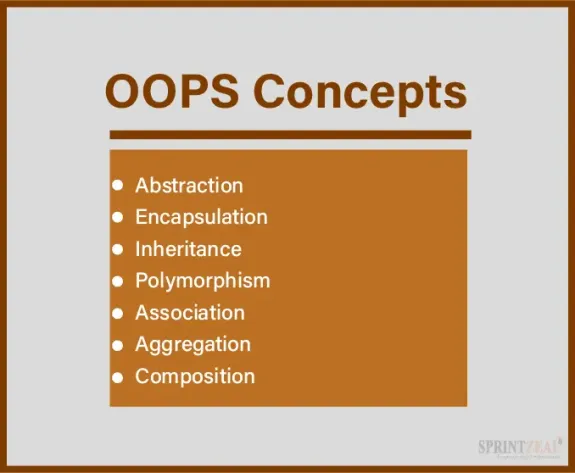
It also relies on the other three concepts of association, aggregation, and composition.
Our blog on OOPs Interview Questions And Answers provides all the important OOPs interview questions and answers to help you begin your journey in this sphere.
The basic Java OOPs concepts in general includes,
The class is the first basic OOPs concepts, which is a group of the same entities. Class is a logical component and not a physical entity.
For example:
If there is a class as 'branded shoes', the objects can be Burberry, Stuart Weitzman, Louis Vuitton, Gucci, and more. The properties or data of the class can be brands, unique pieces, or prices of these shoes.
The methods that may be performed with these shoes are global size standards, unique materials or features, comfort, signature, and style.
Class declaration also has some elements. We have discussed them here.
Modifiers: By default a class can be accessed. Yet it can also be public.
Class name: The convention is to start the name of a class with the capital letter.
Body: The braces, { } are used to enclose the class body.
A class is one of the most basic building blocks in any object oriented language. Once you know how a class works the rest of oops concepts become much easier to follow.
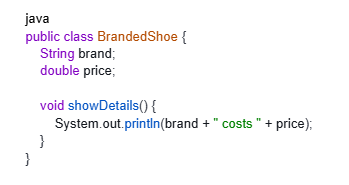
The code above is a plain example of a class in Java. It has data in the form of fields and a method that works on that data.
An object is a real-world thing. It is a basic unit of OOP that can be physical or conceptual.
An object in object-oriented programming is a class instance that can be physical or conceptual.
It also has a state and behavior. Along with this, the information and function that operate on the data.
For example, let us consider conceptual and physical objects. This can be bikes (physical) and institutes (conceptual). Other examples include tables and chairs. Even glass, trucks, cars, engines, and more.
An object mainly consists of:
An object in oop is created from a class using the new keyword in Java.
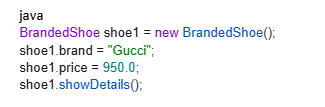
Here shoe1 is one object made from the BrandedShoe class. You can make many objects from a single class and each one can hold different data.
Inheritance is another of the basic OOPs concepts in Java and the most powerful feature, in which one class shares structure and behavior defined in one or more classes. The medium of obtaining a new class from an old class is defined as inheritance or derivation.
It is the relationship among the classes. The old class is the base class. The new class is called the subclass (derived).
An OOP example: A family of four members having a father, mother, son, and daughter. The father and mother (parents) were taken as the base class. The son and daughter (children) as a subclass.
The subclasses (children) will often inherit features derived from both the base class (parents) with better versions of inheritance.
Similarly, OOP, with the use of effective inheritance, can reduce errors and save time in programming. This, thus, will result in quality work and productivity.
Another example:
Java and C# are OOPs languages that do not support multiple inheritances through classes.
The different types of inheritance that are supported by Java:
Inheritance oop java works through the extends keyword. This is one reason people say java is oop at its core since inheritance sits at the center of almost every Java framework.
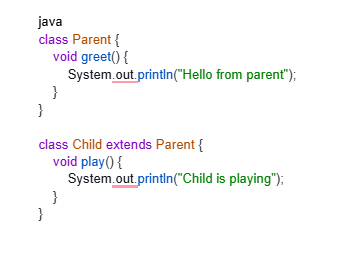
Child gets the greet method for free and adds its own play method. This is java object oriented programming in action. It shows why java and oop are almost always mentioned together in tutorials and job postings.
Inheritance oop java questions come up in almost every entry level interview so it pays to practice this pattern until it feels natural. Anyone learning java in oop should write this exact kind of code by hand at least once before moving to interfaces.
'Poly' is a Greek term that means 'many,' and 'morphism' means 'forms.'
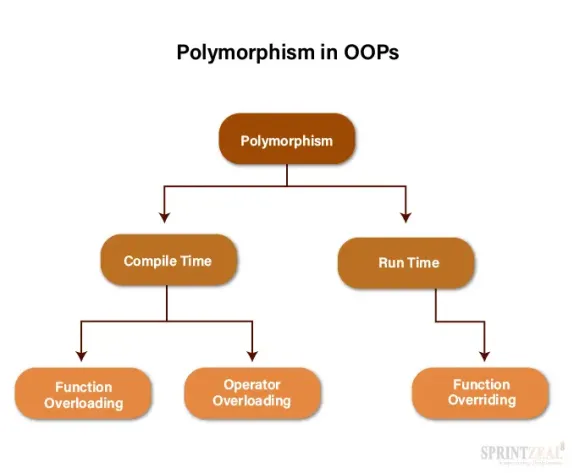
This is another OOPs concept that has the ability of a variable or function to take more than one form. Polymorphism is also the ability to use a function in many forms. This means that the same operator behaves differently in varying scenarios.
Types of Polymorphism
Polymorphism in Java is mainly of 2 types, as mentioned below:
Take an OOPs example: the class animal or human cannot have the same behavior. Similarly, an entity, function, or object behaves differently as per the scenarios. Overloading and overriding are examples of OOPs.
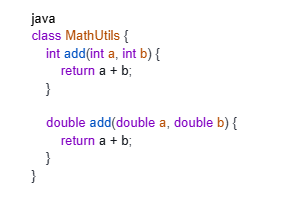
Both methods share the same name add. Java picks the right one based on the type you pass in. That is method overloading and it is decided at compile time.
Method overriding is different. A child class writes its own version of a method that already exists in the parent class. It is checked and used at run time. Both forms are core to oops concepts and both show up often in interview rounds on oop coding.
Abstraction is an activity that displays only the essential information and excludes unnecessary information.
A technique for data hiding that selects data from multiple data sources to display only required information. The motive is to minimize programming complexity and effort.
For example, for operating a television, a user need not focus on internal operations. They have to pay attention to the remote control, screen display, switch and cable connection, and others.
There are also certain benefits associated with abstraction. These include:
Abstraction is one of the most tested topics in an object oriented programming concepts interview. In Java it is achieved through abstract classes and interfaces. We cover both later in this article so you have a complete picture of this part of object oriented concepts.
Encapsulation is the first pillar or principle of object-oriented programming. A process of binding data (properties, variables) and operations or functions (methods) that works on data together in a single construct. A class can be the best example of encapsulation.
For example, consider going to the salon; only the stylist has the experience and the options based on your requirements.
Now let us discuss some advantages associated with encapsulation
Improved data security
Encapsulation hides sensitive data. It does this by restricting direct access to variables. Remember that only controlled methods can modify the values. They also improve the overall security.
Improved maintenance of code
Internal changes to a class don't affect external code. This makes updates easier. At the same time, it supports cleaner and more stable programs.
Increased Flexibility and Control
Getters and setters allow controlled data access. Validation and rules can be added to make sure there are safe modifications.
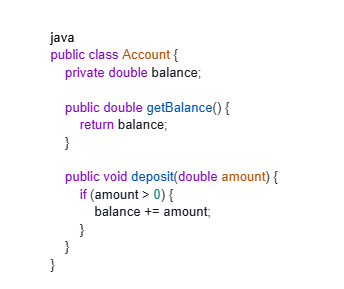
The balance field is private. No outside code can touch it directly. It can only change through the deposit method where you control the rules. This small pattern is at the heart of every strong object oriented programming concepts course.
The relationship between two separate classes with the help of objects is called association. A basic concept in Java describes the connection between two or more objects.
For example; let us take a connection between the airplane and the passengers. Many passengers associate with one airline, while, a single passenger associates with multiple airlines. Likewise, multiple passengers connect with multiple airlines, and a single passenger with one airline.
Association can be one-to-one, one-to-many, many-to-one or many-to-many. It is the widest of all class relationships in oops concepts and the other two below are more specific forms of it.
Aggregation is the technique where objects have their separate lifecycles; it represents a special connection between an object containing other objects.
When an object 'has a' another object, then you have got an aggregation in between them. This is also called a 'has a' relationship. For an OOPs example, an employee can be only in one department. Even if the department is deleted, the employee exists. This is called an 'has a' relationship.
Composition is one of the fundamental aspects of object-oriented programming that is a special case of aggregation.
It outlines a class that cites one or more objects of the other class occurrence variables. In both aggregation and composition, a direction to specify is a must as the object contains the other object.
When an object carries another object, if the contained object is incapable to exist without the existence of the container object, it is defined as composition.
For example; if item 2 is created from item 1, then, item 1 has the power to delete item 2. Unlike aggregation, object 2 cannot exist without object 1.
Class, object, inheritance, polymorphism, abstraction, encapsulation, association, aggregation and composition are the core nine. But a complete look at oops concepts should also cover a few more building blocks that show up daily in real Java code. These are less talked about in older guides but come up often in current interviews and real projects.
A constructor is a special method that runs the moment an object is created. Its job is to set up the starting state of that object. A constructor shares its name with the class. It never has a return type not even void.
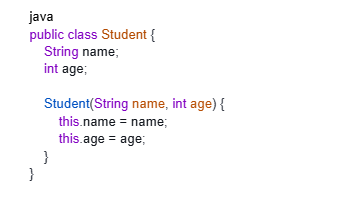
Every time you write new Student("Aditi", 21) this constructor runs automatically. Java supports a few types of constructors:
Access modifiers decide who can see or use a class field or method. Java gives you three main choices along with a default level.
|
Modifier |
Who can access it |
|
public |
Any class in the application |
|
private |
Only inside the same class |
|
protected |
Same package plus child classes |
|
default (no keyword) |
Only inside the same package |
Access modifiers are the tool that actually makes encapsulation work. Without private there would be no way to hide data at all.
An enum is a special type that only allows a fixed list of values. It is useful any time a field should never hold a random value.
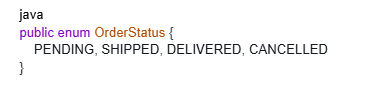
Using a plain string for order status leaves room for typing mistakes that the compiler cannot catch. An enum removes that risk. This is a small feature but a strong one and it often gets missed in beginner level oops concepts articles.
Both interfaces and abstract classes help you build abstraction in Java but they are not the same thing and picking the right one matters in real design work.
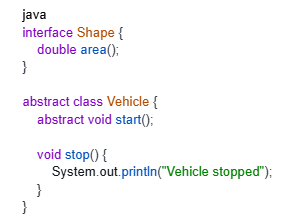
An interface only defines a contract. A class that implements Shape must supply its own area method. An abstract class can hold shared code along with methods that still need to be written by a child class. stop() above already works for every vehicle while start() is left open.
A simple rule to remember: use an interface when you want to describe what a class can do. Use an abstract class when related classes need to share some working code along with the contract.
|
Relationship |
Meaning |
Example |
|
Association |
Two classes are simply connected |
A student and a teacher |
|
Aggregation |
Has-a relation with weak ownership |
A team and its players |
|
Composition |
Has-a relation with strong ownership |
A house and its rooms |
|
Dependency |
One class briefly uses another to do a task |
An InvoiceService using a TaxCalculator |
Dependency is a fourth relationship worth knowing along with association aggregation and composition. It is weaker than all three. The dependent class does not store the other object as a field. It only borrows it for a moment such as a method parameter to get a task done.
Object-oriented programming (also referred to as OOP) is an object-centric development paradigm. The fundamental OOPs concepts offer a systematic and modular software construction methodology.
In object-oriented programming systems are considered to be cooperating groups of interacting objects. This view contrasts OOP with the previous procedural programming and is the foundation of the current concepts of object-oriented programming applied in most languages.
Each object in OOP possesses a state, which is represented in terms of its properties, and behavior in terms of its methods. In this method, the concept of encapsulation is of concern, as data are not subjected to outside interference.
They are always used in languages like OOP Java, object-oriented programming C++, and OOP concepts in Python, where the structures of objects combine data and operations in order to have controlled access and protection.
One of the most important aspects of OOP principles is that more focus is placed on data and less on procedure.
Programs can therefore be separated into autonomous objects that interact with each other by passing messages, i.e., sending and receiving information using functions. The model of interaction provides a solid basis for effective OOP coding and easier maintenance and understanding of the program.
In OOPs concepts, information is contained in data structures, which characterize objects.
The structures assist the developers to structure the state and behavior of a program in a consistent manner, whether C++ OOP programs or Java object-oriented concepts or any other language based on Java in OOP methodologies.
The concept of extensibility is one of the most useful OOPs concepts, which enables the easy addition of new data or functions. This is together with the abstraction of object-oriented programming whereby developers are able to conceal complexities and reveal only those features that are necessary.
This is conducive to a bottom-up design model so that OOP is scalable, flexible, and suited to changing software environments.
OOP, or the OOPs concepts, has become the core of modern software development.
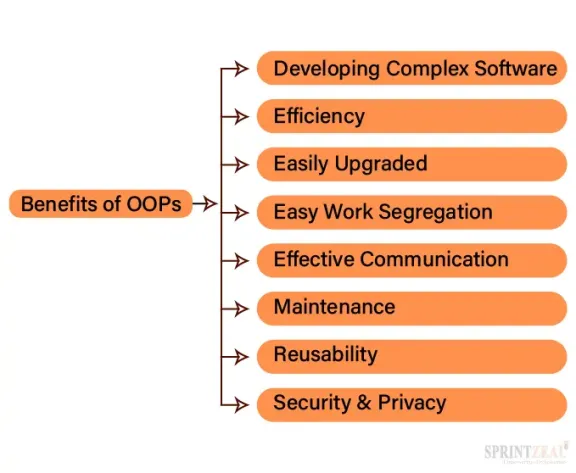
Summing up, the OOPs concepts provided provide a robust base that makes the implementation simpler, the communication more effective, and the long-term scalability achievable, which makes OOP an inevitable solution in contemporary software engineering.
No paradigm is perfect and a fair look at oop principles should mention the trade-offs too.
Knowing these limits does not make oops concepts less useful. It just means OOP is a tool that fits some problems better than others.
Coupling is a concept used in Java to describe the level of dependency. The level of dependency that one class has on the other in the larger context of the OOPs concepts. It is important to know the concept of coupling in constructing applications in object-oriented programming. This is because it directly impacts flexibility and maintainability, along with scalability.
Two major types of coupling are identified in OOP programming, namely tight and loose coupling.
Tight coupling
This is when classes are strongly dependent on the internal structures of each other. When there is a change in one of the classes, the dependent ones should also be changed. This renders the design inflexible and minimizes maintainability, which is contrary to major object-oriented principles.
Tight coupling can be caused by the direct creation of objects within another class or by revealing excessive details of the inner workings, which is not the right thing to do when adhering to sound OOPs concepts that can be found in any object-oriented programming tutorial.
Loose coupling
Loose coupling, however, permits classes to communicate with a low dependency. This is normally done through interfaces, abstraction, or design patterns such as dependency injection.
Loose coupling is a more favorable object-oriented design, which allows easier testing, extending, and modifying without interfering with the old code. It is compatible with the objectives of Java object-oriented programming ideas, where the flexibility and modularity are of high importance.
One of the distinctive features of strong OOPs concepts in Java is loose coupling, which allows developers to learn how to do OOP in a way that allows systems to be resilient to change. It also simplifies the adaptation of programs to other languages, such as a course on OOPs in Python or a course on learn OOP in Python. Finally, the level of seamlessness through which objects interact is what is referred to as coupling"—a critical aspect of contemporary OOP code.
Another important concept in OOPs concepts is cohesion. This refers to the level of focus and purpose of an individual class. The ideal number of tasks that a class can do is one, in relation to Java and other concepts of object-oriented programming. A cohesive class means that its techniques and attributes combine to fulfill one task and help to create a better, more understandable architecture.
High cohesion implies that the purpose of a class is clear and single. As an example, a database connection management class should not also have user interface logic. High cohesion enhances the clarity and ease of maintaining the system, and it goes hand in hand with the concept of object-oriented programming and mostly taught concepts in an object-oriented programming tutorial. It also increases reusability, which is one of the objectives of OOP principles.
On the other hand, low cohesion implies that the class does not do related things, and thus, it is more difficult to test, understand, and make necessary changes. This type of design is contradictory to the best principles of object-oriented design whereby scalability requires modular structure. Low-cohesion classes often become bloated as time passes and establish unwarranted interdependencies.
In OOPs concepts, high cohesion is highly applied in Java when it is coupled with loose coupling. They are used together to assist developers in creating stable, maintainable systems, either through learning about OOP, doing OOP-like tasks, or switching to languages that are similar in their paradigm, such as OOPs concepts in Python.
Extensibility is another property that is supported by cohesion and is highly desirable in OOP programming. The developers design classes based on one responsibility to make their applications cleaner and more robust and take full advantage of the benefit of modern object-oriented programming.
Our blog on True guide for JAVA Scanner Classes provides essential knowledge on Java platforms and other aspects in this domain.
Java is not the only object oriented language. Object oriented programming python developers use the exact same ideas of class object inheritance polymorphism abstraction and encapsulation. Only the syntax changes.
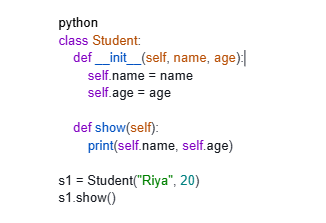
This short block shows object oriented concept in python at work. _ _init_ _ acts as the constructor. self refers to the current object the same way this does in Java.
A few real differences between object orientation in python and java object orientation:
Object oriented programming using python is popular in data science and scripting work while object oriented program in java remains the standard for enterprise backend systems and Android apps. The core oops concepts stay identical across both so learning one language makes the other far easier to pick up.
Oops in python follows the same four pillars covered earlier in this article. A developer moving from java object orientation to object orientation in python mostly has to unlearn strict access control rather than learn new theory. If you already understand class object and inheritance the object oriented concept in python will feel familiar within a day or two of practice.
|
Feature |
Java |
Python |
|
Access control |
Enforced by the compiler with public private protected |
Convention only using underscore naming |
|
Multiple inheritance |
Not allowed through classes, only through interfaces |
Allowed directly through classes |
|
Typing |
Statically typed, checked before running |
Dynamically typed, checked while running |
|
Abstraction tool |
Interfaces and abstract classes |
Abstract base classes from the abc module |
|
Constructor name |
Same as the class name |
Always __init__ |
Whether you write object oriented programming using java or object oriented programming using python the four pillars of oop stay the same. Only the tools you use to express them change.
Once class object inheritance polymorphism abstraction and encapsulation feel comfortable, the next stage most developers reach for is SOLID. SOLID is a set of five design guidelines built on top of oop principles.
SOLID does not replace oops concepts. It builds directly on association aggregation composition and the four pillars covered above.
A frequent beginner mistake is reaching for inheritance just to reuse some code. For example a class called ReportService should not extend an EmailSender class only because it needs to send an email. A report service is not a type of email sender at all.
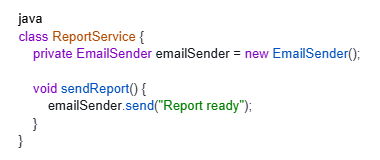
This version uses composition instead of inheritance. ReportService simply holds an EmailSender object and uses it when needed. This keeps the design loosely coupled and easier to change later. A good rule to remember from real object oriented design work: use inheritance only when one class truly is a specialised version of another, and use composition when a class simply needs to use another class's behaviour.
Programmers around the world count on OOPs concepts as it is easy to divide tasks for the same projects. Why not? The best part is that software becomes simple to handle unlike the traditional system of approach with flaws. An Object-Oriented System can effortlessly upgrade from a small system to a large system. Doubtlessly, programs are tightened to secure and cannot be invaded by other applications or systems.
No wonder, with all the advancements in the expanding digital era, the relevancy of an object-oriented system to build programs from standard working modules makes communications easier, saving time and ensuring high inclusivity.
Whether your goal is object oriented programming using java object oriented programming using python or simply a solid grip on oo concept fundamentals for an interview, the ideas on this page cover the full range of oops concepts you are likely to be tested on.
Every object in oop starts as a simple idea before it becomes a class in code. That is really what object oriented programming concepts and oo programming concepts are trying to teach at the end of the day. Java and oop grew up together and that history is one reason object oriented programming python later borrowed so many of the same design habits.
Programmers can also earn a certification in Javascript Course Training, which is a popular and leading profession involving Object-Oriented Programming (OOP)s.
To learn about our career-oriented top certification courses, you can take up the training offered by Sprintzeal and earn a certification to level up your career.
For details about certification programs or queries in your field, Click Here or chat with our experts, and our course experts will get to you.
Encapsulation abstraction inheritance and polymorphism are the four pillars. These four form the base of almost every object oriented language including Java Python C++ and C#.
Most guides count class and object as separate items and add them to the four pillars. That gives five basic concepts: class object encapsulation inheritance and polymorphism, with abstraction sometimes folded into encapsulation depending on the source.
A common six-item list used in Java courses is class object encapsulation inheritance polymorphism and abstraction. Some versions swap in interface as the sixth item since interfaces are so central to java object oriented programming.
A seven-item list usually adds association aggregation or composition on top of the four pillars plus class and object. Sprintzeal's own list above goes further and also covers coupling and cohesion which many seven-point lists leave out.
Not completely. Java is object oriented at its core which is why people often say java is oop, but it still uses primitive types like int and double that are not objects. A fully object oriented language treats everything including numbers as an object.
There is no real technical difference. Object driven programming is simply a phrase some learners use when they mean object oriented programming. The correct and widely used industry term remains object oriented programming or OOP.
Not in principle. An object oriented program in java follows the same oo concept as any other object oriented programming oop language. Every oops object still has a state and a behaviour whether it is written in Java Python or C++. Only the syntax used to build that oops object changes from one language to the next.
Oo programming concepts are the raw building blocks such as class object and inheritance. Oop object oriented design patterns are proven ways of arranging those building blocks to solve a recurring problem. You need the oo concept first before design patterns make any sense.

Thu, 16 July 2026
Fri, 31 January 2025

Tue, 18 February 2025

Thu, 24 September 2026

Fri, 30 May 2025

Wed, 28 May 2025

Fri, 23 May 2025
Wed, 18 June 2025
Fri, 18 July 2025

Wed, 30 July 2025

© 2026 Sprintzeal Americas Inc. - All Rights Reserved.

 USA : +1315-322-7821
 UK : +44 7700 174870
 IND : +919036108287
 AUS : +61 480 005 455