If you want to be part of the $3.88tn projected ecommerce revenue growth in 2026, it would help significantly if you leveraged email marketing to its full potential — and paired it with referral marketing platforms like ReferralCandy that turn your happiest customers into a repeatable acquisition channel.
Choosing the right marketing platform is critical for your ecommerce success, but it doesn't have to be complicated. With Klaviyo, you may end up paying for enterprise features you don't yet need.
Instead of trying to figure your way around the steep learning curve, you can find a solution that offers the perfect balance of power and intuitiveness. As your business grows, you need software that scales with your ambitions while remaining accessible.
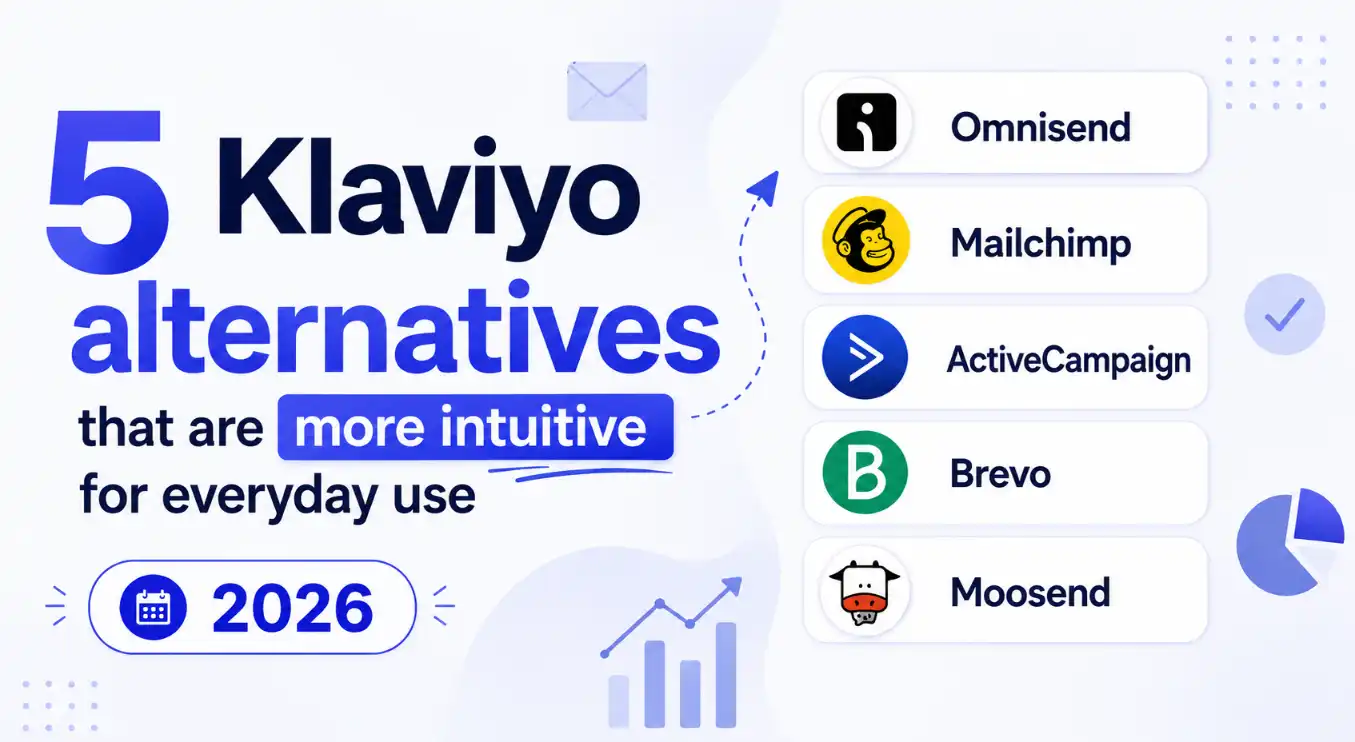
Let's explore the top Klaviyo alternatives designed for intuitive everyday use, letting you focus on growth rather than managing tech. We'll explore how these platforms differ in core features, user experience, and pricing so you can make the best choice for your store.
1. Omnisend
Omnisend is a dedicated platform for mid-sized ecommerce brands that offers strong email and SMS capabilities but doesn’t come with an excessive complexity trade-off. It deals with all the boring stuff associated with marketing and allows you to focus on growing your business.
Instead of trying to figure out an overwhelming dashboard, you get an intuitive interface that’s been designed with user experience in mind. They do all the heavy lifting behind the scenes so you can focus on driving sales, not figuring out the tech.
The platform is trusted by 150,000+ customers around the globe, has an average 4.8 rating across review platforms, and their merchants boast an incredible average $79 ROI for every $1 spent.
Key features
- Multichannel automations:
Combine email, SMS marketing, and push notifications in a single workflow to reach your customers wherever they are most active.
- AI-powered tools:
Forms AI creates new forms in seconds and gives recommendations based on the best ecommerce patterns, Generative AI provides copywriting assistance, and Predictive AI helps with segments, RFM, and CLV product recs).
- Marketing control panel (MCP):
With MCP, your ChatGPT or Claude can talk directly to Omnisend to create campaigns, check performance, and get answers without endless copy-pasting.
- Multiple store management:
Manage multiple stores from a single account with centralized billing and one-click store switching, meaning no extra logins.
- Flexible SMS billing:
Enjoy small top-ups and a 60-day credit rollover for your SMS marketing, ensuring you only pay for what you actually use.
Pros
- Award-winning 24/7 customer support for everyone, meaning your access to help doesn't have an expiration date
- Offers a highly generous free plan that grants access to the vast majority of ecommerce-focused features
- Global SMS reach supports sending text messages around the world
- Seamless integration with Shopify, WooCommerce, Wix, BigCommerce, and other top ecommerce platforms
- Free 5-day migration service for brands switching to Omnisend who sign up with an eligible monthly commitment
Cons
- It’s primarily focused on ecommerce, making it less suitable for B2B or service-based businesses
- Does not offer a standalone CRM for sales teams managing complex, long-term sales cycles
Pricing
- Free plan available
- Paid plans start at $16/month
2. Mailchimp
Mailchimp is one of the most familiar names in email marketing. What started as a simple newsletter tool is now a full marketing platform, including even social media management and basic webpage builder, for small businesses across various industries.
Even with all the added features, the interface remains relatively intuitive if you’re just getting started with digital marketing. If you want a recognizable platform with a massive library of integrations, it's a great option to consider.
Key features
- Drag-and-drop editor:
Build your campaigns quickly with a user-friendly interface that allows you to customize the emails to your liking without needing to use code.
- Pre-built templates:
Choose from a large library of email design templates that you can later customize and tailor to your industry or your needs.
- Predictive demographics:
Use basic AI to predict customer behavior and tailor your messaging based on their likely purchasing habits
- Marketing CRM:
Keep track of customer interactions and basic purchase data to better segment your upcoming marketing campaigns
- Social media posting:
Create and schedule organic social media posts directly from the same dashboard you use for emails
Pros
- Very recognizable and widely supported by nearly every third-party integration on the market
- Highly accessible learning curve for basic email marketing and standard newsletter creation
- Offers built-in tools for designing simple landing pages and managing your social media presence
- Includes a creative assistant that resizes your design assets automatically for different channels
Cons
- They charge you for unsubscribed and duplicate contacts, which can creep up on your budget over time
- Advanced automations aren’t available from the get-go, and you need to upgrade to higher plans
Pricing
- Free plan available
- Paid plans start from $13/month
3. ActiveCampaign
ActiveCampaign focuses heavily on deep marketing automation and customer relationship management for a variety of business types. It caters to a wide spectrum of companies, ranging from growing ecommerce stores to established B2B tech organizations.
It’s worth noting, however, that it’s most likely not worth the effort and price for ecommerce as there are significantly better alternatives with a deep focus on ecommerce. For B2B and service-based business, on the other hand, it could be irreplaceable.
Key features
- Visual automation builder:
Map out complex customer journeys with a flexible canvas that lets you see exactly how subscribers move through your funnels.
- Built-in CRM:
Manage your sales pipeline directly alongside your marketing campaigns to ensure your sales and marketing teams stay aligned.
- Site tracking:
Monitor exactly what your contacts are doing on your website to trigger specific emails based on the pages they visit.
- Conditional content:
Show different text or images to different subscribers within the exact same email to increase personalization.
- Lead scoring:
Assign points to your contacts based on their engagement to identify your most qualified leads automatically.
Pros
- Offers some of the most highly customizable automation workflows available on the market today
- Maintains strong deliverability rates to ensure your important emails actually reach the inbox
- Serves as an excellent option for businesses that combine dedicated sales teams with marketing efforts
- Provides a massive library of pre-built automation templates to help you get started quickly
Cons
- Overwhelming for beginners due to the sheer volume of features and settings available out of the box
- Pricing scales up very quickly as your list grows or as you realize you need more advanced functionality
- The CRM features might be completely unnecessary if you only want to focus on basic newsletters
Pricing
- No free plan, only a 14-day free trial
- Paid plans start at $15/month, but it’s billed annually
4. Brevo
Brevo is an all-in-one digital marketing platform that handles email, SMS, live chat, and CRM. As opposed to most other email marketing platforms in the market, they charge based on the number of emails you send rather than your contact list size.
It makes Brevo a uniquely attractive option to those that have large contact lists but don’t send too often. It also has a user-friendly interface that helps you navigate the platform with no trouble, though it may take a little bit to get used to it.
Key features
- Transactional emails:
Send password resets, shipping notifications, order status updates, and more using Brevo’s reliable SMTP infrastructure.
- WhatsApp campaigns:
Reach your customers directly on their favorite messaging app to drive higher engagement rates.
- Shared inbox:
Manage all your customer conversations from email and live chat in one centralized location.
- SMS marketing:
Send time-sensitive promotions and alerts directly to your customers' mobile phones.
- Send time optimization:
Let the platform automatically send your emails at the exact time each subscriber is most likely to open them.
Pros
- Provides unlimited contact storage across all pricing tiers, saving you money as your audience grows
- Offers highly predictable pricing based purely on your email volume rather than list fluctuations
- Delivers strong and reliable transactional email capabilities alongside email and SMS
- Includes a sales CRM feature so you can track leads without relying on other apps
Cons
- While the free plan is generous, it still restricts you with a daily sending limit of 300 emails
- Setting up complex automation workflows is not as intuitive as it is on some alternative platforms
Pricing
- Free plan is available
- Paid plans start from $9/month
5. Moosend
Moosend is a great starting point for businesses or individuals who have just started their journey. It’s cheap, it doesn’t focus on feature bloat and provides you with what you need to send newsletters, set up basic automations, and build email lists.
The interface is clean, intuitive, and quick to pick up. This makes it an excellent choice if your team needs to move fast, giving you a surprising amount of functionality for a very accessible price.
Key features
- Countdown timers:
Add a sense of urgency to your promotional emails with dynamic timers that tick down to the end of a sale.
- Weather-based recommendations:
Trigger specific product suggestions based on the subscriber's local weather conditions for hyper-personalization.
- Custom reports:
Build analytics dashboards to track the exact metrics that matter most to your specific business goals.
- Landing page builder:
Create high-converting lead generation pages to grow your email list without needing a web developer.
- AI product recommendations:
Use AI-driven dynamic blocks to automatically show the items your customers are most likely to buy based on their browsing history.
Pros
- Extremely cost-effective for businesses managing small to medium-sized contact lists
- Includes unlimited email sends on all paid plans, giving you complete freedom to communicate often
- Provides excellent, easy-to-use automation templates that allow for incredibly quick setup
- The user interface is highly intuitive and requires virtually no onboarding time to master
Cons
- Native integrations are somewhat fewer compared to the massive ecosystems of ESP giants
- Support options are slightly slower if you are not on their higher-tier enterprise plans
Pricing
- Free plan unavailable, only a 30-day free trial
- Paid plans start from $9/month
6. Maestra
Maestra is an all-in-one personalization platform for DTC brands that have outgrown Klaviyo. It covers everything Klaviyo offers — email, SMS, push, flow builder, segmentation, and product recommendations — and adds a real-time CDP, on-site personalization, a loyalty engine, and referral programs natively, without third-party integrations.
Every account includes a dedicated forward-deployed marketer who handles migration, sets up segments and campaigns, configures recommendation logic and flows. Available via a shared Slack channel and weekly calls.
Key features
- Real-time CDP:
Unify data from every touchpoint and build granular segments. Deliver a seamless experience with all channels working off the same customer profile.
- Omnichannel visual builder:
Orchestrate email, SMS, MMS, RCS, push, messengers, website, mobile app, chatbots, and paid media in one flow. Design advanced flows with cascade logic: email → SMS → push.
- On-site personalization:
Leverage gamified popups, social proof widgets, product-discovery quizzes, upsell banners and bars, embedded blocks, surveys, polls, stories, and more.
- AI-powered recommendations:
Drive conversion and AOV with 14 algorithms that work inside your automations. Fine-tune recommendation logic with business rules.
- Loyalty programs and referrals:
Maximize LTV with points, tiers, cashback, personalized promo codes, and other rewards natively integrated into flows.
- Forward-deployed marketer included:
Get a forward-deployed specialist who sets up your segments, flows, and recommendation logic at no extra cost.
Pros
- Takes your marketing beyond what Klaviyo offers with on-site personalization, loyalty programs, and AI recommendations built in
- Covers messaging, on-site experience, loyalty, and AI recommendations in one connected system
- Lets teams build complex flows like omnichannel cascades, price drop alerts, or segmented abandoned cart sequences
- A dedicated forward-deployed marketer does all the heavy lifting for your team
Cons
- No free plan
- Built for mid-market and enterprise — overkill for early-stage stores
Pricing
- Starts at $2,990/month for up to 150K active profiles with full feature access and a dedicated CSM for each account.
- No free trial.
Conclusion
Finding the right Klaviyo alternative comes down to matching your business needs with an intuitive interface. You need a platform that handles your marketing without a steep learning curve. This way, you spend less time configuring settings and more time actually engaging your customers.
To make the best choice, take a look at your budget, the features that you’ll need, and think about your future needs and whether the platform will be able to handle them without overpowering your budget.
If possible, always test the platform using the free plan. It can be a great indicator of the platform's intuitiveness and capabilities. Do that until you find one that feels the most natural to you, and then decide if you want to stick with it for the long term.









 USA : +1315-322-7821
 UK : +44 7700 174870
 IND : +919036108287
 AUS : +61 480 005 455