How Certified Professionals Turn a Credential Into Career Momentum
Wed, 21 October 2026

Inspirational journeys
Follow the stories of academics and their research expeditions
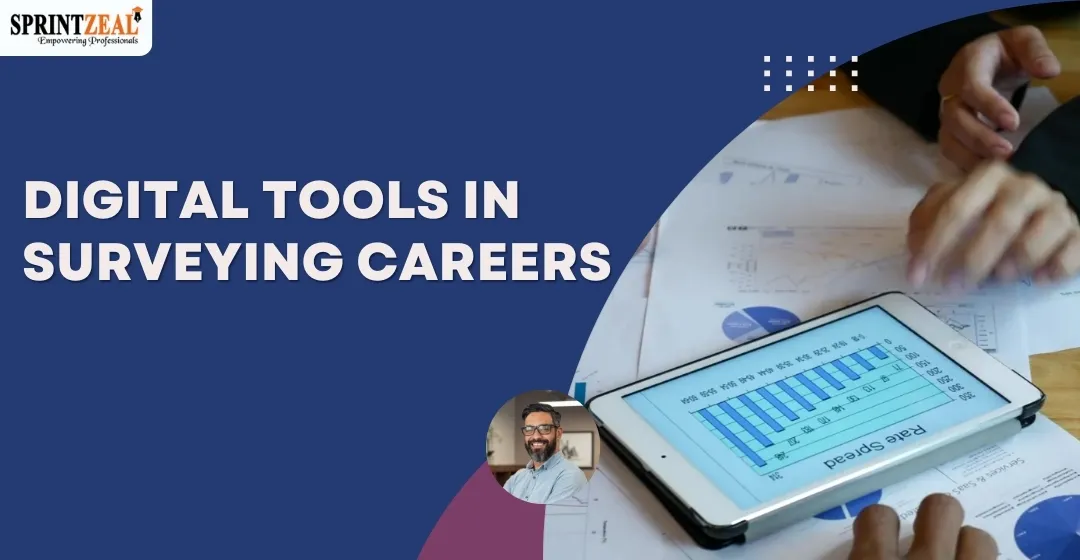
Introduction to Digital Surveying Careers
Surveying no longer relies simply on manual tools and extensive field hours. Digital tools in surveying today impact how professionals measure, evaluate, and transmit data.
Modern surveying integrates technology, data accuracy, and strategic planning. Surveyors today employ drones, GPS surveying systems, and modern surveying software. These tools transform the way surveyors approach land surveying and project management.
As a result, surveying jobs today require a higher level of technical competence and digital proficiency. This trend affects every field, from surveys of renewable energy to surveys of farms. Surveyors who are good with technology have more stable jobs and more growth opportunities.
This article highlights how digital tools have transformed surveying careers in today's industry.
Project managers demand immediate results and accurate data. When surveyors employ digital tools, they can consistently achieve these requirements. Clients now want every job to be correct, quick, and precise.
Traditional measuring jobs that only happen in the field are changing. Surveyors now measure in the field and then perform calculations on computing devices to prepare their report.
People who know how to use surveying apps and drone surveying tools are highly sought after. Having these GPS measuring skills is a new basic requirement.
Having experience with drone mapping can help you get jobs on big, complex projects.
Surveyors who do not keep up with today's technology will find it difficult to stay successful. These jobs now require individuals to be flexible and ready to learn.
Digital skills increase people's career potential in the engineering and land surveying industry. Surveyors who are tech-savvy can get access to more valuable and varied tasks.
Every step of modern surveys is driven by technology.
Surveyors use GNSS and GPS systems to get accurate information about where things are. These tools are more consistent, reducing human error.
Surveyors use a variety of technologies, including laser scanners, handheld mapping systems, and remote sensing equipment.
These facilitate the terrain mapping of extensive or complicated sites.
Surveyors complete tasks faster and more precisely. Surveying software translates raw readings to usable project data.
Surveyors analyze data immediately and deliver results more swiftly. Utilizing digital survey technologies promotes safer and environmentally friendlier work practices.
Engineers collaborate with surveyors these days. Technology enables teams to share accurate information immediately.
This strategy increases the project's outcomes and administration.
Surveyors are now using technology to collect data in the field.
Conventional surveying techniques are being supplemented with high-precision instruments and GPS survey instruments, making it easier to acquire measurements.
Drone survey enables access into areas that cannot be easily reached and maps areas quickly. It makes things faster and safer for surveyors and on-field personnel.
With the help of drones, surveyors can even upload images as soon as they take them. Data collection is now more accurate and consistent, and surveying software helps correct any mistakes during the actual survey.
As a result, surveyors have access to more accurate data, letting them focus more on research and decision-making.
Surveyors no longer have to do estimates by hand or manually. Surveying software simplifies the process of processing and checking data. This technique increases accuracy and speed.
Modern tools allow better reports and precise visual results. Surveyors can examine ground mapping results more thoroughly. All job-related information is provided to clients clearly and accurately.
Survey technologies can readily handle enormous datasets. Surveyors break down information faster, reducing project delays. Also, digital tools improve overall productivity.
Today, surveying focuses on understanding and explaining data. Surveyors bring value by explaining how the data influences the results of a project. It makes their work more important and gives them greater responsibility. When they work on projects, this job provides them with greater authority.
Importing survey data into CAD and BIM programs has become easy, which sets up a project more efficiently. As a result, engineers receive reliable information at an early stage. Engineers require decent survey data to make good design choices.
In addition, land survey outcomes assist in conducting viability analysis as well as groundwork planning. Land surveyors are capable of much more than taking measurements; they also give advice. This knowledge, therefore, influences project timing and expenditure.
Furthermore, integrated systems make teamwork easier and lower error rates. Thus, projects performed much more efficiently when precise survey data is successfully transmitted and shared across platforms.
The same information can be shared between teams in different parts of the company. Today, surveyors often work both in the field and in office planning. Digital tools make the surveyor's job easier when measuring.
Surveyors strongly support better teamwork on projects, and this integration sets the standard for modern work.
Drone surveys are now common in the business world. Surveyors use drones to get high-resolution images and information about elevation.
With these tools, you can quickly and accurately map the land.
Drones help surveyors complete work faster and reduce time spent in the field without losing accuracy. They also help lower project costs.
Drone data is handy for surveys of renewable energy sources. Surveyors look at aerial models to find places where solar panels and wind turbines could go.
Having correct information helps you make better decisions about where to put things and how to build them. Drone surveying also helps keep track of safety and the environment better.
Another advantage of carrying out surveys using drones is the ease of monitoring safety and environmental factors. Surveyors can keep clear of dangerous and unstable sites. This method works in accordance with current values on environmental protection and safety.
Getting information from the air is useful for surveying terrain. Surveyors can swiftly make maps for places where buildings will be built and roads that will be used to get there.
Drones deliver data that is accurate and can be reproduced.
In agriculture, survey apps allow farmers to make decisions promptly. Surveyors also help farmers assess their crops, soil, and drainage to improve farm productivity. As a result, digital tools support better land management and higher yields.
Accurate land analysis is essential for renewable energy projects. Surveyors play a key role in building wind farms and solar plants by providing precise measurements and site evaluations. Drone data supports effective planning and efficient land use, and drone surveying is used landfor marking boundaries and monitoring the environment.
Land surveyors use digital data to track changes in land over time. These advanced tools improve accuracy and planning while also creating more job opportunities for surveyors as technology continues to expand in the industry.
To work as a surveyor today, you must know how to use GPS, drones, and surveying tools. You must also be skilled in data analysis to help engineers and planners make sound judgments based on available data.
On top of that, surveyors must also be willing to keep learning. Since technology changes so quickly, adaptability is essential for long-term success.
Finally, new ideas and flexibility are highly prized in today's surveying world. Professionals with a wide range can land more career opportunities and have more job options.
In a highly competitive market, it is those surveyors with high technical proficiency who are likely to have higher career progression.
There are survey jobs across a broad range of industries now; there is even survey work available within agriculture and renewable energies. Experience of modern survey techniques gives professionalism and the client's faith in the outcome of surveys.
Beyond that, knowing your way around drone monitoring doesn't just help professionals work on complex and valuable projects. It also keeps people from having to go to dangerous areas.
Surveyors’ job prospects will continue to evolve as technology advances. Tools like AI, robotics, high-tech drones, and digital methods are becoming the standard, making work more efficient from field data collection to office analysis.
Drone surveying, GPS surveying, and other advanced technologies are shaping modern surveying and expanding the profession’s impact.
Surveyors will play an essential role in building smart cities and sustainable infrastructure. Their recommendations will guide construction and planning decisions, helping shape future communities.
As digital technologies continue to transform the industry, well-prepared professionals will thrive in this ever-changing environment. Because technology keeps advancing, surveyors must continuously develop new skills. Those who adopt modern tools will lead the growing field forward.
At Drone as a Service (DaaS), we redefine survey careers for professionals from any field. Get in touch with us to learn how digital surveying can help you succeed.
Surveying no longer relies simply on manual tools and extensive field hours. Digital tools in surveying today impact how professionals measure, evaluate, and transmit data.
Modern surveying integrates technology, data accuracy, and strategic planning. Surveyors today employ drones, GPS surveying systems, and modern surveying software. These tools transform the way surveyors approach land surveying and project management.
As a result, surveying jobs today require a higher level of technical competence and digital proficiency. This trend affects every field, from surveys of renewable energy to surveys of farms. Surveyors who are good with technology have more stable jobs and more growth opportunities.
This article highlights how digital tools have transformed surveying careers in today's industry.
Project managers demand immediate results and accurate data. When surveyors employ digital tools, they can consistently achieve these requirements. Clients now want every job to be correct, quick, and precise.
Traditional measuring jobs that only happen in the field are changing. Surveyors now measure in the field and then perform calculations on computing devices to prepare their report.
People who know how to use surveying apps and drone surveying tools are highly sought after. Having these GPS measuring skills is a new basic requirement.
Having experience with drone mapping can help you get jobs on big, complex projects.
Surveyors who do not keep up with today's technology will find it difficult to stay successful. These jobs now require individuals to be flexible and ready to learn.
Digital skills increase people's career potential in the engineering and land surveying industry. Surveyors who are tech-savvy can get access to more valuable and varied tasks.
Every step of modern surveys is driven by technology.
Surveyors use GNSS and GPS systems to get accurate information about where things are. These tools are more consistent, reducing human error.
Surveyors use a variety of technologies, including laser scanners, handheld mapping systems, and remote sensing equipment.
These facilitate the terrain mapping of extensive or complicated sites.
Surveyors complete tasks faster and more precisely. Surveying software translates raw readings to usable project data.
Surveyors analyze data immediately and deliver results more swiftly. Utilizing digital survey technologies promotes safer and environmentally friendlier work practices.
Engineers collaborate with surveyors these days. Technology enables teams to share accurate information immediately.
This strategy increases the project's outcomes and administration
Surveyors are now using technology to collect data in the field.
Conventional surveying techniques are being supplemented with high-precision instruments and GPS survey instruments, making it easier to acquire measurements.
Drone survey enables access into areas that cannot be easily reached and maps areas quickly. It makes things faster and safer for surveyors and on-field personnel.
With the help of drones, surveyors can even upload images as soon as they take them. Data collection is now more accurate and consistent, and surveying software helps correct any mistakes during the actual survey.
As a result, surveyors have access to more accurate data, letting them focus more on research and decision-making.
Surveyors no longer have to do estimates by hand or manually. Surveying software simplifies the process of processing and checking data. This technique increases accuracy and speed.
Modern tools allow better reports and precise visual results. Surveyors can examine ground mapping results more thoroughly. All job-related information is provided to clients clearly and accurately.
Survey technologies can readily handle enormous datasets. Surveyors break down information faster, reducing project delays. Also, digital tools improve overall productivity.
Today, surveying focuses on understanding and explaining data. Surveyors bring value by explaining how the data influences the results of a project. It makes their work more important and gives them greater responsibility. When they work on projects, this job provides them with greater authority.
Importing survey data into CAD and BIM programs has become easy, which sets up a project more efficiently. As a result, engineers receive reliable information at an early stage. Engineers require decent survey data to make good design choices.
In addition, land survey outcomes assist in conducting viability analysis as well as groundwork planning. Land surveyors are capable of much more than taking measurements; they also give advice. This knowledge, therefore, influences project timing and expenditure.
Furthermore, integrated systems make teamwork easier and lower error rates. Thus, projects performed much more efficiently when precise survey data is successfully transmitted and shared across platforms.
The same information can be shared between teams in different parts of the company. Today, surveyors often work both in the field and in office planning. Digital tools make the surveyor's job easier when measuring.
Surveyors strongly support better teamwork on projects, and this integration sets the standard for modern work.
Drone surveys are now common in the business world. Surveyors use drones to get high-resolution images and information about elevation.
With these tools, you can quickly and accurately map the land.
Drones help surveyors complete work faster and reduce time spent in the field without losing accuracy. They also help lower project costs.
Drone data is handy for surveys of renewable energy sources. Surveyors look at aerial models to find places where solar panels and wind turbines could go.
Having correct information helps you make better decisions about where to put things and how to build them. Drone surveying also helps keep track of safety and the environment better.
Another advantage of carrying out surveys using drones is the ease of monitoring safety and environmental factors. Surveyors can keep clear of dangerous and unstable sites. This method works in accordance with current values on environmental protection and safety.
Getting information from the air is useful for surveying terrain. Surveyors can swiftly make maps for places where buildings will be built and roads that will be used to get there.
Drones deliver data that is accurate and can be reproduced.
In agriculture, survey apps allow farmers to make decisions promptly. Surveyors also help farmers assess their crops, soil, and drainage to improve farm productivity. As a result, digital tools support better land management and higher yields.
Accurate land analysis is essential for renewable energy projects. Surveyors play a key role in building wind farms and solar plants by providing precise measurements and site evaluations. Drone data supports effective planning and efficient land use, and drone surveying is used landfor marking boundaries and monitoring the environment.
Land surveyors use digital data to track changes in land over time. These advanced tools improve accuracy and planning while also creating more job opportunities for surveyors as technology continues to expand in the industry.
To work as a surveyor today, you must know how to use GPS, drones, and surveying tools. You must also be skilled in data analysis to help engineers and planners make sound judgments based on available data.
On top of that, surveyors must also be willing to keep learning. Since technology changes so quickly, adaptability is essential for long-term success.
Finally, new ideas and flexibility are highly prized in today's surveying world. Professionals with a wide range can land more career opportunities and have more job options.
In a highly competitive market, it is those surveyors with high technical proficiency who are likely to have higher career progression.
There are survey jobs across a broad range of industries now; there is even survey work available within agriculture and renewable energies. Experience of modern survey techniques gives professionalism and the client's faith in the outcome of surveys.
Beyond that, knowing your way around drone monitoring doesn't just help professionals work on complex and valuable projects. It also keeps people from having to go to dangerous areas.
Surveyors’ job prospects will continue to evolve as technology advances. Tools like AI, robotics, high-tech drones, and digital methods are becoming the standard, making work more efficient from field data collection to office analysis.
Drone surveying, GPS surveying, and other advanced technologies are shaping modern surveying and expanding the profession’s impact.
Surveyors will play an essential role in building smart cities and sustainable infrastructure. Their recommendations will guide construction and planning decisions, helping shape future communities.
As digital technologies continue to transform the industry, well-prepared professionals will thrive in this ever-changing environment. Because technology keeps advancing, surveyors must continuously develop new skills. Those who adopt modern tools will lead the growing field forward.
At Drone as a Service (DaaS), we redefine survey careers for professionals from any field. Get in touch with us to learn how digital surveying can help you succeed.

Wed, 21 October 2026
Thu, 15 October 2026

Wed, 14 October 2026

Tue, 13 October 2026
Wed, 07 October 2026

Fri, 02 October 2026

Wed, 30 September 2026

Tue, 29 September 2026

Fri, 25 September 2026

Tue, 22 September 2026


© 2026 Sprintzeal Americas Inc. - All Rights Reserved.

 USA : +1315-322-7821
 UK : +44 7700 174870
 IND : +919036108287
 AUS : +61 480 005 455