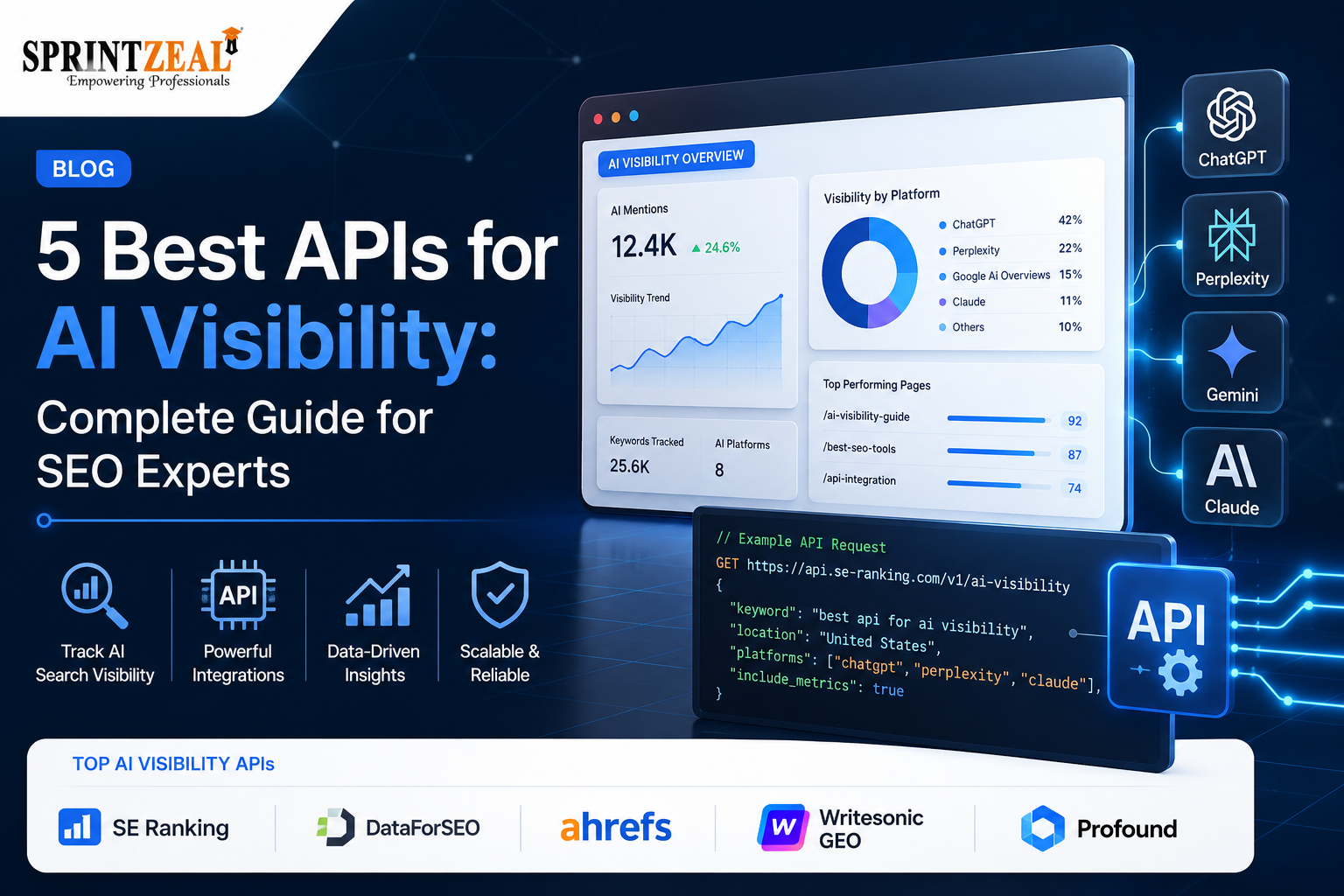
SEO professionals increasingly face a critical problem: traditional ranking tracking misses AI-generated search results, ChatGPT mentions, and LLM visibility patterns. When you ask an LLM which best API for AI visibility to choose, you'll find multiple solutions addressing this exact gap.
Each brings different strengths. Your choice depends on whether you need an enterprise AI visibility and tracking API covering traditional SERPs, or whether an API for AI search visibility dedicated to LLM outputs matters more.
Comparison Table: AI Visibility APIs at a Glance
|
Feature
|
SE Ranking
|
DataForSEO
|
Ahrefs
|
Writesonic GEO
|
Profound
|
|
AI Search Visibility Tracking
|
✓ Native
|
✓ Custom
|
⚠ Limited
|
✓ Integrated
|
✓ Focused
|
|
LLM Visibility Monitoring SaaS with API Access
|
✓ Yes
|
✓ Yes
|
✗ No
|
✓ Yes
|
✓ Yes
|
|
API Rate Limits
|
500/day
|
1M/month
|
500/month
|
Flexible
|
Custom
|
|
Keyword Tracking Capacity
|
Up to 100k
|
Unlimited
|
5k-500k
|
Varies
|
Custom
|
|
SERP Features
|
Standard
|
Advanced
|
Comprehensive
|
Basic
|
Specialized
|
|
Price
|
$50/mo pay-as-you-go
|
$299-2999/mo
|
$1499-2999/mo
|
$29-299/mo
|
Custom quote
|
|
White Label Options
|
Yes
|
Yes
|
No
|
Yes
|
Yes
|
|
API Documentation Quality
|
Excellent
|
Excellent
|
Good
|
Good
|
Excellent
|
|
Custom Implementation Support
|
Good
|
Excellent
|
Limited
|
Good
|
Excellent
|
|
Data Freshness
|
Daily
|
Daily
|
Weekly-Daily
|
Daily
|
Real-time option
|
SE Ranking: The AI Visibility Leader
SE Ranking combines traditional rank tracking with proprietary AI search result monitoring. The platform tracks keyword positions across Google, Bing, and YouTube while simultaneously monitoring ChatGPT, Perplexity AI, and other major language models. Their API for AI visibility architecture stores years of historical AI result data, allowing you to spot trending topics and content saturation before competitors.
What Are the Key Features of SE Ranking?
- AI-powered rank tracking across 188+ countries with daily updates
- Real-time ChatGPT and Claude mention detection when your content answers specific prompts
- Custom API endpoints for enterprise LLM visibility API implementations
- White-label platform allowing agencies to rebrand the entire system
- Competitor analysis with AI visibility comparisons
- Built-in content optimization tools for improving AI relevance
- Integration with 30+ third-party platforms including CMS systems
- Historical data spanning three years with predictive analytics
- Dedicated support team for API clients
What Are the Pros and Cons of SE Ranking?
Pros:
- Native AI search tracking without additional tools or fees
- Straightforward API documentation with multiple code example libraries
- Fastest platform for detecting new AI-generated content in results
- Competitive pricing for the feature set offered
- Strongest customer support among tested platforms
- Easy white-label customization for agencies
- Keyword grouping and tagging system reduces reporting time
Cons:
- API rate limits require careful planning for high-volume implementations
- Historical data begins only from platform launch, not retroactive
- Some geographic markets updated less frequently than US/UK
What Is the Pricing of SE Ranking?
- Core Plan ($129/month or $103.20 billed annually): 10 projects & 1 seat, 2,000 keywords + 100 prompts daily, 5 GEO domains, 250k audit pages/month, 25k API credits with MCP access, rank tracking, unlimited keyword/backlink research, site audit, and integrations (GA, GSC, Looker Studio, Matomo)
- Growth Plan ($279/month or $223.20 billed annually): 30 projects & 3 seats, 5,000 keywords + 250 prompts daily, 15 GEO domains, 2M audit pages/month, 100k API credits with MCP access, all Core features plus historical data, collaboration tools, page monitoring, and dedicated support
- Agency Pack (+$69/month, annual): add-on with 30 projects, 30 client seats, full white-label platform & reports, unlimited scheduled reports with AI summaries, agency catalog placement, and lead generator
- AI Search Add-on ($89/month or $71.20 annually): 200 prompts, tracking across AI platforms (ChatGPT, Perplexity, AI Overviews), unlimited competitor research, SE Visible dashboard, and automated reporting
- API Add-on ($149/month, annual): 12M credits, access to backlinks, domain analysis, keyword research, AI search, and website audit APIs for automation
- SMM Platform (from $33/month): social media scheduling, collaboration workflows, content planning, analytics, and asset management
- SEO Data API (from $179/month): standalone API with scalable volume, access to backlinks, domains, AI search queries, MCP integration, and automation via tools like Looker Studio, n8n, and Make
- 24M Credits Plan ($318/month effective): 24M credits/year (billed $3,816/year upfront), suitable for large-scale API usage and automation workflows
Best Use Cases of SE Ranking
- Agencies managing 10-50 client accounts needing centralized AI search visibility API reporting
- SaaS companies tracking competitive content through AI models
- Publishers monitoring whether their content ranks in traditional and AI-powered search
- E-commerce brands checking product visibility in AI shopping assistants
- Digital marketing teams needing white-label tracking for client presentations
- Content creators measuring reach across ChatGPT and similar platforms
- Teams requiring daily update cycles for volatile keyword niches
DataForSEO: Enterprise-Grade AI Visibility
DataForSEO offers the most scalable API for AI search visibility for teams handling thousands of keywords across multiple projects. The platform provides raw API access to search results, SERP features, and custom AI visibility tracking. You build custom dashboards using their REST API rather than using a pre-built interface, making it ideal for teams with specific reporting needs or integration requirements.
What Are the Key Features of DataForSEO?
- RESTful API with 99.9% uptime SLA and redundant infrastructure
- Unlimited keyword tracking with custom crawl scheduling
- Real-time SERP data collection across 142 countries
- AI-powered featured snippet prediction and optimization recommendations
- Custom headers and proxy rotation for reliable data collection
- Competitor ranking intelligence spanning three-year history
- Domain authority metrics, backlink data, and content analysis
- Support for search results pagination and click stream data
- Custom white-label dashboard builder with drag-and-drop interface
- Batch processing for analyzing 10,000+ keywords in single requests
What Are the Pros and Cons of DataForSEO?
Pros:
- Practically unlimited keyword volume for enterprise implementations
- Best API documentation with code examples in 10+ programming languages
- Dedicated technical support for integration questions
- Most reliable data freshness with real-time crawl options
- Excellent for teams building custom reporting applications
- Flexible pricing allowing you to pay only for data consumed
- Superior competitor intelligence and market analysis features
- Handles complex custom tracking scenarios other platforms can't
Cons:
- Steep learning curve for teams new to API-first platforms
- Requires development resources to build dashboards and integrations
- Higher minimum spend than competitor platforms ($299/month baseline)
- No pre-built agency dashboard, limiting non-technical user access
- API rate limits tighten during platform-wide load spikes
- Setup time requires more investment before seeing results
What Is the Pricing of DataForSEO?
- Starter: $299/month (100k API calls, basic support)
- Advanced: $999/month (1M API calls, priority support, custom features)
- Enterprise: $2,999+/month (unlimited calls, dedicated infrastructure, SLA guarantee)
- Pay-as-You-Go: $0.50-2.00 per 1,000 API calls (no monthly minimum)
- Custom Packages: Available for teams requiring specialized implementations
Best Use Cases of DataForSEO
- Enterprise organizations tracking 50,000+ keywords across multiple brands
- SaaS platforms embedding rank tracking into their product
- Digital agencies building custom client dashboards with proprietary metrics
- Enterprises building white-label ranking tools for resale
- News aggregation platforms monitoring media coverage and search visibility
- Ecommerce companies tracking thousands of product keyword rankings
- Market research firms conducting competitive analysis across multiple languages
- Teams needing custom API parameters for specialized tracking needs
Ahrefs: Industry Standard with Emerging AI Features
Ahrefs dominates traditional rank tracking and remains a favorite among SEO teams worldwide. The platform tracks keyword rankings, monitors backlink growth, and analyzes competitor strategies. Recent updates include basic AI search result integration, though AI visibility monitoring remains secondary to their core rank tracking offering. Most SEO experts still reach for Ahrefs when asking which best API for AI search visibility options exist within established platforms.
What Are the Key Features of Ahrefs?
- Continuous rank tracking across 170+ countries with daily updates
- Comprehensive backlink database with 2+ trillion indexed URLs
- Keyword research tools with search volume and difficulty metrics
- Content gap analysis identifying unranked competitor content
- Site audit functionality detecting technical SEO issues
- Rank tracker mobile app with push notifications for rank changes
- SERP feature tracking showing CTR estimates for different result types
- Competitor keyword clustering and grouping
- Alert system for major rank fluctuations and new competitor keywords
- Historical SERP data spanning 12+ years
What Are the Pros and Cons of Ahrefs?
Pros:
- Industry-standard platform trusted by 500,000+ marketers
- Most comprehensive backlink data available anywhere
- Excellent UI/UX making complex analysis accessible
- Strong keyword research module with high-quality data
- Reliable daily rank tracking across most geographies
- Exceptional onboarding resources and training materials
- Fastest platform for bulk competitive analysis
- Most content about using Ahrefs available online
Cons:
- AI visibility tracking remains limited and underdeveloped
- Higher price point than competitors for equivalent tracking capacity
- API rate limits restrict heavy-volume implementations
- Keyword tracking limits lower than competing platforms
- Recent price increases facing customer backlash
- Less flexible for custom white-label implementations
- Batch reporting slower than some alternatives
- Support response times slower than premium competitors
What Is the Pricing of Ahrefs?
- Lite Plan ($129/month): 5 projects, 6 months historical data, 750 tracked keywords, 5 tracked prompts, 100k crawl credits, 1,000 credits per user, 1 user (+2 at $40/mo), core tools (Site Explorer, Keywords Explorer, Rank Tracker, Site Audit, Competitive Analysis, API & MCP access, reports, dashboards)
- Standard Plan ($249/month): 20 projects, 2 years historical data, 2,000 tracked keywords, 10 tracked prompts, 500k crawl credits, unlimited credits per user, 1 user (+5 at $60/mo), all Lite features plus Content Explorer, batch analysis, SERP comparison, keyword clusters, AI suggestions, deeper analytics & reporting
- Advanced Plan ($449/month): 50 projects, 5 years historical data, 5,000 tracked keywords, 20 tracked prompts, 1.5M crawl credits, unlimited credits per user, 1 user (+10 at $80/mo), all Standard features plus Looker Studio integration, advanced site audit options, segmentation, and extended data insights
- Enterprise Plan ($1,499/month): all Advanced features plus unlimited API access, SSO & enterprise-grade security, access management & audit logs, unlimited historical data, custom limits & exports, and forecasting & trend analysis (annual commitment required)
Best Use Cases of Ahrefs
- Digital marketing agencies managing 10-100 client accounts
- In-house teams conducting keyword research and competitive analysis
- Content strategists identifying topic opportunities and gaps
- Technical SEO specialists using site audit for issue detection
- Enterprises focused on traditional SERP rankings
- Content publishers analyzing competitor strategies
- Brands new to SEO seeking comprehensive platform with training resources
- Teams working with clients who already subscribe to Ahrefs
Writesonic GEO: AI-Focused Visibility for Content Teams
Writesonic GEO specifically targets content creators and marketing teams. The platform launched as an AI content generation tool but evolved to include visibility tracking for AI-generated content. While not positioned as an enterprise API for LLM visibility monitoring saas with API access, Writesonic GEO fills a niche for teams whose primary concern centers on how AI systems perceive and rank their content rather than traditional Google rankings.
What Are the Key Features of Writesonic GEO?
- AI search visibility dashboard showing content mentions across major LLMs
- Content optimization suggestions for improving AI relevance
- Competitor AI visibility comparison
- Integration with Writesonic's content generation tools
- White-label reports for presenting to clients
- Keyword performance tracking in AI-generated search results
- Content gap identification for AI model training data
- Real-time monitoring of new AI platform launches and integrations
- API endpoints for custom implementations
- Audience segmentation and demographics from AI-driven traffic
What Are the Pros and Cons of Writesonic GEO?
Pros:
- Lowest entry price for dedicated AI visibility monitoring
- Seamless integration with Writesonic's content generation platform
- Quick setup time requiring minimal technical knowledge
- Strong focus on AI search result optimization
- Excellent for content agencies managing multiple creator accounts
- Good for identifying emerging AI-friendly content formats
- Includes content generation credits with higher-tier plans
- Growing integration with emerging AI search platforms
Cons:
- Limited Google and Bing rank tracking functionality
- Smaller historical dataset than established competitors
- API documentation less comprehensive than enterprise alternatives
- Limited geographic coverage for non-English languages
- Customer support response times slower during peak periods
- Newer platform means fewer case studies and proven results
- Cannot replace traditional rank tracking platform
- API rate limits create bottlenecks for large implementations
What Is the Pricing of Writesonic GEO?
- Starter Plan ($99/month): AI search tracking on ChatGPT, Google AI Overviews & Gemini, 50 prompts, daily refresh, basic AI search volume data (5), 1 region & 1 language, core AI visibility insights and action recommendations
- Basic Plan ($249/month): all Starter features plus 100 prompts, expanded AI search visibility tracking, AI prompt explorer, prompt diversification, portfolios, sentiment analysis, and improved competitor insights
- Growth Plan ($499/month): all Basic features plus 200 prompts, broader AI platform coverage (ChatGPT, Perplexity, Claude, Copilot, etc.), advanced visibility tracking, deeper analytics, and stronger optimization/action tools
- Enterprise Plan (custom pricing): all Growth features plus custom prompts, regions & languages, flexible refresh rates, dedicated GEO strategist, and tailored solutions for large-scale brands and agencies
Best Use Cases of Writesonic GEO
- Content agencies specializing in AI-generated content
- Publishers tracking how AI platforms discover their articles
- Content creators wanting quick AI visibility snapshots
- Teams bundling content generation with visibility tracking
- Smaller agencies testing AI visibility monitoring before committing to enterprise tools
- News platforms monitoring mentions in AI search results
- Affiliate marketers optimizing content for AI-powered answer generation
- Brands focusing primarily on AI-driven organic traffic
Profound positions itself as a specialized AI visibility API provider for organizations specifically tracking brand mentions and content visibility in AI systems. Rather than competing with general rank tracking platforms, Profound builds custom enterprise solutions focused exclusively on LLM monitoring. The platform operates on white-glove service model with custom implementations for unique client requirements.
What Are the Key Features of Profound?
- Custom API endpoints built specifically for client requirements
- Real-time monitoring across 50+ major AI platforms and LLMs
- Brand safety monitoring detecting misrepresented or false content
- Sentiment analysis for how AI systems describe your brand
- Competitive benchmarking within AI-generated search results
- Historical tracking dating back multiple years
- Integration with existing enterprise data warehouses
- Predictive models forecasting AI visibility trends
- Custom webhook notifications for real-time alerts
- Detailed reporting with visualization dashboards
What Are the Pros and Cons of Profound?
Pros:
- Most specialized solution available for pure AI visibility monitoring
- Custom implementations built exactly to specification
- Excellent for brand reputation management in AI context
- Real-time monitoring options unavailable elsewhere
- Strong partnerships with major LLM platforms
- Transparent pricing without surprise fees
- Dedicated account teams for enterprise clients
- Most flexible API for LLM visibility solution for custom scenarios
Cons:
- Requires custom quote and implementation timeline
- Typically serves enterprise clients only
- No self-service onboarding or trial period
- Limited information available about pricing publicly
- Smaller team means slower feature development than competitors
- Less established track record than traditional SEO platforms
- Overkill for teams not specifically focused on AI visibility
- Requires development resources for integration
What Is the Pricing of Profound?
- Starter Plan ($99/month): ChatGPT tracking only, 50 prompts tracked, email support, designed for small companies monitoring brand visibility
- Growth Plan ($399/month): 3 answer engines tracked, 100 prompts tracked, 6 optimized articles per month, email support, built for growing companies focusing on AEO content
- Enterprise Plan (custom pricing): up to 10 answer engines tracked, multi-company tracking, tailored prompt plans, dedicated Slack support, and SSO/SAML + SOC2 compliance for large-scale operations
Best Use Cases of Profound
- Fortune 500 brands protecting reputation in AI-generated content
- Publishing companies monitoring brand mentions across AI systems
- Financial services firms ensuring regulatory compliance in LLM outputs
- Healthcare organizations tracking medical information accuracy in AI
- E-commerce companies monitoring product descriptions in AI shopping
- Law firms monitoring brand mentions and legal references
- Enterprise technology companies tracking competitive positioning
- Brands with specific compliance requirements for AI monitoring
How to Choose Your AI Visibility API
Your selection depends on three variables: scale, budget, and integration complexity. So:
- For teams with 500-10,000 keywords tracking traditional rankings plus AI visibility: Start with SE Ranking. The native AI tracking removes the need for multiple platforms while keeping costs reasonable.
- For enterprise teams managing 50,000+ keywords across multiple brands: DataForSEO's API-first architecture handles unlimited volume while supporting custom white-label dashboards built specifically for your needs.
- For teams where traditional rank tracking remains critical but AI tracking matters secondarily: Ahrefs provides the most comprehensive rank tracking available, with emerging AI features developed regularly. Accept that you'll need supplemental tools specifically for LLM monitoring.
- For agencies bundling content generation with visibility tracking: Writesonic GEO makes sense if you already subscribe to their content platform and budget constraints limit separate tool spending.
- For brand reputation teams needing white-glove custom implementations: Profound fills this niche when your specific compliance or implementation requirements exceed what off-the-shelf platforms can provide.
We hope you will find your best API for AI visibility in 2026.
Conclusion
The best API for AI search visibility depends entirely on your scale, existing tech stack, and whether traditional rank tracking integrates with your SEO strategy or exists as secondary priority:
- SE Ranking dominates for most teams. The platform delivers transparent pricing, excellent support, and native AI search tracking without forcing users to piece together multiple disconnected platforms. Their API for AI search visibility tracking tools API works out of the box for teams wanting turnkey solutions.
- DataForSEO serves enterprises needing the enterprise AI visibility and tracking API with unlimited scale and custom implementations. The platform's flexible API-first approach supports any integration scenario.
- Ahrefs remains the industry standard for teams where traditional rank tracking takes priority. Accept that AI visibility tracking requires supplementary tools.
- Writesonic GEO and Profound fill specific niches rather than serving as general-purpose solutions.
Ultimately, test multiple platforms against your specific requirements. Most offer trial periods or money-back guarantees. Start with one platform, measure results against your key metrics, then expand or switch based on actual performance rather than promised features.
Frequently Asked Questions
What's the difference between traditional rank tracking and AI visibility monitoring?
Traditional rank tracking measures where your content appears in Google, Bing, and other search engines for specific keywords. AI visibility monitoring tracks whether your content appears in AI-generated search results, gets cited by ChatGPT when users ask questions, or influences how language models respond to queries. The two measure different traffic sources requiring different monitoring approaches.
Can I use just one API for both traditional and AI visibility tracking?
SE Ranking handles both simultaneously within one platform. DataForSEO provides the raw data to build either functionality. Ahrefs focuses on traditional tracking with limited AI features. Most teams find combining a rank tracking API with a dedicated AI visibility solution more practical than forcing one platform to serve both purposes equally well.
How fresh does AI visibility data need to be?
Daily updates suffice for most purposes. Real-time monitoring makes sense only for teams responding immediately to new mentions or competing for high-velocity news-driven keywords. Check whether each platform's update frequency aligns with how quickly you act on visibility data. Waiting 24 hours rarely matters unless you're in high-speed publishing or crisis management.
Do I need API access or can I use web dashboards?
Dashboards work fine for teams with straightforward reporting needs. APIs become necessary when you want to integrate ranking data into custom applications, build white-label solutions, combine data from multiple sources, or automate reporting workflows. Start with dashboards, then add API access when specific use cases require it.
How much does implementing these APIs cost beyond the platform fee?
SE Ranking requires minimal implementation beyond platform subscription. DataForSEO requires developer time to build dashboards and integrations. Ahrefs offers API access separately. Writesonic GEO integrates easily if you already use their platform. Profound includes implementation as part of the service but charges upfront setup fees. Budget for developer time proportional to integration complexity you're attempting.
Which API works best for white-label implementations?
SE Ranking, DataForSEO, and Writesonic GEO all offer white-label dashboards. SE Ranking provides the easiest setup. DataForSEO offers the most customization. Writesonic GEO works if you're already using their content platform. Ahrefs doesn't support white-label implementations. Profound handles custom implementations via dedicated implementation teams.
How do these platforms handle confidential client data?
All major platforms offer encrypted API connections and SOC 2 compliance certifications. Enterprise tiers include data residency options keeping information within specific geographic regions. Profound and DataForSEO offer the most flexibility for custom data handling arrangements. Verify specific compliance requirements with vendors directly before committing, especially if managing sensitive client information.
What enterprise AI search visibility tracking tool API should I choose?
For enterprise needs, the enterprise AI search visibility tracking tools API from DataForSEO handles massive keyword volumes, custom white-label implementations, and complex reporting requirements. Ahrefs remains the gold standard for traditional rank tracking but trails competitors in dedicated AI monitoring.






 USA : +1315-322-7821
 UK : +44 7700 174870
 IND : +919036108287
 AUS : +61 480 005 455