Full Stack Developer Roadmap for 2026 - A Shift in Skills. The job role is currently the talk of the town. According to Search Engine Journal, it ranks among the top ten most sought-after jobs. Therefore, one should be up to date with the “Full Stack Developer Roadmap” in 2026. The introduction of AI, cloud, and web applications has expanded the role of IT.
Approximately 35% of the annual spike has been observed in job postings for the role of full-stack developer. The number of job postings that are presently being advertised on various platforms is over 60,000. The initial salary is $60,000 and can reach $140,000 in the US. Why choose in 2026: skills, trends, and challenges? This blog extensively covers the topic ‘’Full Stack Developer Roadmap 2026.
How is the creation of modern apps and websites done? A full stack developer knows how to do both. Creating and running the software. They can be called ‘’all-in-one builders’’ who work on what we see on the screen and what happens behind the scenes.
It is skilfully similar to playing two roles and executing both successfully. Considering all the facts, applying for a full stack developer role is one of the best choices in 2026. Since the role is important, the full stack developer roadmap will be more beneficial.
Here are the following reasons:
High Global Demand
In the ongoing era, every business has its own website and application. Right from the banking sector to healthcare, shopping, e-learning, and many more. Therefore, for a company to hire someone who has the ability to handle both will be unchallenging. The reason for its high demand is that one individual can cut the pressure of hiring multiple people.
High Paying
A single person can handle both frontend and backend. Therefore, the job role will be high-paying, as the employee is an asset to the company. A single person is performing what two people could have.
Versatile and Flexible
Businesses related to almost every sector need their website and an application. Healthcare, startups, schools, shopping, and so on. Therefore, a full-stack developer’s skills won’t be limited to just one field.
AI and Cloud Integration
Apart from frontend and backend, if a full-stack developer learns how to integrate both AI and cloud for storage and speed purposes, it will make their work more advanced. At the same time, you would be a helpful employee to the company.
Rapid Career Growth
A full-stack developer's skills surround frontend, backend, and other newly integrated skills related to AI, cloud, and web applications expansion. Therefore, they will surely advance in their career in quick succession.
They will also be promoted to higher roles. They can become a team lead or a product developer. Best of all, a full stack developer has the freedom to create their own company or app.
Freelance and Remote Opportunities
Various employees are also hired from outside the office location. A full-stack developer can perform their duties from anywhere. They can take freelance projects and work for international clients from their own location.
Complete Product Understanding
Two things: what are the users clicking on their screen, and how is the data being processed? A full-stack developer knows how everything is connected. Developers can detect issues, fix them, and create applications that are easily accessible to users.
Future-Proof Skillset
As everything moves forward, so does technology. Since a full-stack developer is already aware of various skills , they would find it easy to adapt to new trends. At the same time, they can also learn about new tools. This will help a full-stack developer to be an apt choice in the long run.
Key Insights: All these points suggest that a full stack developer roadmap in 2026 will have benefits to cater to a full-stack developer’s role. This role exhibits someone who is flexible, is a treasure for the company, and is prepared to adapt to the new trends. It stands as one of the strongest career choices in the tech industry.
Skill Set For Full Stack Developer in 2026
Frontend Development Skills (User Interface)
Whenever you open an app or visit a website, there are various things that are visible.You can either view all the visual components. The visual components include buttons, photos, texts, and menus. At the same time, you can also engage with controls such as forms or navigation.
After the frontend, the focus shifts to understanding the backend in the full stack developer roadmap 2026. The backend manages server operations, logic, and the database.
Developers can securely and effectively manage data. But how? To do that, they have to learn data management skills. One of the crucial skills that is part of the full stack developer roadmap 2026.
Core skills:
SQL Databases: MySQL, PostgreSQL
NoSQL: MongoDB
ORM tools (Prisma, Sequelize)
What is New in 2026 :
Handling data in real time.
Scalable distributed database.
Data security and compliance.
DevOps & Cloud Skills
Building apps – do developers only do that? No, they also maintain and distribute them. So, the next step for a full-stack developer is to learn DevOps and skills related to the cloud.
Core Skills:
Cloud Platforms:
Amazon Web Services
Microsoft Azure
Google Cloud Platform
CI/CD pipelines
Containerization: Docker
Orchestration: Kubernetes
What is new in 2026:
Serverless computing
Infrastructure as Code (IaC)
Automated deployments
AI & Automation Integration
AI is nowadays the first to be visited. So, it's not a choice anymore. It is a necessity.
The full stack developer roadmap also consists of learning about AI.
One Must-Know:
How to use AI APIs (chatbots, recommendations).
Basics of machine learning.
Prompt engineering.
Tools:
OpenAI APIs
GitHub Copilot-like assistants
What is new in 2026 :
AI-driven applications
Automation in coding & testing.
Intelligent user interfaces.
Version Control & Collaboration
It is included as a skill in the full stack developer roadmap because it betters teamwork and is good for managing code.
Core Skills:
Git & GitHub
Code reviews
Agile / Scrum methodologies
Testing & Debugging
Testing and debugging skills are also included in the full stack developer roadmap.
Core Skills:
Unit Testing (Jest, Mocha)
End-to-End Testing (Cypress, Selenium)
Debugging tools
Top Security Guidelines
Security is critical and a top priority
The key areas to consider are:
HTTPS, encryption
Preventing XSS and CSRF attacks
Secure authentication systems
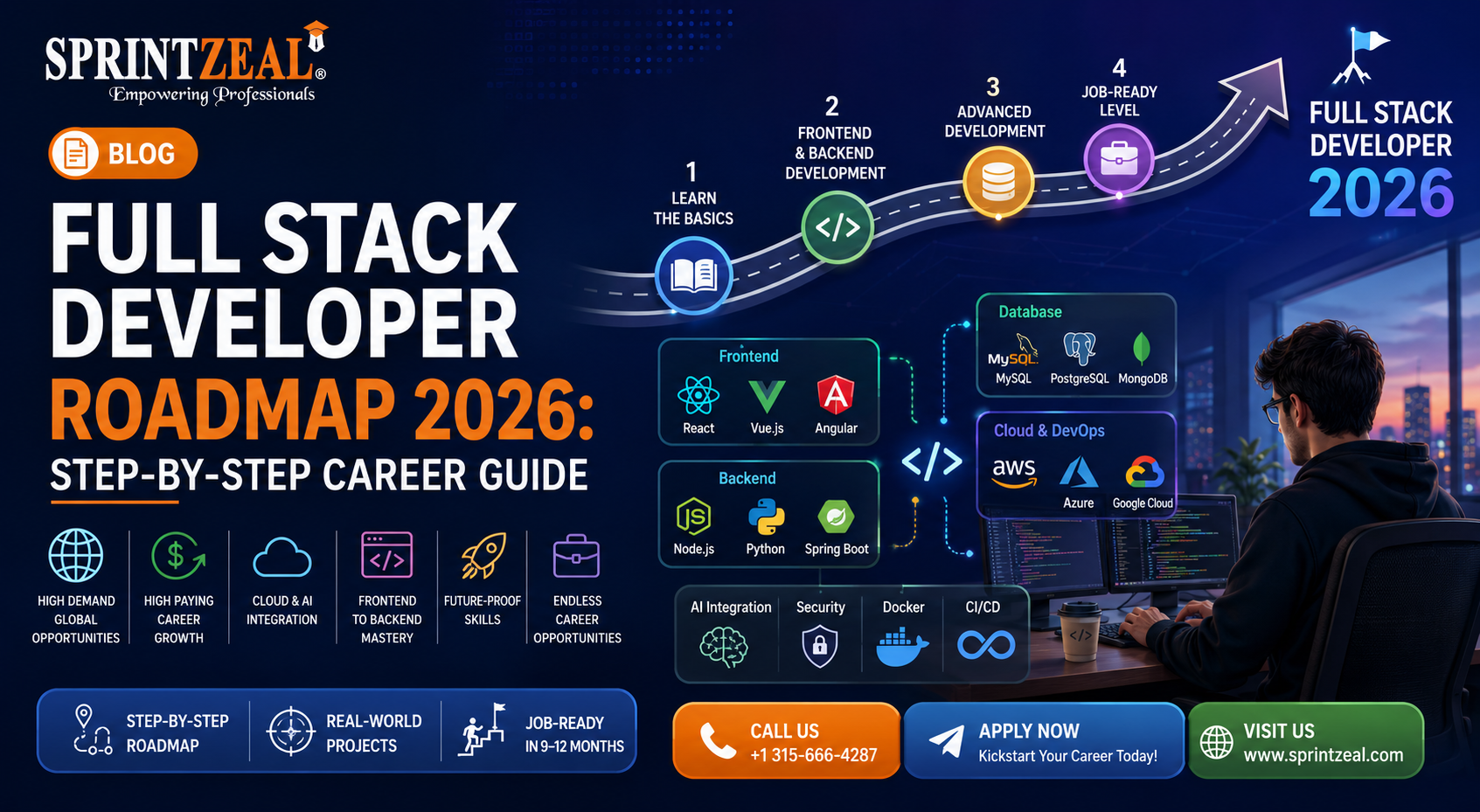
Full Stack Developer Roadmap: Step-by-step Guide
From what skills a beginner should acquire to get job-ready, the step-by-step guide of a fullstack engineer roadmap covers all the points thoroughly.
1st Phase: Learn Basics (For 3 months)
The first step for a fullstack engineer roadmap includes understanding how the web works and how to create a basic user interface.
The first step for a fullstack engineer roadmap includes understanding how the web works and how to create a basic user interface.
Things to learn:
1. HTML
Tags, forms, tables
(
,
,
) the building blocks of HTML are called Tags.
Forms such as login or contact forms. Users enter data with the help of these forms.
Data are organized in rows and columns (Table).
To Improve SEO, Semantic HTML is Essential
,
It also helps to improve seo and accessibility. Therefore, a search engine like Google can easily understand the content.
2. CSS (Styling)
The colors, layout, spacing, and design all together make a website look attractive. CSS is used for that purpose only.
Flexbox & Grid (VERY important)
For arranging elements on page, Flexbox & Grid (layout systems) are used
Flexbox works well with one-dimensional layouts (rows or columns
Grid suits complex 2D layouts
Flexbox and Grid help in creating clean and responsive designs
Responsive design (mobile-first)
The process in which a website for a mobile is created in the first place before even doing any kind of adjustments for the large screen is called responsive design (mobile-first).
Phones are the first device a customer will pick if they have to browse. Therefore, this strategy makes sure that your website looks attractive.
Basic animations
Hover effect, transitions, and movements are some simple animation effects that can be added with the help of CSS.
This not only makes the website interactive, but also improves the user experience.
3. JavaScript (Core Logic)
A website becomes interactive and dynamic with the help of JavaScript.
Variables, functions, loops
These are the basics of programming.
Data is stored in variables.
Actions are carried out by functions.
Loops carry out repetitive activities.
The core logic of any application is formed by them.
DOM Manipulation
DOM shows how a web page is put together.
JavaScript lets us change the content on the page as needed. Whether it is updating text, adding items, and hiding any section without refreshing the page.
Events (click, input, submit)
Typing in a field or pressing a button are the user actions called events.
Button clicks and messages displayed accordingly. It is JavaScript that detects the user actions.
ES6 (arrow functions, promises)
More powerful and cleaner syntax was introduced by ES6:
Arrow functions → shorter function syntax.
Promises → handle asynchronous tasks (like API calls)
These features are used to make it easier to write and keep up with code.
What You Should Build
For a better understanding of concepts, it is important to apply what you have learned. So, build small portfolios accordingly.
A personal portfolio website
You can consider it as your online resume. A resume has all your skills and projects.
Your resume should clearly display your personal info, skills, and projects
HTML will help you with structure, CSS with styling, and JavaScript for interactivity
It should look good on both mobile and laptop screens.
Before hiring, recruiters will first look at all these. You could think of it as the first thing that catches your eye.
Landing page (say, like a product page)
To promote a service or product, a single-page website, called a landing page, is used.
Its main focus is on designing clearly and clear messaging.
Product features, benefits, testimonials, and a call-to-action (CTA) are the sections it also includes
Flexbox or Grid is used for layout skills practice
You can understand the fundamentals of real-world UI/UX design.
Easy to use app(with local storage)
Start by creating a simple yet interactive app. The best option is to create an app like notes or a to-do list.
Adding, deleting, and updating tasks are user actions. JavaScript handles those actions.
If you make use of local storage to save data in the browser, the data won’t disappear even after refreshing.
Without the help of the backend, real apps manage data. But how is it done? This will teach you.
Tools You Should Learn
Git+GitHub
Git is a version control system. On the other hand, GitHub is where the code is stored and managed online.
What did you change in your code? It keeps track of everything.
In case something breaks, you can go back to previous versions.
You can also work together with other developers.
You can also publicly share your projects (a crucial requirement for job applications).
VS Code
It is a beginner-friendly code editor. Also a popular one.
You can write and edit your code effectively.
Server, code formatter, and debugger, all these extensions are supported
To boost productivity, features like auto-complete and error highlighting are used.
When This Phase Ends, What Will You Be Able To Do:
You’ll be able to create a responsive website independently
Add interactivity by making use of JavaScript.
Should be able to host your site (GitHub Pages/Netlify)
This phase is all about building real-world applications. By integrating frontend (what users can see) with backend (how the data is handled and stored), in this phase, you will move beyond the basics.
Things to learn:
1. Frontend Framework
React: For building fast, dynamic, and reusable user interfaces, the React framework is used.
Components
Buttons, forms, and navbars are the building blocks that can be used again and again.
You can create small pieces and use them again instead of writing everything fresh.
Props & State
Props → To transfer data between components, Props are used.
State → To store and manage data inside a component, State is used.
For your app to be dynamic, these are necessary.
Hooks (useState, useEffect)
To make use of advanced features in simple ways, Hooks are used.
useState → It handles data (like counters or form inputs)
useEffect → It manages side effects (such as fetching data from APIs)
You Should Also learn:
Next.js (for real-world apps)
It helps in creating product-ready applications.
It also supports SEO optimization and server-side rendering (SSR)
It is used extensively in real-world projects and companies.
2. Backend Basics
Node.js
It helps JavaScript to be run on the server.
It is used in the development of scalable backend systems.
Express.js
It makes backend development easier.
It facilitates the easy creation of APIs and server logic.
REST APIs
APIs let the front end and back end communicate with each other.
For example: Storing form inputs or retrieving user info.
You Should Also Learn:
Routing
/login, /signup, /tasks(these are the different endpoint URLs). These are defined by routing.
Middleware
Between a request and a response, the functions that take place.
It is used for error handling, logging, and authentication, and also for other purposes.
Handling requests/responses
How the frontend provides the data and how the backend returns the results (response), it is all about learning those.
What You Should Build
Full Stack To-Do App
This is going to be your first complete real-world project.
Frontend: React
Backend: Node + Express
Database: store data in JSON or a simple database
At the end what, will you learn:
How to connect the frontend with the backend
How to send and receive data by making use of APIs
How to control the status of an application
Authentication System
Signup/Login : Users can create their accounts and also log in.
Password hashing: It protects users’ password as it never saves plain-text passwords
This will introduce you to the real-world security procedures.
Tools You Should Learn
Postman (API testing)
Without a frontend, it can be used to test APIs
It helps in debugging issues related to the backend easily.
npm (package manager)
Tools such as Express, React packages, and libraries are installed by making use of npm
It oversees project dependencies.
By The End of The Phase, What Will You Be Able To Do:
Build a frontend + backend connected app.
Create and test REST APIs
How does the data flow between client and server? You will understand this at the end.
Make use of real-world tools that developers use.
3rd Phase: Advanced Development (For 6 to 9 Months)
The past two phases were all about learning concepts. In this phase, you will be building product-level apps. The apps that are used by actual companies. You will mainly concentrate on scalability, security, and deployment.
What You Should Learn
1. Databases (Used for Data Management and Storage)
SQL (Structured Databases)
Two databases: PostgreSQL or MySQL (your concepts should be clear)
Table stores data using rows & columns. The data remains structured.
NoSQL Databases
Understand MongoDB: JSON-like is a flexible format that stores data, which supports modern app development
You Should Also Learn:
CRUD operations
These are the basic operations for handling data: Create, Read, Update, and Delete
Relationships
Learn the relationships between data in several tables (eg, users and orders)
Indexing basics
It helps to speed up database queries and enhance performance.
2. Authentication & Security
JWT (JSON Web Tokens)
It is used to safely identify users after they log in.
It helps to maintain user sessions without requiring the server to store data.
OAuth (Google login)
It enables users to sign in with Google accounts.
It enhances security and user experience.
Data validation
It guarantees that the user input is correct and secure (prevents attacks and bugs)
3. Advanced Backend
MVC architecture
It helps to organize code into a structure:
Model → data
View → UI
Controller → logic
It makes your code scalable and maintainable.
Error handling
Discover how to detect and manage errors gracefully without causing the application to fail.
File uploads
It manages the uploading of images, documents, and other files (for example: profile pictures)
4. Deployment
Hosting apps on:
Amazon Web Services: It is used for hosting backend servers and databases
Vercel: It is best for deploying frontend apps in a quick time.
By the help of deployment, the project is accessible to the users across the globe.
What Important Thing One Should Focus On:
Build two strong projects. These projects will be the highlights of your portfolio.
Project 1: E-commerce Website
Product listing
This is the page where all the products are shown, like how it is displayed on Amazon
Product name, pricing, image, and rating are all displayed
It obtains data from the backend (database or API)
It allows users to filter products on the basis of Price, category, and search.
What is the goal? Find out how frontend and backend data work together.
Cart system
Users can control what they wish to purchase here.
Putting items to your cart
Removing things out of your cart
Update the quantity
Calculate the total price.
What you’ll learn:
State management (React state / Redux)
Storing cart data (local storage or backend)
Payment Integration
This is where the real thing happens.
Includes payment gateways like Razorpay or Stripe
Respond to successes and failures
The payment process is safe
What you’ll learn:
APIs
Basics of security (tokens, validation)
Project 2: Blogging Platform
Create/edit/delete posts
Users can write blogs, edit the existing ones, and delete posts.
What you’ll learn:
CRUD operations (Create, Read, Update, Delete)
Database handling
User Login
Authentication system for users: A system that confirms the user's identity to securely grant access to an application.
Signup / Login
Password encryption
Session or token-based login (JWT)
What You’ll learn:
Authentication flow
Backend security basics
Comments System
It is a feature that helps users to interact and share their opinions about the posts.
Add comments
Delete comments
Show comments under posts.
What you’ll learn:
User interaction features
Linking data (users ↔ posts ↔ comments)
What Tools You Should Learn:
Docker (Basic)
To run your app in a container, Docker is used.
There will be no such issue, as it works only on my machine. The same setting is present everywhere. The app works the same way on every system.
It combines the program with all required dependencies into a single container.
It makes deployment of apps easier, quicker, and more reliable across several platforms.
Environment Variables
It is used to keep changeable or sensitive data separated from the main code.
API keys
Database URLs
Secret tokens
For instance:
It keeps passwords out of code.
Use .env files
By The End of The Phase, What Will You Be Able To Do:
Build Scalable Apps
Create apps that can effectively handle user and data growth.
Make sure your code is organized in a clean and manageable manner for easier scaling.
For flexibility and performance, keep server logic and user interface separate.
Design systems that can easily handle high traffic levels without crashing
Deploy Full-stack Projects
Launch the complete app by enabling access to both the frontend and the backend.
For rapid and reliable access, implement the user interface on platforms such as Netlify or Vercel.
Make use of services like Render or AWS to run server-side logic.
For complete functionality, link your custom domain and combine the application with a database.
Handle Authentication Securely
Make sure that secure authentication procedures are used to safeguard user data and access.
To prevent misuse in case the data is leaked, store passwords in an encrypted (hashed) form
To safely handle user sessions and authentication, use tokens
Limit access so that if a user has not logged in, they cannot open pages or features. At the same time, if they have logged in, they can access those protected pages.
Phase 4: Job Ready Level (For 9 to 12 Months)
The main goal of this phase is to get hired. And start earning by building real-world, productive level skills.
What You Should Learn
1. System Design (Basic)
How prominent and big apps like Netflix and Instagram operate on a large scale. This will make it easier for you to understand how the apps do that.
You can learn how the database, frontend, and backend are connected (client-server architecture)
You can also understand how thousands or millions of users are handled by APIs
Learn the basic of scaling apps (caching, load balancing)
The goal is simple: you should think like an engineer and not just a coder
2. Performance Optimization
To give a user an experience of a smoother, quicker, and more fruitful application, the performance optimization process is applied.
Lazy loading: Images, videos, or scripts are non-critical resources. These resources are loaded when required. You don't have to load everything all at once.
Code splitting: You should break the code into small parts just to reduce the initial loading time.
API optimization: To speed up data fetching and make it more efficient, improve backend responses.
The main goal here is to improve the speed and overall performance of an app so that it enhances user performance.
3. Cloud Basics
How are the apps hosted, deployed, and managed online? You can learn it all here.
AWS or Google Cloud (The hosting apps): These cloud providers help in running your application on the internet.
CI or CD pipelines: If the testing, development, and deployment of your code are automated, the updates will be more reliable and quicker
If you want to make that transition of converting your project from a local set-up to a live production environment (user-accessible), you should clearly understand cloud basics.
4. AI Integration (Must For 2026)
Your application will appear engaging and smart if you incorporate intelligent features.
Use APIs (chatbots, recommendations): If you merge AI services, features like automated tasks, personalized suggestions, and chatbots will be possible.
Automate workflows: sending emails, making recommendations, or automatically replying to users; all these are streamlined.
To enhance functionality and user experience, applications should integrate AI. Modern apps will do that. So, here the only objective is to build those kinds of apps.
What You Should Build In This Phase
Final Portfolio (3–5 Projects)
Create strong and polished projects that clearly demonstrate your skills.
An app that can solve a real-world problem is the best option to create
An app that is user-friendly on the frontend and at the same time reliable, effective, and quick enough on the backend. Build those kinds of apps.
SaaS app (subscription-based idea)
Build a subscription-based app. Users can access it by paying at regular intervals.
For example, you can create something such as a resume builder app, a note-taking app, or analytics tools.
Add login + payment + subscription logic: Put user authentication, payment integration, and subscription management into practice.
The main objective here is to gain knowledge about how the creation and monetization of real-world business apps are done.
Real-time app (chat app using sockets)
Refreshing the page shouldn’t be an option.
Think of creating a chatting app, WhatsApp, for instance.
Use WebSockets: This allows real-time connection, so you can get instant updates.
The main reason for this is to understand how real-time data exchange functions in modern applications.
One AI-integrated project
You should focus on creating apps that include AI-powered features.
Chatbot: Users should be able to interact with the system conversationally.
Content generator: The tools that you have developed should be able to automatically generate text, ideas, or responses
Recommendation system: Based on user behavior, there should be a relevant suggestion of content or product
The main goal here is to make you stand out in the marketplace, as you will be showcasing your modern AI skills.
By The End of The Phase, What Will You Be Able To Do:
Crack interviews
Build real-world applications
Freelance or get a job
Things That Will Make You Struggle
If you only watch tutorials and do not focus on projects
If you avoid debugging
If you ignore the backend or cloud
Instead, You Will Win If You Do This:
Build real-world projects
Pay close attention to ONE stack at a time.
Publicly display your work.
Try to be consistent for 6 to 12 months.
Focus on your skills more than certifications.
Full Stack Developer Roadmap 2026: Interview Tips
Make sure your basics are strong (frontend, backend, and databases). An interviewer is always keen to know about our basics more than advanced tools.
A real-world project might have given you a lot of exposure. The first question that will arise is, what is the purpose of your application? In addition, what tools did you use, and what problems did you face while carrying out the project? What steps did you take to make the app work better? Be ready to answer all these questions.
Practice DSA: Use LeetCode and HackerRank to concentrate on key topics.
Understand the basics of system design: How do the apps function end-to-end?
APIs, authentication, SQL vs NoSQL, and so on, be aware of all the concepts.
While writing the code, also make sure to communicate what your approach is clearly.
Use GitHub and other sites like Vercel to learn Git and how to deploy.
Prepare for your behavioural response: Use the STAR method.
AI and performance optimization are some of the latest trends you should be aware of :
Mock interviews should be a must. It will give you confidence and improve your skills.
Your resume, alongside your portfolio, should clearly display the projects you have worked on, along with the results.
You can also ask smart questions, which shows you're genuinely interested in the job and the company.
Fullstack Engineer Roadmap 2026: Certifications
How To Choose Certifications?
Now you know which skills to master. The second step in the full stack developer roadmap is to acquire the certificates. In case you are starting to learn skills, it is recommended to acquire skills in this order:
Certification for frontend
Certification for Backend
Basics of database
Certification related to cloud
Acquire a certificate related to AI skills.
It is optional, but one can also acquire a certificate related to security.
Tips To Get Certificates in 2026
One certification for one skill is enough.
Only acquiring certificates is not enough; also, work on real-world projects.
GitHub also matters.
Certifications
Frontend Development Certifications
A full stack developer roadmap also guides someone in what certifications they should choose.
The Best certifications available are:
Meta Front-End Developer Professional Certificate
Responsive Web Design Certification
Frontend Developer Career Path
The Skills that are covered in this certification are:
Certifications Related To AI-Integrated Development
AI for everyone
Generated AI for developers
Machine Learning
What skills are covered:
AI APIs integration
Chatbots, automation
Prompt engineering basics
Certifications Related To Database
Certification for a MongoDB developer
Certification related to Oracle Database SQL
What skills are covered:
Data storage & retrieval
Query optimization
Database design
Security Certifications
Certified Ethical Hacker (CEH)
CompTIA security+
What skills are covered:
Secure coding
Preventing attacks
Data protection
Full Stack Developer Roadmap 2026: Career Opportunities
Roadmap for a full stack developer in 2026 talks about how this career has evolved. Now it is not only about knowing skills related to frontend and backend, but also AI and cloud.
Core Roles in the Full Stack Developer Roadmap 2026
Full Stack Developer
The role of full stack developers is most adaptable.
They create the whole application from start to end.
What the users see and what goes behind the scenes, a developer can handle both.
Startups and businesses are the first ones to hire them.
Frontend Developer
In the full stack developer roadmap 2026, UI/UX is the primary focus
HTML, JavaScript, and CSS are all involved by the developers
One of the other objectives is to make the app functional and attractive
Backend Developer
After the frontend, it's another important part of the 2026 full stack developer roadmap.
Databases, APIs, and servers are all handled by the backend developers.
Logic, performance, and scalability are their priority areas.
They work with Node.js, Python, and Java
Cloud/DevOps Engineer
Cloud/DevOps engineer is an emerging and rapidly growing role in the full stack developer roadmap 2026
They perform all three: infrastructure, deployment, and scaling.
AWS, Docker, and Kubernetes are the tools that come into the picture
Making sure the application runs without any errors is their priority.
Emerging Roles in Full Stack Developer Roadmap 2026
AI-Integrated Developer
This role is the latest trend in the full stack developer roadmap 2026
By making use of AI tools and APIs, they create apps.
They add features like automation, chatbots, and recommendations.
They combine AI capabilities with development.
Mobile + Web Hybrid Developer
It is one of the other career opportunities that is also highlighted in the full stack developer roadmap 2026.
People in this job role create applications for both mobile and web.
They make use of React Native and Flutter.
They are popular among startups and product companies.
Security Focused Developer
It is an essential position specialized for security purposes in the full stack developer roadmap 2026.
Their primary focus is to secure coding and do data protection.
In advance, the developers help in preventing cyber threats and vulnerabilities.
The demand for employees related to the role is increasing due to the growing security risks.
Industry Opportunities
If you follow full stack developer roadmap of 2026, you will come to know that you are getting prepared to get hired across various industries:
Starting from Fintech (it includes banking sectors, payment, and digital wallets)
You can also get hired by an e-commerce company.
Healthcare sectors are also a good option to get hired
Gaming & entertainment
EdTech (learning platforms)
SaaS (software-as-a-service products)
Salary & Demand Insights
The full stack developer roadmap trends in 2026 indicate that the position is in high demand.
Experience Level
Front-end Developer
Back-end Developer
Full Stack Developer
Fresher (0-2 yrs)
$70K – $95K
$75K – $110K
$80K – $120K
Mid-Level (2-5 yrs)
$95K – $130K
$110K – $160K
$110K – $160K
Senior (5-10 yrs)
$130K – $170K
$150K – $220K
$150K – $200K
Lead/Architect
$160K – $200K+
$180K – $250K+
$180K – $260K+
Career Flexibility
The full stack developer roadmap 2026 also makes possibility for other job options:
Freelance developer
Startup founder
Technical blogger or educator
Consultant
Benefits of Full Stack Developer Roadmap in 2026
Keeping in mind the above mentioned pointers along with skill set, considering a full stack developer roadmap in 2026 comes up with several benefits. It is mainly beneficial for someone looking to build a successful career in the tech industry:
Clear Learning Path
Along with all the skills like HTML, CSS, and JavaScript, and what to learn in each step from basics to job-ready, a full stack developer roadmap in 2026 provides step-by-step guidance in a structured way.
High Career Opportunities
There are many skills mentioned in the full stack developer roadmap of 2026. So, if you acquire all the skills and get hired across multiple industries, including IT companies, product-based firms, and startups.
Versatility In Skills
Thoroughly going through the full stack developer 2026, you’ll realize that you have gained expertise in both frontend and backend. Moreover, building a full application from start to end, you will be able to do that as well.
Better Problem-Solving Ability
How are the different parts of an application connected? Going ahead through the full stack developer roadmap 2026, you’ll understand that as well. To improve your debugging and problem-solving skills, the above knowledge is vital.
Increased Salary Potential
Developers handle several tasks within a project. Therefore, the professionals who adhere to the full stack developer roadmap in 2026 will definitely receive better wages.
Freelancing and Entrepreneurship Opportunities
Following a full stack developer roadmap in 2026 will help an individual to work independently. An individual can create their own startup, SaaS product, and best of all, take on freelance jobs.
Adaptability to New Technologies
Following a full stack developer roadmap in 2026, an individual will be up to date with the tools like AI, cloud computing, and APIs. They will be able to keep up with the industry trends.
Strong Portfolio Development
A full stack developer in 2026 encourages an individual to take up real-world projects rather than only focusing on theory. In this way, they can strengthen their portfolio and raise their employment chances.
Conclusion
According to the full stack developer roadmap 2026, this career is a safe and wise employment choice for the future. There will be many job opportunities knocking at your door once you acquire the above-mentioned skills. A full stack developer’s job is to not only build websites, but also to create applications. Those apps can grow easily and even make use of smart technologies.
The introduction of AI and cloud computing is an added advantage for developers in the marketplace. This position of full stack developers is in high demand. Therefore, choosing this career will not only be a secure option, but it will also come with the perk of a high salary. Learning the evolving and basic skills, and also practicing them, is the key.
In addition, our organization, SprintZeal , offers some courses that you might find insightful. Here's some of them that might help you as you follow the full stack developer roadmap 2026.
1. Full Stack Developer Roadmap 2026? What is meant by it?
The skills required to attain the position of a full stack developer. The job role in which an individual is capable of working on both the frontend and backend. Moreover, with the addition of modern trends like AI and cloud computing, all the things are covered as a step-by-step manner in the fullstack engineer roadmap 2026.
2. What is the duration to complete the Full Stack Developer Roadmap 2026?
Sprintzeal is a world-class professional training provider, offering the latest and curated training programs and delivering top-notch and industry-relevant/up-to-date training materials. We are focused on educating the world and making professionals industry-relevant and job-ready.
PMP, PMI, PMBOK, CAPM, PgMP, PfMP, ACP, PBA, RMP and SP are registered marks of the Project Management Institute, Inc.
CBAP® - Is a registered trade mark of IIBA.
ITIL® is a registered trade mark of AXELOS Limited, used under permission of AXELOS Limited. The Swirl logoTM is a trademark of AXELOS Limited, used under permission of AXELOS Limited. All rights reserved
PRINCE2® is a registered trade mark of AXELOS Limited, used under permission of AXELOS Limited. The Swirl logoTM is a trademark of AXELOS Limited, used under permission of AXELOS Limited. All rights reserved
Certified ScrumMaster® (CSM) and Certified Scrum Trainer® (CST) are registered trademarks of SCRUM ALLIANCE®
Professional Scrum Master is a registered trademark of Scrum.org
The APMG-International Finance for Non-Financial Managers and Swirl Device logo is a trade mark of The APM Group Limited.
The Open Group®, TOGAF® are trademarks of The Open Group.
IIBA®, the IIBA® logo, BABOK® and Business Analysis Body of Knowledge® are registered trademarks owned by International Institute of Business Analysis.
CBAP® is a registered certification mark owned by International Institute of Business Analysis. Certified Business Analysis Professional, EEP and the EEP logo are trademarks owned by International Institute of Business Analysis..
COBIT® is a trademark of ISACA® registered in the United States and other countries.
CISA® is a Registered Trade Mark of the Information Systems Audit and Control Association (ISACA) and the IT Governance Institute.
CISSP® is a registered mark of The International Information Systems Security Certification Consortium ((ISC)2).
CompTIA A+, CompTIA Network+, CompTIA Security+ are registered marks of CompTIA Inc
CISCO®, CCNA®, and CCNP® are trademarks of Cisco and registered trademarks in the United States and certain other countries.
CSM®, CSPO®, CSD®, CSP®, A-CSPO®, A-CSM® are registered trademarks of Scrum Alliance®
TOGAF® is a registered trademark of The Open Group in the United States and other countries
All the online courses are accredited by respective governing bodies and belong to their respective owners.







 USA : +1315-322-7821
 UK : +44 7700 174870
 IND : +919036108287
 AUS : +61 480 005 455