Switching Into Strategy? The Best AI for Case Interviews With Live Exhibits
Fri, 09 October 2026

Inspirational journeys
Follow the stories of academics and their research expeditions
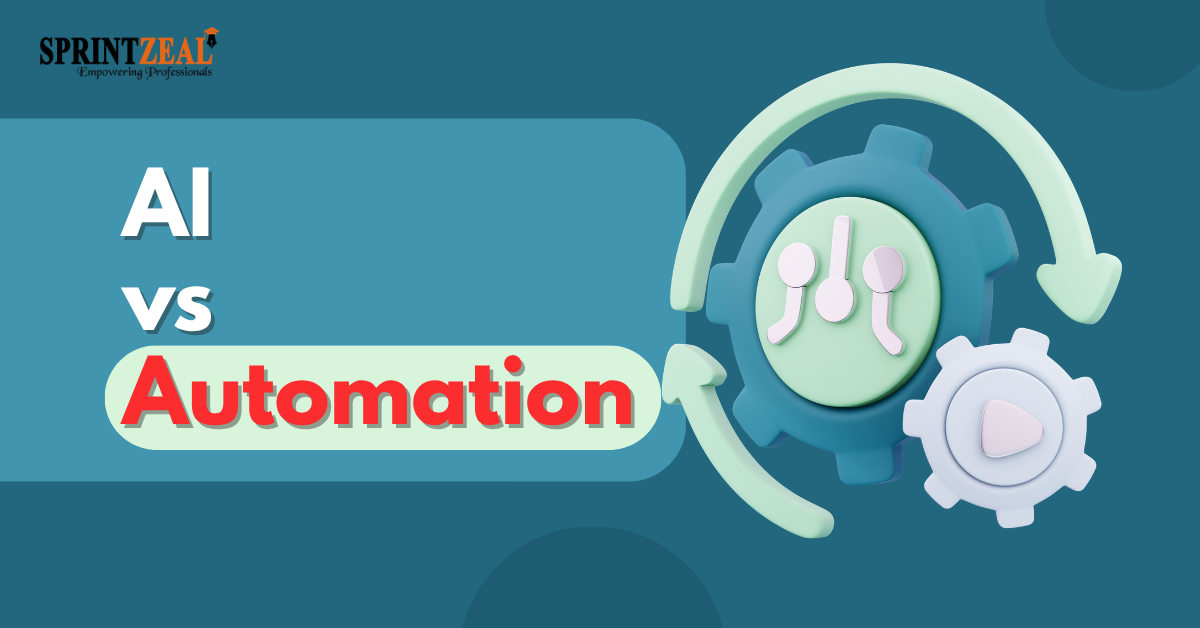
Modern companies are updating their work speed with growing business requirements like sending mail, resolving customer requests, and decision-making; for all this, they take help of technology to run work smoothly and efficiently on software. In these cases, companies should understand the difference between AI and Automation as a primary importance to know. A lot of people assume AI and Automation are both nearly the same, but what they actually are is that they are used for different purposes based on the work and tools. If the companies know the real difference between AI vs Automation, they can drive their businesses to work more efficiently.
Automation is used to do repetitive tasks by some instructions, like a system. The work should happen like the same thing that is exactly given instruction by humans again and again to do. On the other hand, AI takes the next step of automation, where decision tools are based on data, understanding the pattern, and making decisions based on the prompt learnt in different situations. For this reason, AI and tools can handle more complex tasks, and it improve over time.
Both AI and Automation are helpful in company growth, while Automation helps to reduce manual work and let AI help to make better decisions in processes. Both help to drive the growth for the company faster, smarter, and more competitively. But it also helps to know about the difference between AI vs Automation.
Automation is the process where a machine or software does the tasks automatically without taking help from humans or any other interaction. It clearly works on the instructions given by the humans. If anything happens that is not mentioned in the fixed rules, the system starts doing other work, like sending mail and updating the data in the system. Automation helps in performing repetitive tasks in daily work based on completing it.
Automation is required in business because if the employee is doing the same work daily, he will definitely get bored; it will affect the other works as well. So, that doing repetitive tasks using automation software helps to complete the task as well as the employee can work on the other work more focused. Automation can reduce the errors, and work goes faster and easier.
Artificial intelligence is a kind of technology where a system thinks like a human to complete work for specific tasks. This includes language understanding, recognizing patterns, solving the problems, and making decisions. It means AI helps the machine to act smarter and give responses based on the given information.
AI works done with the help of pattern understanding; meaning, before understanding the pattern, it learns from data, understands the data, and then understands the pattern. With this thing, AI improves the performance over time. It helps in complex problem-solving to make better decisions to complete the task. Businesses need this kind of technology so that they can develop everyday useful tools, like chatbots and apps, to improve efficiency.
AI works by learning from data, not like automation—no need to be told to do tasks. It studies patterns and improves performance over time. So, it's very useful for complex tasks, helping businesses and making better decisions.
AI also has different types of AI to perform specific tasks. The first is task-specific and designed to work on one thing, like ChatGPT, which is known as "artificial narrow AI." A theoretical AI that matches its solutions with human solutions is called "artificial general intelligence," and others are also present.
|
Feature |
Automation |
Artificial Intelligence (AI) |
|
Meaning |
Automatically perform tasks using rules |
Makes machines “smart” to think and learn |
|
How it works |
Follows given instructions |
Learns from data and past experience |
|
Learning |
Cannot learn or improve |
Can learn and get better over time |
|
Flexibility |
Complete the task in the same way that used to for every task get. |
Change the work process differently according to the task |
|
Task type |
Repetitive and simple tasks |
Complex and decision-based tasks |
|
Decision-making |
Do not make decisions |
Can make simple decisions |
|
Goal |
Save time and reduce manual work |
Solve problems and improve decision-making |
|
Example |
Auto email replies, data entry |
Chatbots, voice assistants, recommendations |
The above table explains the difference between RPA and AI in simple terms. RPA is generally known as "automation," where it follows fixed rules and handles repetitive tasks. For example, data entry and moving information from one system to another system. Not like AI, it won’t learn from data and make decisions. AI, on the other hand, is like an intelligence where data helps to understand the situation and make decisions based on the data.
In the world of business, companies are looking for work faster and smarter; this thing happens only by understanding the difference between AI vs Automation, which seems important. Because both these technologies work with the help of technology. Using these tools helps to improve work efficiency. But it's used for different works depending on the type of tasks. Knowing when to use automation and AI can help to save time and make better decisions.
For example, automations and RPA are used to complete daily tasks in a repetitive way, and AI is used to better produce decisions and works where the answer comes from learning from data and thinking and making better decisions. The below table helps understand the difference of implementation and business area in AI vs automation.
|
Area |
Automation |
AI |
|
Customer Support |
Auto-send replies and route emails based on keywords |
Chatbots that understand questions and give smart answers |
|
Data Entry |
Copy and move data between systems automatically |
Read, understand, and organize unstructured data (like emails) |
|
Finance |
Generate invoices and process payments automatically |
Detect fraud and predict financial trends |
|
HR (Hiring) |
Sort resumes based on fixed rules |
Analyze resumes and suggest best candidates |
|
Marketing |
Schedule emails and social media posts |
Recommend products based on customer behavior |
|
Operations |
Track orders and update status automatically |
Predict demand and improve supply planning |
|
IT Support |
Run system checks and alerts |
Identify issues early and suggest solutions |
|
Example |
The system sends invoice after purchase |
The system suggests what customer might buy next |
AI is used in automation to make the system faster and smarter to use. For this thing to be understood more clearly, the difference between AI vs Automation is necessary. For example, imagine an automation is doing a task given by the instructor on fixed rules while AI adds in its ability to learn and make decisions. Also, when AI is connected with automation, systems can handle more than just repetitive work. So it can understand data after finding the patterns and responding in the best ways.
automation can do repetitive tasks like sending bulk mail and data transfer. AI works to do decision-making with the help of learning from data and learning patterns. By using both the technologies in business, it will give me more work efficiency to do and better answer all the queries as well. In a simple way, automation does the work taking AI helps to do it faster and smarter and more efficiently. This is exactly how AI Automation evolve in the business world, taking help of AI to do Automation tasks in such a way that work can go faster and smarter.
When the topic is intelligence in technology, understanding the difference between AI vs Automation becomes important to know. Automation simply works under the instructions of a system that does exactly what is instructed and does it again and again without thinking. It is fast and reliable for repetitive tasks, not like learning from data or adapting.
On the other hand, AI brings a smarter approach. Understand data and learn from it; find the pattern, and after that, make the decisions based on what it learns. This is where we know the difference between AI vs automation becomes clear. RPA handles daily tasks by following rules, while AI works on the decision-making process and helps with complex work.
How AI vs Automations help each others in intelligence
Taking help of each other, AI and automation in doing tasks will help to increase the work speed and be more efficient to finish the work. Both are taking help from something like automation to get instructions from the user while the AI gets the data from the user to understand the pattern.
If the AI is involved in the automation work, the ability to do repeat tasks speed would increase, and you would be able to do more work and give better work results in a faster way. Like moving data faster, sending mail, or updating the systems because it does not take long to think.
AI takes help from automation. AI can do more work, make faster decisions, and improve the efficiency of completing decision-making. The automation takes the responsibility of loading the data and starting the programming and understanding the pattern of how to do it. By doing this work, AI can understand the work more quickly and easily. The ability to make decisions goes faster and smarter. Taking help from the AI agents like LLM models to perceive, plan, and take actions using tools to achieve specific goals makes it more efficient to complete the task using exactly what to do in automation.
This is where we can see the difference between AI vs Automation clear and use it in real cases.
Companies and businesses rely on automation as well as AI for completing daily work and making better decisions. Many organizations are trying to build smarter systems to reduce the manual work and improve the decision-making process, making everything simpler. While for automation, organizations want to reduce the time it takes to complete the task, meaning save the time and improve work speed.
Related to this, below, the data gives an understanding of both AI and automation marketplaces growing in 2025 clearly. Which means companies are ready to invest in both technologies.
|
Year |
AI Market (Billion USD) |
Automation Market (Billion USD) |
|
2025 |
390 |
129 |
|
2026 |
500 |
169 |
|
2033 |
3497 |
1144 |
How to understand this graph:
The increasing job market from 2025, 2026 to 2033 is clearly showing AI has a good career future compared to others
|
Feature |
Automation Benefits |
AI Benefits |
|
Speed |
Completes tasks very fast |
Works fast and improves speed over time |
|
Accuracy |
Reduces human errors in repetitive tasks |
Improves accuracy by learning from data |
|
Efficiency |
Saves time by handling routine work |
Makes processes smarter and more efficient |
|
Cost-Saving |
Reduces need for manual work |
Helps make better decisions, saving long-term costs |
|
Consistency |
It gives the same result every time |
Can adapt and improve results over time |
|
Decision Making |
No decision-making |
Supports smart and data-based decisions |
|
Scalability |
Easy to scale repetitive tasks |
Can handle complex and growing business needs |
|
Customer Experience |
Faster service through automated responses |
Personalized and better customer interactions |
|
Productivity |
Frees employees from repetitive tasks |
Helps employees focus on important decisions |
Agentic AI is shifting automation from strict, task-based execution to dynamic, goal-oriented planning. Traditional systems rely on fixed instructions and human intervention, but autonomous agents can independently work, adapt to changing data, execute complex, multi-step tasks and workflows, and handle them itself. By integrating with existing software ecosystems, these intelligent agents can manage to complete operational cycles—such as software development, supply chain logistics, and financial compliance—with minimal human oversight.
The future of this technology lies in the rise of collaborative, multi-agent workforces operating under human management. Organizations are moving toward "Human-in-the-loop" models, where AI agents handle the large data processing and execution while humans step in for strategic oversight and ethical decision-making processes. As security protocols and reasoning capabilities mature, agentic automation will unlock unprecedented business scaling, shifting the human workforce from hands-on execution to high-level system management.
Learning AI and automation is a good decision to step into IT job roles. But choosing the right website for training gives more trust to crack it. There are many platforms that offer professional training programs with certification. These courses are beginner-friendly and help to gain and improve skills for corporate jobs.
The business environment is changing fast. Human-to-technology dependence depends on work completion. For this, everyone is to know the difference between AI vs automation is important; an even more important thing is that humans can only operate these things because machines can do the work, but who is going to tell them they need to do these tasks in the automation case? Also, in the case of AI, who will provide the data and train the data to understand the pattern for AI? All this would be done by humans.
For this, humans should have creative and ethical thinking. The difference between AI vs Automation that can support the work of humans. Humans do the work, like designing systems, making final decisions, and ensuring everything goes smoothly and the right way.
The future of technology will be seen as the future of AI because AI helps in every field as it helps in Automation and everyday increases of work and complex tasks it only can handle. This is AI for this; it is called the future of AI.
Choosing the right platform for learning these skills makes you different in the world of automation and AI. SprintZeal offers professional training programs designed to help the beginners to build strong technical skills in AI and automation. This course will help beginners cover all the concepts of AI and automation, real-world use cases, tools, and practical knowledge on these systems. Also, SprintZeal has expert trainers, flexible learning options, and globally recognized certifications; it helps to stay competitive and grow a career in today's technology-driven world.

Fri, 09 October 2026
Mon, 28 September 2026
Tue, 22 September 2026
Tue, 08 September 2026

Mon, 24 August 2026
Wed, 19 August 2026
Mon, 17 August 2026
Mon, 17 August 2026
Thu, 13 August 2026

Mon, 24 August 2026
© 2026 Sprintzeal Americas Inc. - All Rights Reserved.

 USA : +1315-322-7821
 UK : +44 7700 174870
 IND : +919036108287
 AUS : +61 480 005 455