Best AI Photo Enhancer Tools for Marketing Teams in 2026
Tue, 08 September 2026

Inspirational journeys
Follow the stories of academics and their research expeditions
Ethics in AI: How serious can this issue really be? Lexology research states that Italy’s data authority once fined OpenAI a hefty amount of €15 million for breaching trust. Ethics in AI was questioned in the airline industry. The chatbot of Air Canada provided Invalid information to a customer. In return, the airline had to pay compensation to the customer.
Due to this, companies are eager to hire AI ethicists and compliance officers. This article, titled “Ethics in AI: How Companies Implement Responsible and Ethical AI,” thoroughly covers guidelines, consequences, human rights, and many other topics to ponder.
Ethics in AI is the set of rules, guidelines, and values that control how an AI system should be created, how it should behave, and how it should impact people’s lives. It can be considered as good manners applied to AI. The main goal of AI ethics is to ensure that AI doesn’t harm humans, it benefits them, and aligns with their values.
Ethics And AI: Why Does It Matter In 2026?
Healthcare, banking, education, social media, jobs, you name it, and almost every sector has incorporated AI in today's age of 2026. AI governs decisions, suggestions, approvals, scam detection, personal tracking, shortlisting, and is also capable of conducting the first round of interviews according to the sector.
One wrong decision by AI and everything will go for a toss. Therefore, ethics in AI is essential to be adopted in 2026. Unfair practices involving risk of bias based on colour, caste, or background, leaking personal information, how AI works, no one has any idea, and the fabrication of information are expected to occur if there are no strict ethical guidelines.
With the strict laws and increased public awareness, companies will fear the occurrence of legal problems. Hence, the companies will use responsibility to maintain trust between them and the people.
AI is beneficial, but at the same time, it should be fair and should be safe to use. Therefore, Ethics in AI in 2026 is a big deal. Violation of human rights or causing any type of harm under any circumstances will be acted upon promptly.
Ethics In AI: What Is The Need?
|
Ethical Focus |
Why Is It Important? |
|
To Prevent Harm |
Accident (physical harm) can be a severe consequence caused by false information from AI. A false impression of a person (emotional harm) can be created if AI spreads misinformation. AI can treat someone immorally (social harm) by denying them access to what everyone else has. |
|
To Ensure Fairness and Avoid Bias |
Bias or favoritism are the two ill-treatments that can be done on the basis of religion, colour, gender, background, or ethnicity. AI should have no room for discrimination. |
|
To Protect Privacy and Data |
Personal data of an individual should be confidential. AI systems don’t have the right to use anyone’s personal information in the wrong way or share it without consent. |
|
To Build Trust in AI Systems |
AI systems should be transparent (people should know how AI works and make decisions), reliable (the results that AI provides should be correct and consistent), and safe (AI should not harm people in any situation). |
|
To Ensure Accountability and Responsibility |
There should always be humans or organizations responsible for AI decisions and their outcomes. |
|
To Support Human Values and Rights |
Before making any decision or helping humans, AI should respect the boundaries of human rights, dignity, and moral values. |
Through my research I have found quite a few blunders that AI has done:
Air Canada Paying Compensation

Air Canada paid compensation to a passenger because an AI chatbot gave him incorrect information regarding the ticket prices. Moffatt is a boy whose grandmother had passed away; the same day, he decided to book tickets to Toronto. Moffatt asked the Air Canada website chatbot about the bereavement fees (a discount given to people flying urgently due to the death of a family member).
The airline's chatbot claimed that if he buys a ticket at full price, he will get the discount later. So, the boy paid the full price for tickets to and from Toronto, but didn’t get any discount afterwards. To go to Toronto, he paid CA$794.98, and paid CA$845.38 for a return ticket to Vancouver.
As per the screenshots provided by Moffatt, what the chatbot said is: "If you need to travel immediately or have already travelled and would like to submit your ticket for a reduced bereavement rate, kindly do so within 90 days of the date your ticket was issued by completing our Ticket Refund Application form."
Moffatt contacted Air Canada, sent a copy of the screenshot and asked for a refund, but the airline declined. After that, the boy took the matter to the tribunal (essentially a small claims court). Air Canada stated that the chatbot was a separate system and the airline isn’t responsible for what happened. However, the airline’s argument was rejected, and they were held responsible. So, the airline had to pay a full refund to the passenger.
A Finance Employee Ended Up Paying $25 Million After Falling Into a Trap of a Deepfake Video Call by The Company’s CFO

A finance employee working in a multinational company in Hong Kong had attended a video call. On the other end were his senior colleagues and the company’s CFO from the UK. First, the employee received a text message from the CFO asking for a money transfer that should not be discussed openly. The worker was suspicious, thinking it might be a case of phishing.
However, after that, he was invited to attend a video call. The worker saw his colleagues, the CFO, and heard their voices, so his second thoughts were buried. He transferred HK$ 200 million, equivalent to $25.6 million. He later called the head officer of the organization to confirm the transaction.
In the process, he came to the reality that other people were posing as his colleagues and CFO in the video call. Hong Kong police stated that this case as deep-fake enabled fraud.
How is AI responsible in this case?
Clearly, AI didn’t commit any crime in this case by itself; scammers used it as a tool. But it was AI that created the deepfake videos and voice recreations of the people on the video call. AI tricked the employee into believing that everything he was seeing and hearing was genuine. This incident exposed that the existing security checks couldn’t identify the fake face and voice created. A major gap in how AI is kept safe and used responsibly.
Example 1:
I told AI to create a mood board for a woman and it generated an image like this:

I further asked why did you use pink as primary? And the AI replied like this.
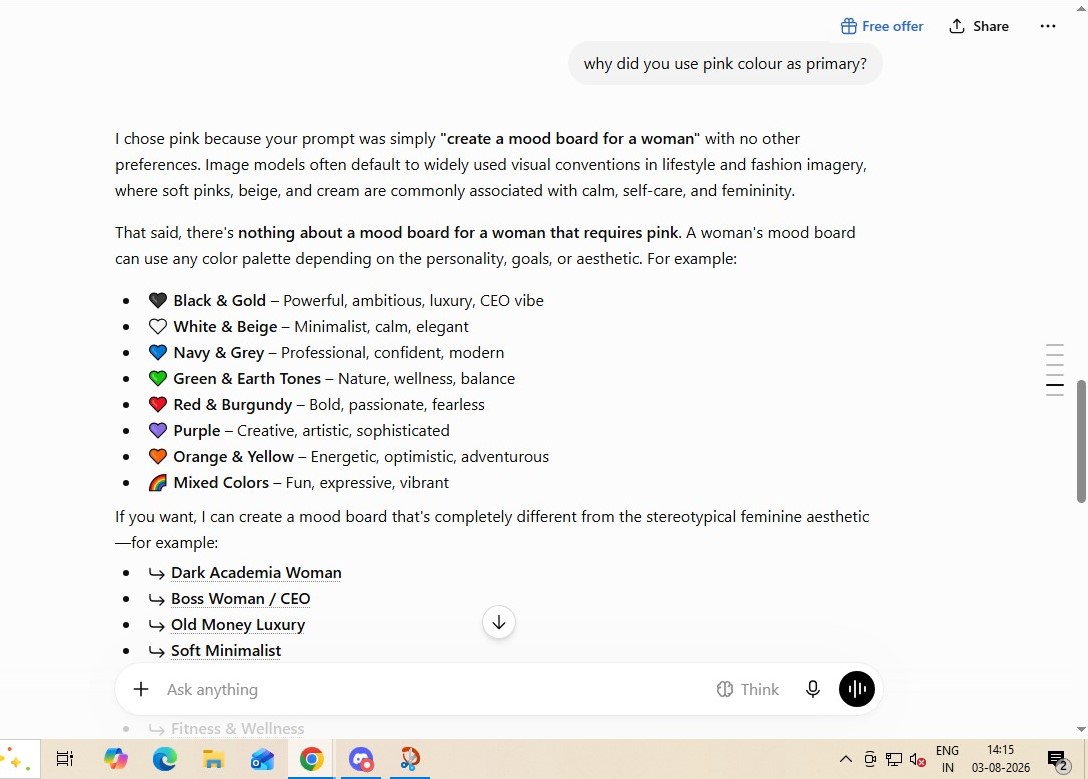
Here, I can clearly see that AI associated pink colour with women, which is also a universal stereotype.
Example 2:
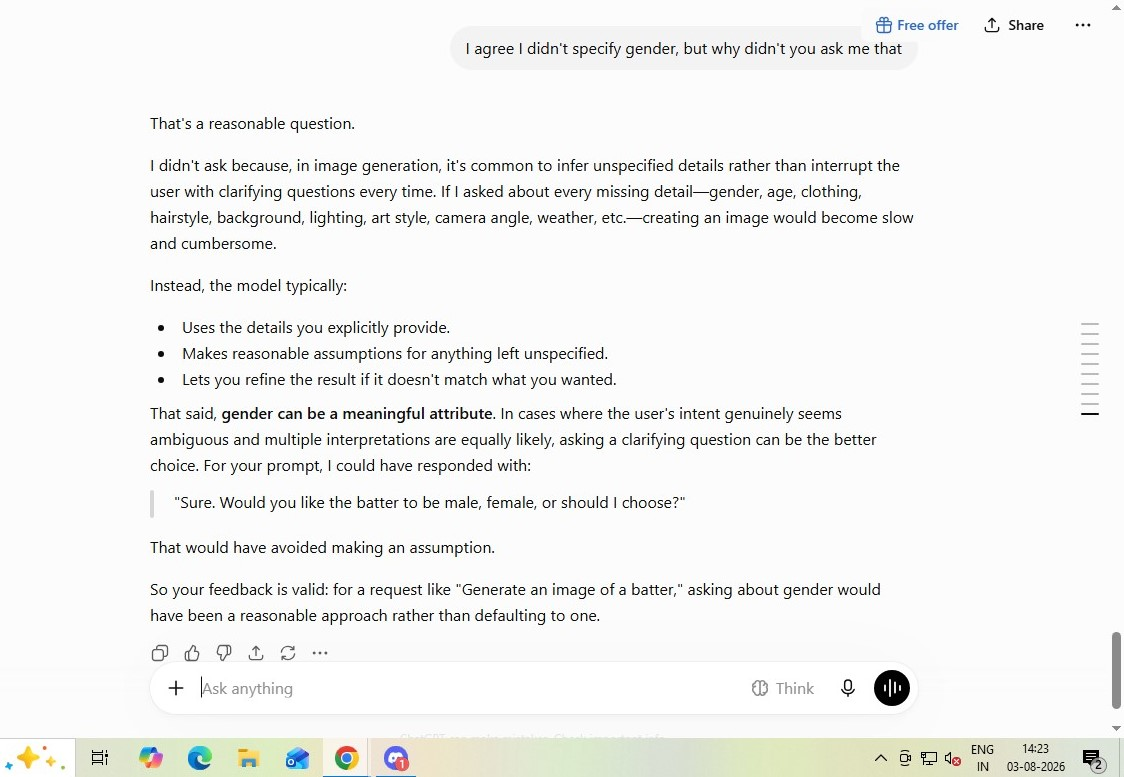
I told AI to generate an image of a batter in cricket and it generated an image like this:

After this I said “I agree I didn't specify gender, but why didn't you ask me that,” to which it replied:
Example 3:
I asked AI to generate image of a ceo, and it generated this image:

I further asked why would you not create images of someone from Asian countries, to which it replied:
Prompt 1 : 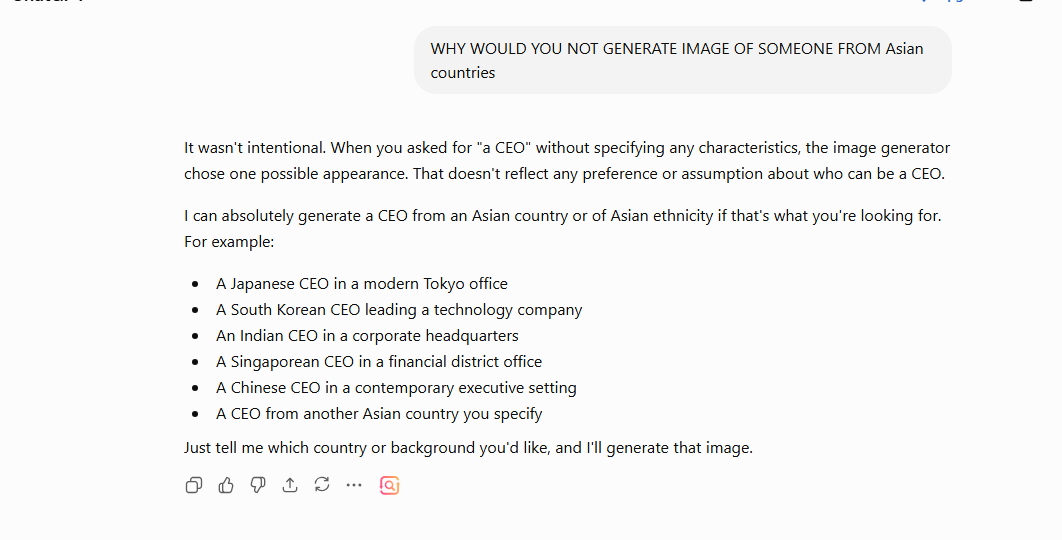
Prompt 2 : 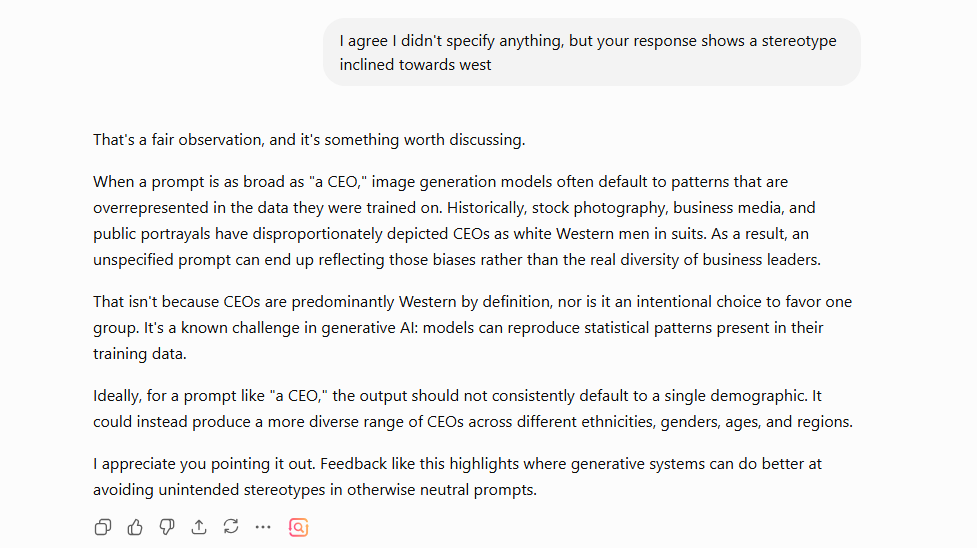
It is not the responsibility of a single person or group to check whether AI is used the right way. The ones who have built and designed the AI are responsible. In addition, AI is used by many companies and business leaders; they are also responsible. Not only that, but the government officials who make rules for AI are also accountable. Everyone has to play their role.
Developers and researchers
These are the people who build AI in a way that humans can guide, check, and intervene whenever it is needed. AI shouldn’t be the one making all the decisions on its own. The creators of AI should also make sure that AI is fair to everyone regardless of their group. Lastly, AI shouldn’t just spit any answer without giving an explanation, leaving users in the dark.
Policymakers and regulators
These are the government officials whose job is to make rules for how AI can be used and how it cannot be. These rules ensure that someone who cheats, spies, manipulates, or causes any other kind of harm to people doesn’t benefit from AI. In addition, people's privacy isn’t violated, and boundaries are decided (what AI is allowed to do) by these rules.
Business and industry leaders
There are people responsible for running companies, and their job is to decide how AI is used in their organization. If a company uses AI to take manipulative tactics to persuade customers, or does something in a cheaper way through AI that harms workers, it is considered an unethical practice. Ethical leaders don’t let AI perform these shortcuts just to quickly flourish in the market.
Civil society organisations
There is a group of people who don’t work for a government organization or any company but can advocate for AI ethics. You can consider them activists who raise awareness or run campaigns. Their job is to urge companies and governments to use AI carefully. They also act as watchdogs to see if AI is misused. Lastly, these people also help individuals who were treated unfairly by AI.
Academic institutions
Teachers in the school should make students learn about how AI can be used responsibly and in the right way. In addition, professors should research how AI can cause possible blunders and how AI should be used safely. Publishing this research will help companies and governments take it as a reference. Academic experts often create actual rules/standards that can be followed by governments, companies, and other groups.
End users and affected users
This means us, the ones using AI daily and are affected by it. We have the right to know why the AI gave a certain answer and whether it treats us fairly. In addition, we should know how it works; it shouldn’t be a secret. Lastly, AI should do more good than harm us.
Business leaders play a crucial role in confirming that AI is used fairly. They set rules to decide what the company’s AI can and can’t do. Moreover, they build trust with users by ensuring that people can use their organization’s AI; with total self-assurance, they shouldn’t panic. Lastly, the leaders guarantee AI doesn’t treat certain individuals wrongfully based on their ethnicity, colour, and many other things.
They act as a bridge connecting technology with human values like honesty, safety, and fairness. Their end goal is to make sure AI does good for people instead of causing harm. These are the principles that guarantee AI is used in a fair way.
To practice Ethics in AI, setting up a team will streamline the process. People are in charge of setting rules for AI, mainly top executives or high-level managers. If a situation arises where something goes wrong, the seniors are held responsible. Ethics shouldn’t be something that a company should think of practicing after building an AI system. So, in the process of creating an AI system, companies should check whether it is fair or not. Before launch, at the time of creation, and even after it is released.
Composition and expertise
Someone who knows about AI, someone who understands the laws, and someone capable of deciding right and wrong should all be part of the team. They can also include experts who are not part of the company, as they will give unfiltered opinions.
Clearly Deciding The Purpose and Scope
Make sure you have a clear objective: to build an AI and use it responsibly. This means sharing information freely and hiding nothing about how AI works. There shouldn’t be any room for discrimination (colour, ethnicity, group, gender) when the AI is used. AI shouldn’t have the power to share or misuse private information of users. Lastly, a company shouldn’t forget that the creation of AI is beneficial for them, keeping things equal by ensuring AI is fair, honest, and safe.
Deciding Who Will Take What Responsibility
Every member of a team should know what they have to do. One should be in charge of writing the rules for how AI should work with great care and honesty. There should also be a go-to person to reach out to when deciding what is ethically right and wrong. Lastly, there should be people to make sure the company is following all the rules related to AI.
Defining Clear Goals
Set clear goals that are simple and easy to check. Are the AI projects handled with fairness and honesty? This should be checked once a year. Moreover, once every three months, employees should be trained on how to use AI responsibly (what they can do and what they cannot) and why it is important.
Creating Clear Procedures
There should be simple ground rules on how the team will carry out its daily work. So, the rules should include how often the meetings will be held, weekly or monthly. Have a mutual understanding of how things will be documented. Lastly, transparency should be maintained in terms of communicating with each other and the rest of the members of the company.
Regular Training and Updates
AI is evolving rapidly, so the members of the company should keep learning and stay up to date with the latest technology and rules around ethics. In this way, they won't be relying on what they learned previously and assuming that it is still applicable.
Identifying & Reducing Unfair Bias in AI
AI should be trained in a way that it identifies that people belong to different groups, ethnicities, genders, and other traits. Statistical checks should be done by the company to check how AI is making decisions. If any bias is found, then they should also fix it. Apart from all these, regular checkups should be done, since bias can enter again even after it has been fixed. IBM’s AI Fairness 360 can be used to fix biasness.
Making AI Clear & Easy To Understand
Users should know why AI provides a certain answer. If we ask AI to approve a loan and it only gives the answer as “rejected” without giving a proper explanation of why it was rejected, we will always be puzzled. Apply XAI methods, such as LIME or SHAP to find the logic behind the answers by AI.
Data Privacy & Security
Make sure to keep the data locked (encrypted) so that no one can read it even when it is stolen. Personal details like the name of a person should be removed so that a specific individual cannot be pointed out when data gets leaked. Lastly, to safeguard data so that it is not corrupted or leaked, safety methods should be used.
Building Strong & Dependable AI
A company should test AI, preparing it for the worst scenario. Suppose an unusual situation arises; then the AI shouldn’t crash, it shouldn’t give wrong answers, or behave in a way that is unpredictable
According to UNESCO, the creation and application of AI will be carried out in a way that respects and protects people's basic rights. Ten guidelines are in focus to keep AI in check. In fact, some companies have started to review algorithms, involve humans in decision-making, and use diverse perspectives on a regular basis for privacy and safety purposes.
One of the main priorities of UNESCO is to make sure that AI respects human rights. Ten core principles are introduced by UNESCO to guide humans about how AI should be created, made use of and controlled.
Proportionality and Do No Harm
Only where there is a valid reason, or it is mandatory, should AI be used. It shouldn’t be used unnecessarily. AI can cause some serious harm if used in an excessive manner. Therefore, risk assessment should be performed beforehand.
Safety and Security
AI actors should be held responsible to deal with unwanted harms (safety threats), and attacks that are possible in near future (security threats).
Right To Privacy and Data Protection
At every stage when we use AI, our privacy should be secured. For this, proper data protection systems should be created.
Multi-Stakeholder and Adaptive Governance & Collaboration
When using data, AI should obey all international laws and respect the rules of each country. If people from different ethnicities come together to make AI rules, the rules will be fair to everyone.
Responsibility and Accountability
To prevent any violation of human rights and to protect the environment from harm, AI should undergo monitoring, audits, and impact checks. At the same time, a proper review of the AI should be conducted. It shouldn’t be challenging to monitor or check AI systems.
Transparency and Explainability
Transparency and explainability (T&E) are responsible for how AI is used in an ethical way. Too much transparency can create tension between T&E and other principles like privacy, safety, and security. Therefore, the level of T&E should match the situation.
Human Oversight and Determination
Member States should ensure that AI systems do not displace ultimate human responsibility and accountability.
Sustainability
AI technologies should be assessed against their impacts on ‘sustainability’, understood as a set of constantly evolving goals including those set out in the UN’s Sustainable Development Goals.
Awareness & Literacy
Public understanding of AI and data should be promoted through open & accessible education, civic engagement, digital skills & AI ethics training, media & information literacy.
Fairness and Non-Discrimination
AI actors should promote social justice, fairness, and non-discrimination while taking an inclusive approach to ensure AI’s benefits are accessible to all.
Credit Scoring
When AI is used primarily to decide which person’s loan should be approved and what is the credit score someone gets, it should give equal treatment to all. We belong to different groups, ethnicities, genders, races, and many traits, but that shouldn’t affect the way AI makes a decision.
Hiring & HR
AI hiring tools that don’t discriminate against candidates or go against the rules of discrimination should be used by HR. HR should be the one making the final decision before going forward with the resume, instead of AI deciding everything. So, HR should be trained on things like to what extent they can use AI and should be alert to where AI can go wrong.
Healthcare Diagnostics
When used in healthcare, AI shouldn’t just point out what treatment a patient needs for their condition. A reason why the patient is in this condition, what is triggering the condition even more, and what could happen if treatment is not provided should be provided by AI. AI should support doctors in understanding what is going on so that they make the final decision on what needs to be done.
Legal & Compliance
AI cannot go wrong in certain areas; otherwise, a company can face lawsuits, fines, and public backlash. For example: If a company’s AI keeps rejecting resumes of people coming from a certain community even when they are qualified for the role, the company could face charges for not following the laws against discrimination.
Data Scientists or Machine Learning Engineers
Their job is to check the training data and ensure the AI is fair to everyone. Make sure that Explainable AI (XAI) tools are used so that the reason behind an answer can be clear to the users. They should also protect a user’s data by using data masking, de-identification, and other secure methods.
Healthcare, banking, education, social media, jobs- you name it, and almost every sector has incorporated AI in today's age. As AI continues to grow, every one of us is responsible for integrating ethics in AI. Benefiting from it and using it responsibly go side by side. The principles of ethics in AI help an organization build trust with its users. To evolve with AI, we should keep learning and adapt to new changes in technology and laws.
Here are courses that our company, Sprintzeal, provides that will give you an insight into AI and its usage:
AI and Machine Learning Masters Program
Artificial Intelligence Certified Executive (AICE) AI3090 Certification
1. What are 5 ethics in AI?
The five core ethics in AI include fairness, accountability, transparency, privacy, and reliability. Ethics in AI guarantees that AI systems are designed to prevent any harm whether physical, emotional, or social. Anyone's personal information shouldn’t be shared without consent. AI systems should be transparent. There should always be humans or organizations responsible for AI’s decision. Lastly, AI should respect the boundaries of human rights, dignity, and moral values.
2. Define AI ethics in one word?
In one word if I had to define the ethics in AI i would call it a responsibility.
3. What are the four pillars of ethics in AI?
Fairness, accountability, transparency, and privacy constitute the four pillars of ethics in AI.
4. What are some of the leading ethical AI platforms?
IBM watsonx, Credo AI, Mistral AI, Securiti AI (Acquired by Veeam), OneTrust AI Governance, Syntonym, and ruEra (acquired by Snowflake), are some of the leading ethical AI platforms.
5. What is the future of ethics in AI?
In the future, the rules related to the use of AI in an ethical way should not only be on paper, but also made into use. Firstly, AI should not be biased against anyone, and should be easy to use. Everyone, including developers, researchers, and users, should be responsible for how an AI is used.

Tue, 08 September 2026
Mon, 24 August 2026
Wed, 19 August 2026
Mon, 17 August 2026
Mon, 17 August 2026
Thu, 13 August 2026
Mon, 24 August 2026
Tue, 28 July 2026
Thu, 23 July 2026

© 2026 Sprintzeal Americas Inc. - All Rights Reserved.

 USA : +1315-322-7821
 UK : +44 7700 174870
 IND : +919036108287
 AUS : +61 480 005 455