Best AI Video Generators in 2027: Tested & Compared
Mon, 28 September 2026
Inspirational journeys
Follow the stories of academics and their research expeditions
Just as when you talk to a person, you can do the same with a computer, all thanks to conversational AI. Grand View Research says that conversational AI’s market size stands at approximately $14.3 B to $17.7 B (2025-2026), and by 2033, it is predicted to reach $78.9 B. AI Prompt Engineer, AI Trainer, Conversational Designer, AI Product Manager, or AI Ethics and Safety Specialist are some job roles that one can get if they want to work in Conversational AI.
Just as you talk to your friends, colleagues, or any other person, you chat with AI the same way. Not only that, you can have a back-and-forth conversation with it: you will ask something, get a reply, and then you can follow up with a question about the response and get another reply. The technology that makes this possible is conversational AI.
Nowadays, you might have come across ChatGPT, Claude AI, Siri, and Alexa; all of these are either chatbots or virtual assistants. The software is engineered in a way that it can figure out what someone is saying and accordingly give a response in a short time.
But how does the conversational AI understand human language?
AI doesn’t understand human language, so it converts something bigger into smaller pieces called tokens. If there are sentences, it converts the text into smaller pieces called tokens and assigns each a numeric ID. For example, if the sentence is “I love cricket,” AI can denote “I” as 035, “love” as 043, and “cricket” as 018.
These are not the exact IDs assigned to words. In addition, a word can also sometimes be broken into pieces. For example: Sprintzeal can be broken into “sprint” and “zeal.” This process is called tokenization. In addition, AI learns patterns and relationships from data (which words usually appear together, how sentences are structured generally, and how people will answer this question). For example, we humans learn a language by continuously hearing and speaking it.
We don’t have to know all the grammar rules to guess which word to speak next. In the same way, AI does the guessing by learning from different patterns in almost everything ever written. AI guesses what word will come next, then next, then next, over and over each time. In this way, you first get a sentence, then a paragraph, and finally the full result.
In addition, AI also keeps track of its current conversations with users and uses the contextual awareness to generate responses that fit naturally and are connected.
Machine learning is a part of AI. It is the way in which AI learns from experience. AI learns from the examples it sees rather than being programmed with a set of instructions to perform a task daily. The more examples an AI sees, the better it becomes at recognizing patterns. With the help of these patterns, it predicts what to respond with in new circumstances.
For example: If you go to Help on an e-commerce platform and ask, “Why hasn’t my package arrived yet?” AI would respond by being apologetic for the inconvenience, and an available agent will text you shortly. Here, AI is not taught word-for-word how to respond to a text; instead, it replies based on the pattern it has learned from similar conversations. It predicts the answer that fits naturally.
Deep Learning (DL)
It is a specialized branch of Machine Learning. DL uses neural networks.
But what is a Neural Network?
A neural network is a system with artificial nodes connected in layers. Information passes from one layer to another. It doesn’t work like a real human brain, but it is inspired by it. It learns from huge amounts of data from text, audio, and images without needing much human guidance.
Consider it a student who learns from seeing more examples rather than being fed specific instructions. A student will recognize a dog after seeing many dogs. He/she will recognize the pattern (a dog means four legs and a tail like that). A neural network learns patterns from data and uses them to make decisions.
Each layer has to do a specific job. The first layer picks up basic stuff (just the outline, individual letters, or basic word patterns). The next layer notices more complex things and combines them into something meaningful (combining letters to form words and then sentences, or recognizing grammatical patterns). Layer by layer, the understanding of complex things increases, adding more meaning to the response.
For example: The first layer will see the lines and edges of a picture; the second layer will recognize the shape of the objects (a square and four cylinders); the third layer will recognize more, and finally it will recognize the object as a dog.
Transformers
Generative AI, Natural Language Processing (NLP), Deep Learning, and Large Language Models (LLMs) are connected in Modern AI with the help of a technology called Transformers. Transformers work differently; they read the whole paragraph or conversation at once. It interprets how every word is related to the others, no matter where they are placed close or far.
For example, if this is the sentence: “Selectors break silence on ROKO's performance, explaining why they had given them rest.”
Here, who do they refer to? If AI only relates words next to each other, it will refer to ROKO as they, as the word is near to ROKO. Which is a wrong guess. A transformer reads the full sentence and figures out how words are related to each other in the sentence, no matter where they are placed, so it will correctly figure out “selectors” as they. Selectors are the one taking the decision to rest ROKO, and not the other way around.
This technology allows AI to pick context from one sentence, and remember it and connect references across the whole paragraph or whole conversation. AI figures out what you are trying to say based on the conversations you had with the AI earlier, and not just your latest message.
Generative AI
Generative AI is a specialized branch of deep learning that creates fresh content. In conversational AI, this means AI improvises and creates fresh answers rather than choosing from a script of answers already written in advance. That is the reason why the answers you get from an AI sound like a human being talking to you.
For Example: Think of an actor. An actor is given a script. If an actor only reads the lines of a script, it will look like someone has mugged up the dialogue. But if they improvise during their dialogue delivery, it makes the acting more real and natural. Generative AI is the improvised actor, it draws from the permanent patterns it has learned during the training, and combines it with the content of the current conversation to generate unique content.
(NLP) Natural Language Processing
Earlier, NLP systems were a group of separate tools, each one used to perform different duties. One would figure out what you are saying; the other one picked up important details (names, places, or dates); another would figure out the emotional tone (positive or negative); and another tool would create a reply keeping all of those things in mind.
However, in modern conversational AI, Transformers are the engine that makes modern NLP possible. Now, all the work happens inside one single model. This is why modern conversational AI is natural to have a conversation with. Moreover, it is also smoother and smarter.
(LLMs) Large Language Models
LLM is an advanced AI type that is built on transformer technology. It has a huge number of parameters (more parameters=more capable of complex and subtle patterns). LLMs are trained on massive amounts of text, which helps them to remember longer conversations. The brain behind how AI responds is the LLM. When you give a prompt, the LLM reads the whole text, figures out the words and your intent, and creates a response based on that without applying a specific rule for every possible situation.
(ASR) Automatic Speech Recognition
When we speak, our voice creates sound waves, meaning vibrations that travel through the air. When we speak into a microphone, it picks up our voice and converts it into a digital audio signal, recording every single detail, like when your voice drops and when it rises, and whether it is fast or slow.
The software then breaks your voice/ audio recording into tiny pieces; sometimes each piece is a fraction of a second. Then the software studies the frequency of each tiny piece. For example, when “S” is spoken, it sounds sharp and hissy; similarly, “M” sounds low and like someone is humming.
Every letter has a different sound, just like fingerprints. By studying all these, the software recognizes patterns and interprets what you are saying. First, it gets to know the sounds, then forms them into words, and then sentences.
To be accurate in its judgement, the software doesn’t just rely on sounds but also meaning. For example, “flour” and “flower” sound the same but have different meanings; here the software doesn’t just guess the word based on sound, but also checks the words nearby in the sentence to decide if the word fits where it makes sense.
For example: If you say: "I bought some ___ to bake bread,"
The software sees words nearby in the sentence like “bake”, “bread”, and “some,” and it will realize that it is about baking, not gardening. Hence, it will fit flour in the blank space.
Finally, after the software has done all these steps, you will be able to see what you spoke on your screen. The software is called STT (Speech-to-Text) software, OR also known as ASR (Automatic Speech Recognition).
TTS (Text-to-Speech)
You might have heard Alexa or Siri replying to you in voice. Text-to-Speech (TTS) is basically the technology behind the voice of a robot that replies to you. When AI needs to talk to you and not just reply to you in text, this technology comes into the picture.
You might have heard that the AI assistant talking to you pronounces the words in the same manner as you, in the same speed, and in the same tone as how it should be pronounced. TTS adjusts these things, making the conversation sound natural and making it feel like talking to a human.
Customers are not the only ones for whom a conversational AI is worth using. In businesses, conversational AI is supportive for the employees as well. Here are some of the examples that will show you how businesses use conversational AI within the organization:
Human Resources & Onboarding
A conversational AI helps new employees by guiding them through formalities (fill out certain forms, what training they need to do, and what the rules of the company are that need to be followed). It also lets an employee know about the benefits and payroll (health insurance, the number of leaves they can apply for, and payslips). HR doesn’t have to guide them manually through everything mentioned.
Lastly, conversational AI helps to get feedback (check-in surveys and exit interviews) from employees.
IT & Technical Support
If an employee has forgotten their password, conversational AI can help them reset their password and recover their account without needing help from the IT team. It handles requests like getting new software, license approvals, or access to certain tools/systems. Moreover, it can help employees to fix simple things like restarting a router and checking a network connection.
Operations & Knowledge Management
Instead of employees digging through all the folders, a conversational AI can help find a particular document, project updates, or company guidelines. Not only that, it helps with reporting expenses (travel reimbursements, filling out expense reports) and scheduling meetings according to everyone’s calendar.
Knowledge Base
Employees can use conversational AI to get answers to their queries. Conversational AI can be connected to a company’s files and systems, and that is how it pulls information about the business directly from the company’s data. So, if an employee wants to know how many people from the US visited their website, they can have an online chat with AI and get a response in return. The headache of putting in the effort to go through reports one by one will be relieved.
Co-pilot Assistant
Employees can build their automated workflows by simply describing what they want to the AI in simple English. A co-pilot assistant understands and builds the automated workflow from beginning to end. No coding is required.
Step 1: What Questions Do Your Customers Generally Ask?
The first and foremost thing to keep in mind before building an AI chatbot is to know what type of queries are generally asked by people. This will make things easy for you to be aware of what your bot chat AI will be able to handle. In this way, it will lift the pressure on support team employees to do repetitive tasks and answer general questions easily.
But first, you must know what the questions are. So, ask your support team what kind of queries they respond to on calls and messages daily.
For Example: If you belong to a banking corporation, the common questions from customers that you come across may be:
Just pick a small number of questions that are common and start building your online talking AI or chatbot. You can add more questions later; obviously, as time progresses, you will gain more and more knowledge of how an online talking AI works. Don't forget what the customer needs.
Step 2: Use FAQs To Understand The Purpose & Scope?
If a customer asks you How can I recover my account? It can also mean the customer wants to log in to their account, they have forgotten their password, and it could also mean they are not able to access their account. These questions look different but have almost the same meaning. So, it is very important to analyze the intent (what does a customer actually want?) behind a question.
A chatbot should be capable of recognizing this. Therefore, the analytics team and the support team should work together. The analytics team can look at what customers are actually typing in the search bar when visiting the company’s website and in past conversations through chatting/calls with them. This digging will help the analytics team to figure out how customers phrase their queries.
Second, your support team chats or talks with your customers daily, so they know how customers raise queries (the words used in daily conversation are not formal). A support team has personally heard or chatted with the customers (instead of “debit card”, they can say “my card”, and instead of “access my account”, they can say “I want to log in to my account”). Therefore, they can help the AI chatbot recognize how the same query is raised in different ways.
Step 3: After You Know The Intent Incorporate relevant keywords and supporting terms
Now, since you have understood the intent (what a customer wants), it is also important to know the relevant keywords (entities) and supporting terms associated with the intent. Here, we have taken a bank as an example; some relevant keywords (entities) related to it are Username, Password, and Account Number. Now, how will you find these keywords? The analytics and support teams have already done their research, so they would come across specific words (entities) appearing many times during that period.
Step 4: Use All These To Create A Conversational AI
Now that the intent is clear along with the entities that need to be used, it is time to create an AI chatbot or online talking AI by putting them together. While intent helps a conversational AI to understand what a customer wants, entities help the conversational AI identify specific keywords so that it can give a precise answer that actually solves a user’s problem.
Conversational Chatbot
AI talking to people through text is a chatbot. Incredibly famous ones are ChatGPT, Claude, and Google Gemini. These chatbots are built using advanced technologies such as NLP (Natural Language Processing), NLU (Natural Language Understanding), NLG (Natural Language Generation), ML (Machine Learning), LLMs (Large Language Models), and Dialogue management systems help conversational AI maintain context, understand the flow of a conversation, and decide what response or action should come next.
Therefore, because of LLM, they have a larger context window; they can understand the intent behind a prompt, handle complex problems, and give unique responses instead of just giving the usual basic answers.
For Example: I asked ChatGPT What is the meaning of “Raining cats and dogs,” and it replied me like this:
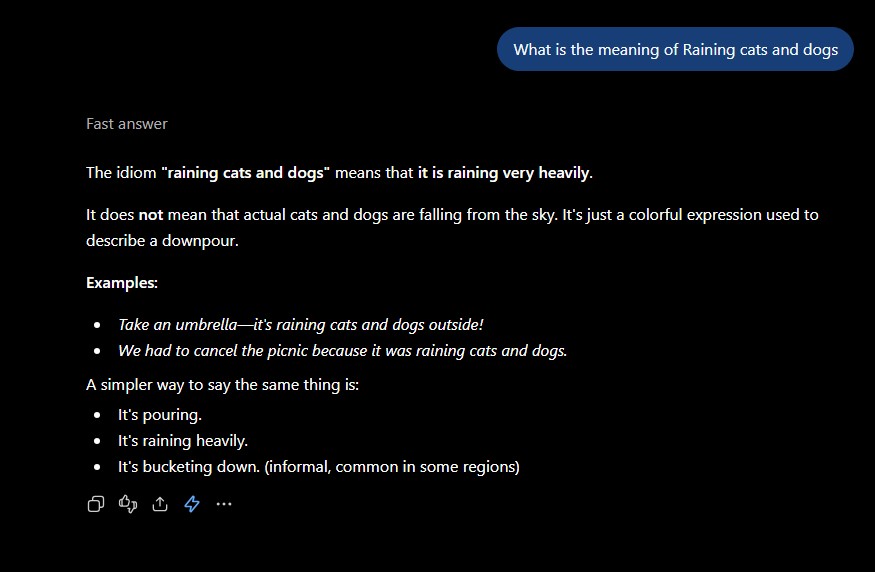
AI understood the intent and didn’t give me the literal meaning.
Example 2: I asked Claude AI “Tell me what is a no ball, wide ball, dead ball, and other balls in a tabular form with every details related to it”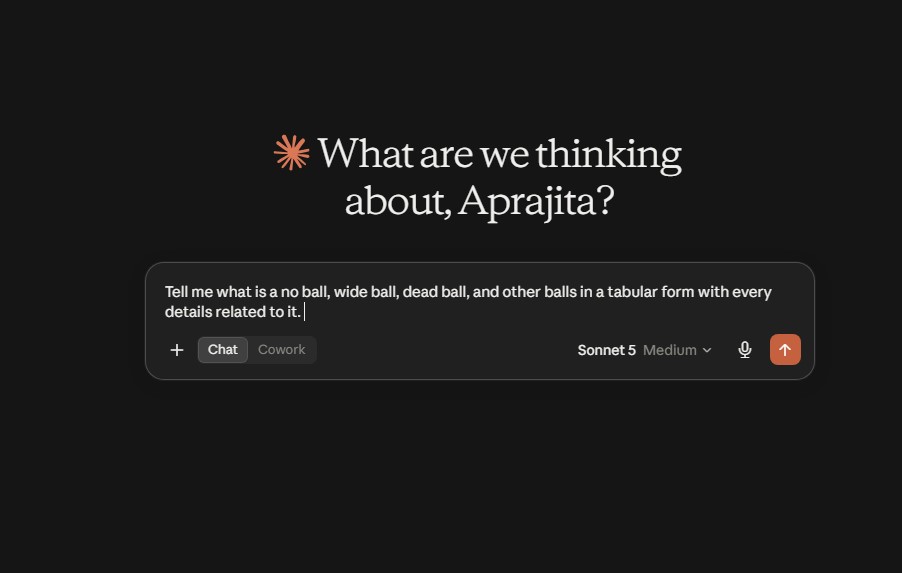
This is how it replied
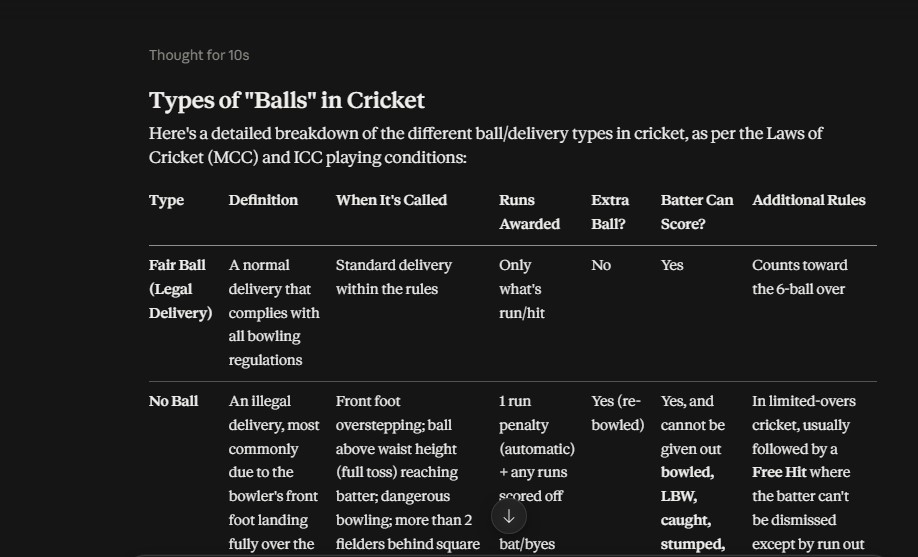
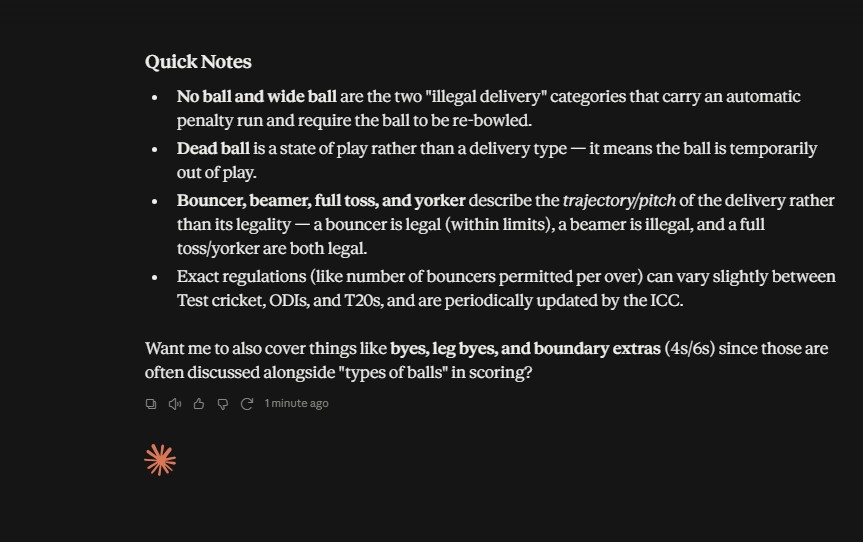
Here you can see it understands what I am asking for and how I want my data to be arranged. I didn’t even mention it is about cricket and it knew.
Voice Assistants
Using this type of conversational AI, you can directly talk to the AI using your voice. Alexa and Siri are noted virtual assistants. You can just tell it to do things like switch on the lights, turn off the lights, or even tell it to set reminders or check your calendar.
In addition, you can also ask any other question, like a weather update, news, or any other general question. You can connect the virtual assistant to your phone and any other smart devices and control it hands-free.
Example: I asked Siri To set an Alarm, and the result was this:
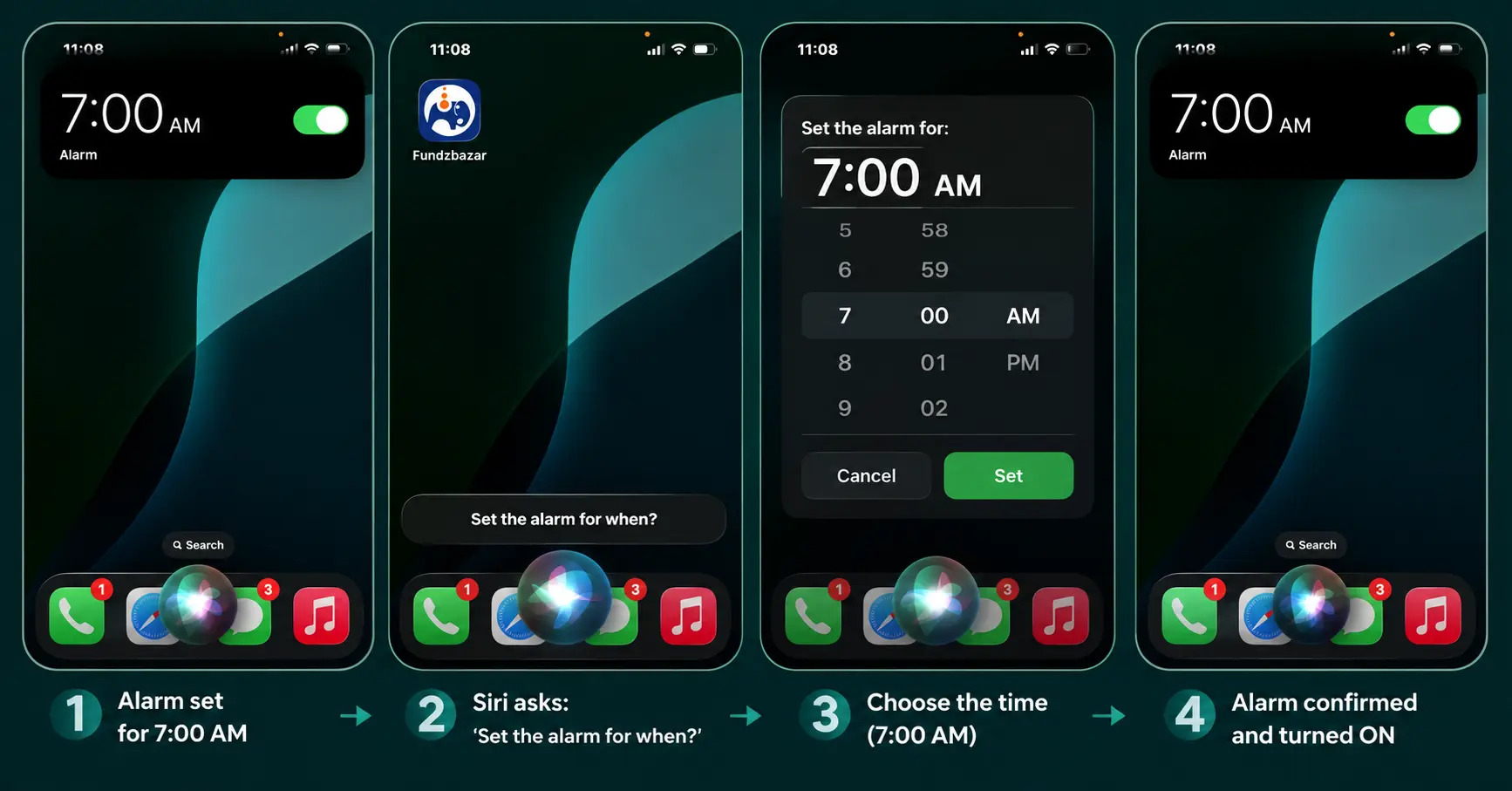
AI Assistants
Ever heard of a copilot assistant? It is a type of conversational AI mostly used by an organization to help employees perform everyday tasks. The copilot assistant is connected to the company’s documents, data, and systems so that it gains knowledge about the business. For example, this AI tool can create analytics reports, suggest code, and also handle repetitive tasks.
Other Types
You might have chatted in the help and support section of an e-commerce website. In malls or restaurants, you might have ordered without talking to anyone (restaurant kiosks). All these are also conversational AIs. Then there are also store Kiosks, which are basically touchscreens in malls that help you find shops or map out your walk.
Here is my personal experience with a shopping app when they said they delivered my order, but it wasn’t at the expected address. The app’s own Chatbot responded to my query and connected me to an agent to talk to.
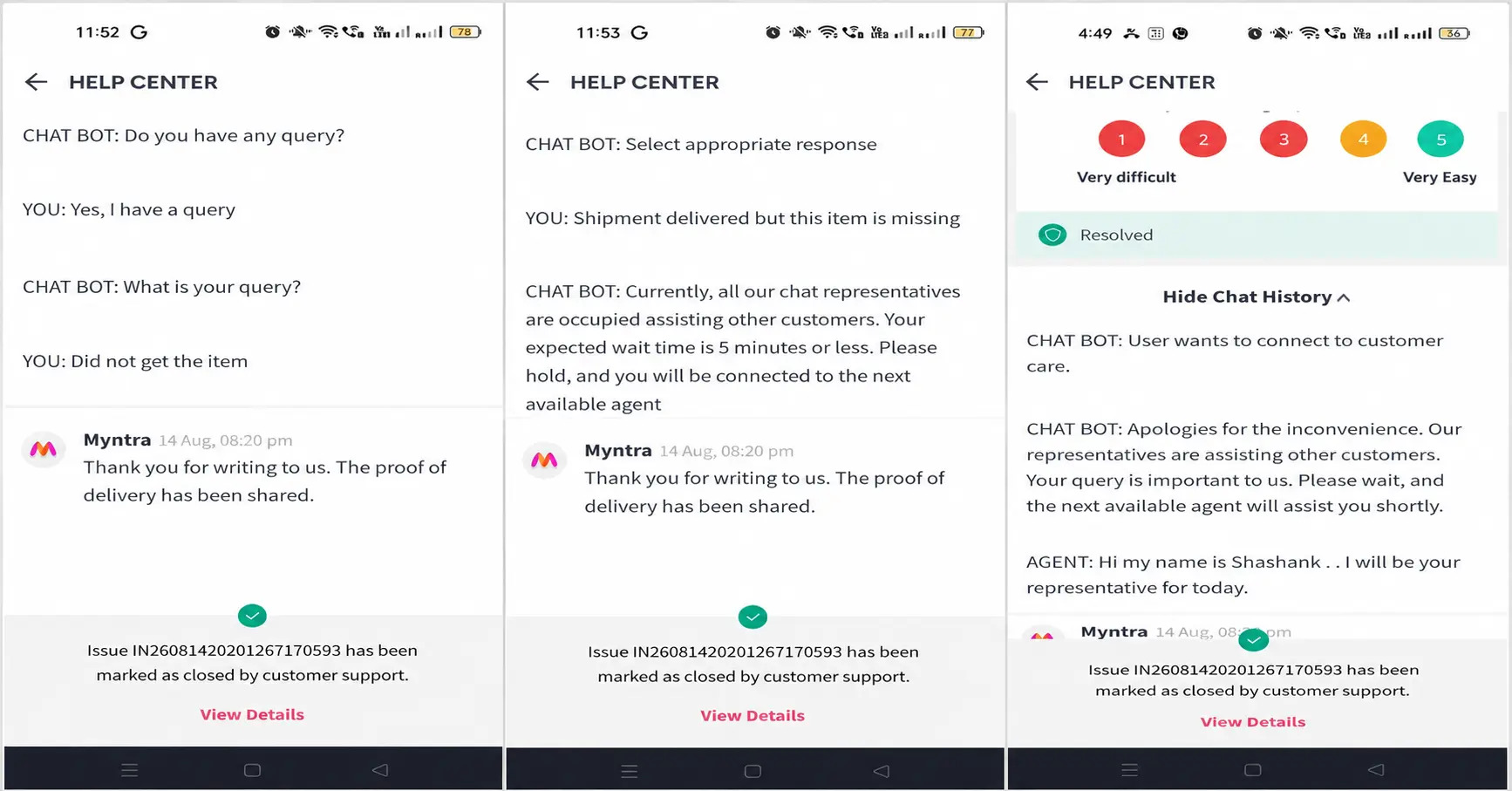
This is how a restaurant and a mall’s kiosks looks like:
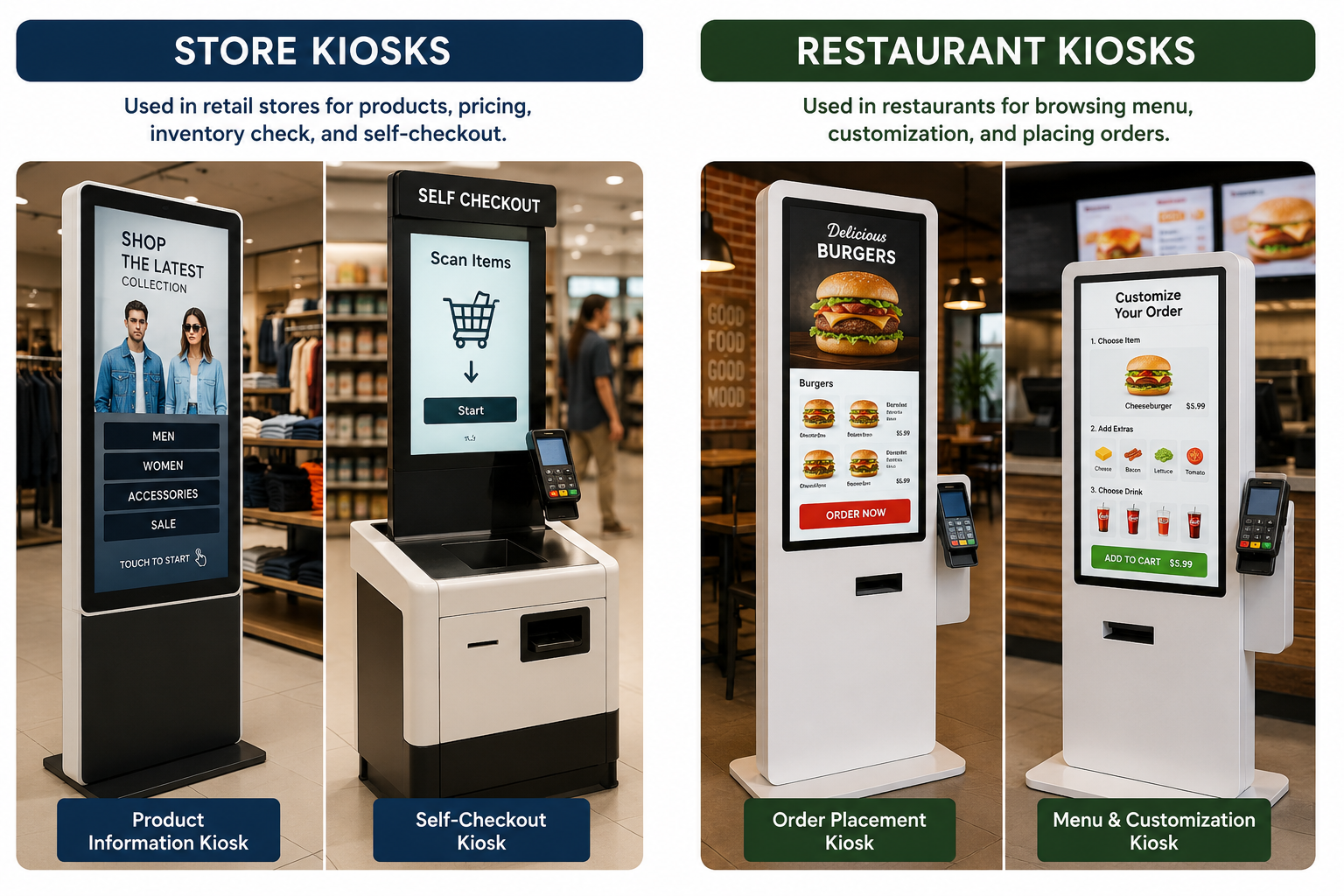
You might have talked to an AI through text or through voice. You might have communicated with the AI back and forth. You might have asked a question; the AI must have replied, again you might have asked another question related to the same query; the AI might have again provided a response.
When you constantly talked with the AI, you might have felt like talking to a real person. This is what conversational AI is built for: talking and understanding what you are trying to say.
On the other hand, Generative AI is like a machine that creates new/fresh content, ideas, images, some code, music, and many more things based on the patterns it has learned.
Fun Fact: Conversational AIs use Generative AI to create unique content.
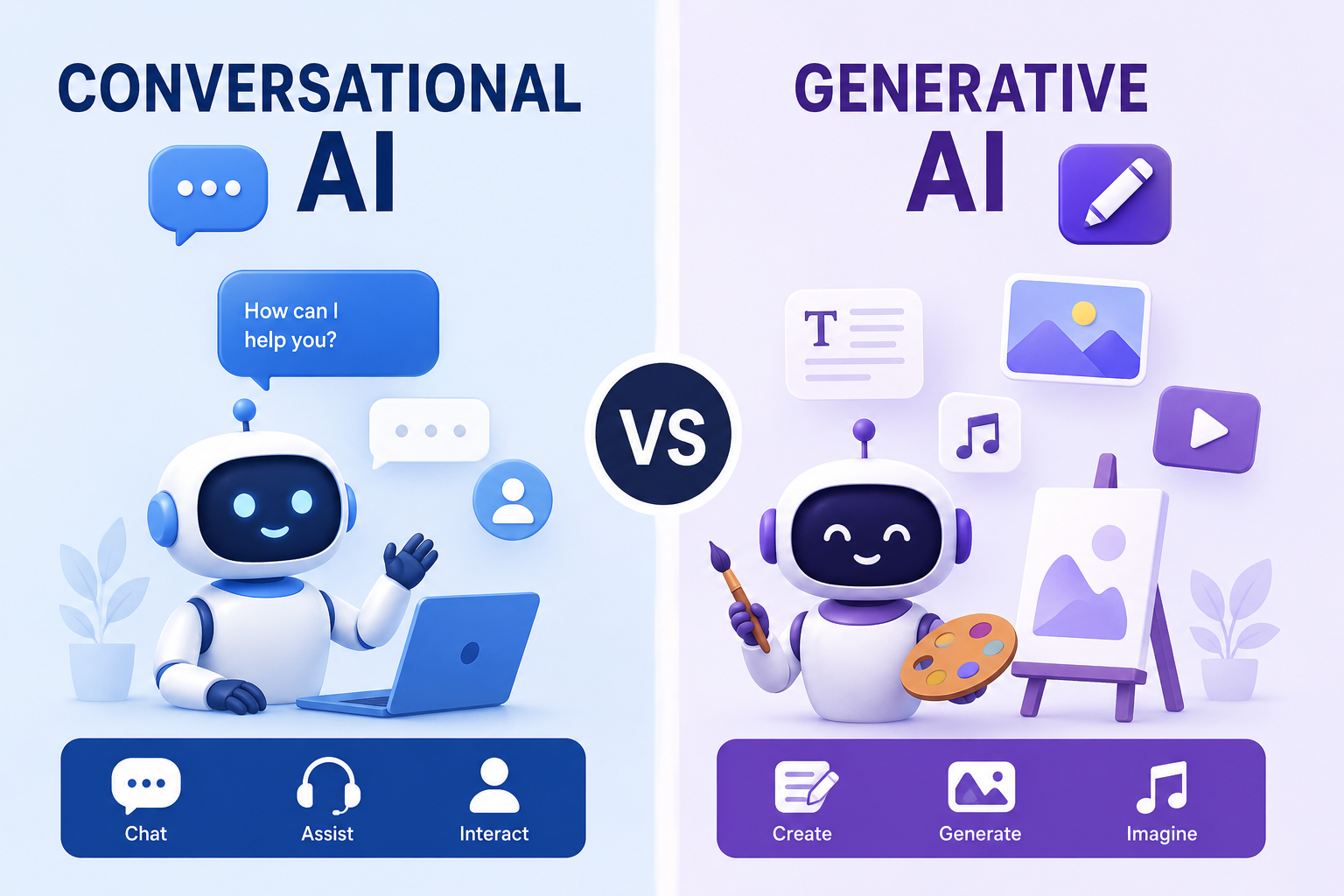
Comparison Table
|
Feature |
Conversational AI |
Generative AI |
|
Main Goal |
Lets you have a conversation (talking and chatting) with a computer |
Create fresh/unique text, images, some code, or media |
|
Primary Input |
Typed messages or your voice |
Prompts, text, or multi-modal files |
|
Output Type |
Replies that make sense based on what you're talking about |
Fresh, original content that didn't exist before |
|
Core Tech |
Natural Language Processing (NLP) and intent recognition |
Deep learning, transformers, and neural networks |
|
Common Uses |
Customer support bots, virtual assistants |
Writing copy, generating art, drafting code |
Customer Service and Support
AI voice bots are capable of picking up calls and handling basic queries. Suppose a customer asks to check their account balance to track an order; voicebots can handle these. It also helps agents in giving the customers more information.
Suppose an agent is on a call; AI can listen to the call and help in providing more details during the call so that the agent doesn’t have to cut the call, hang up, check for details, and then call back.
Conversational AI is also capable of writing a summary of what has been discussed on the call and updating the company about it.
Healthcare and Patient Care
Artificial intelligence chatbots can ask multiple questions to patients and learn about their symptoms. If the symptoms suggest urgency, patients can flag it as priority for their checkup. AI also helps to book appointments; if a patient wants to cancel, reschedule, or schedule, they can directly type or give simple commands to the AI.
Conversational AI can also be used to send reminders to patients, like taking medicines on time or following a recovery plan.
Retail and E-Commerce
If you search for a product on a shopping app, you might come across some things like more from this brand, more of the same colours, followed by similarly looking clothes cataloged underneath. AI does all of these based on your past searches, preferences, and budget. AI can also help you track your order. You will know if it shipped, was dispatched, is out for delivery, or delivered.
Lastly, AI can also automate the process of exchanging or returning your products, without needing a human to guide you.
Banking and Finance
AI can notify you if there is any unusual or suspicious activity taking place on your account. It sends you alerts. Instead of visiting a bank or calling customer service, you can simply use voice or text to check your account balance, transfer money, or activate a new debit/credit card all by yourself.
Moreover, conversational AI can check whether you are eligible to take a loan. It can tell you the EMI amounts and interest rates. You don’t have to visit the branch physically. Conversational AI can send you reminders to pay your EMI before the due date. In this way, you can avoid paying late fees or missing any payments.
Cost efficiency
Chatbots can help companies reduce costs by not hiring many people for the support team, as AI itself can be the one. AI responds in quick time and is available 24/7. Since most queries are general and asked many times, AI can handle them easily.
Increased sales and customer engagement
AI can study the preferences and likes of a customer and suggest products based on that. Therefore, you can also see products that you were not searching for or planning to buy. This is called cross-selling. It helps to boost the sales of a business by introducing customers to relevant products they may not have considered on their own.
Scalability
One big advantage of conversational AI is that it's easy to scale up-meaning if you suddenly need more support capacity, it's much cheaper and faster to expand your chatbot system than it would be to hire and train new human employees.
Language Input
If there is one language, we speak in different lingo, accents, dialects, and background noise is also a concern when it comes to speaking to an AI. AI might have a problem understanding or catching a phrase. Emotions, tone, and sarcasm make it difficult for conversational AI to understand the meaning behind what a user is saying and respond appropriately.
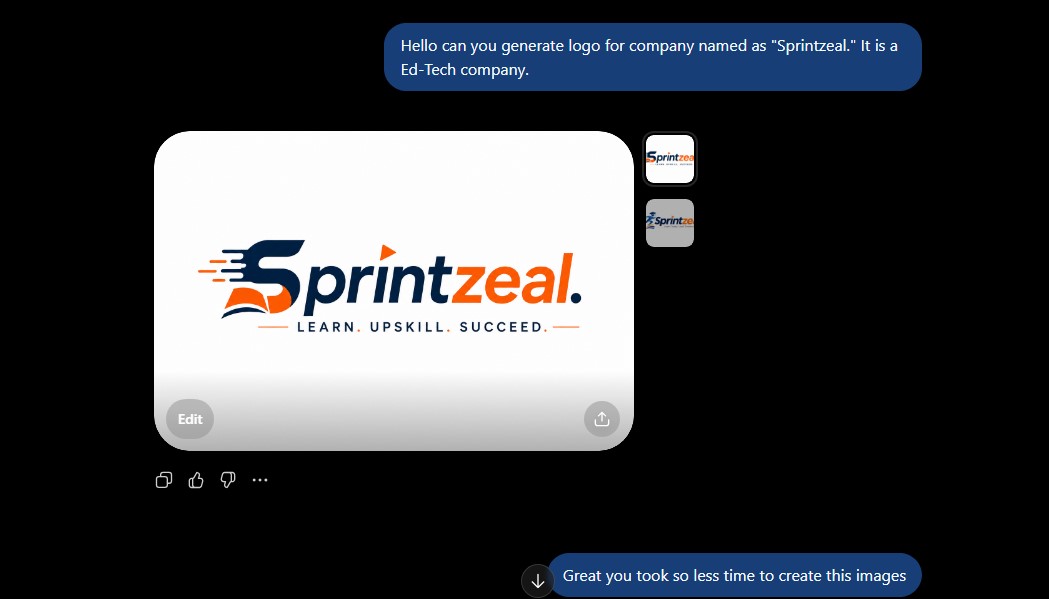
Real life Example: I asked ChatGPT to create a logo, it was created but took a while. To which I replied “Great, you took so less time to create these images.” ChatGPT did not understand the sarcasm behind my response.

Privacy and Security
Since conversational AI can read our prompt, which also includes documents and files of your organization, there might be a possibility that AI can breach privacy.
User Apprehension
As AI is capable of reading the documents that we upload, some people might pause or think twice before uploading it. AI is also not a real person, so some people might not trust it. So, it is the job of businesses to educate people about how AI is safe and can be useful in many ways without breaching their trust.
Moreover, sometimes AI cannot understand exactly what is being asked; a human is required at that time. Lastly, since AI is capable of doing some tasks faster than humans, it is slowly taking over some of the roles. So, AI might spark backlash from many companies.
Conversational AI is a technology that lets you have a conversation (talking and chatting) with a computer, just like you would with a friend or anyone else. Nowadays, you might have come across ChatGPT, Claude AI, Siri, and Alexa. Conversational AI not just helps users, but also helps employees within an organization. While it has advantages it also has limitations.
Nonetheless, our organization “Sprintzeal” offers courses on AI. The course runs in 40+ cities worldwide. Here you will find all the details related to live classroom training and corporate training. Moreover, the course is led by experts with experience in real-world case studies and projects.
It also includes hackathons, practice labs, study materials, mock tests, and 24/7 learner support, preparing you for in-demand AI roles such as AI Engineer, Machine Learning Engineer, Data Scientist, and AI Developer. Here is the course:
AI and Machine Learning Masters Program
1. What are the limitations of conversational AI?
AI understands language, but sometimes it cannot detect the same language with different accents, lingo, or dialect. AI is not good at sentiment analysis. It is not emotionally intelligent. AI can also breach your privacy. You need to be careful.
2. Which conversational AI is best?
The best AI for you depends on your needs. ChatGPT is useful if you want new content in simple language, want to generate an image, or want to convert voice into text. On the other hand, if you want any explanation in depth you can opt for Claude AI. For coding, Claude AI is also the best. Lastly, Gemini fits naturally with Gmail, Docs, or Sheets. So, it can work with you to summarize the last few emails and create a sheet from your data.
3. Give some examples of conversational AIs?
Text Chatbots: ChatGPT, Claude AI, Google AI chatbot Gemini. Voice Assistants: Siri, Alexa, and Google Assistants. Business and Banking bots: Erica, and Airline Support bots.
4. Which type of AI is ChatGPT?
ChatGPT is a generative AI chatbot powered by a Large Language Model (LLM). Built by OpenAI, it uses deep learning and a transformer architecture to predict text and create human-like responses.
5. Can I talk to google conversational AI?
Yes, you can talk to Google's conversational AI using voice or text through Gemini, Google's primary AI assistant.

Mon, 28 September 2026
Tue, 22 September 2026
Tue, 08 September 2026

Mon, 24 August 2026
Wed, 19 August 2026
Mon, 17 August 2026
Mon, 17 August 2026
Thu, 13 August 2026
Mon, 24 August 2026
© 2026 Sprintzeal Americas Inc. - All Rights Reserved.

 USA : +1315-322-7821
 UK : +44 7700 174870
 IND : +919036108287
 AUS : +61 480 005 455