What is ChatGPT?
OpenAI is the company that created the conversational AI or chatbot called ChatGPT. Like while having a conversation, one can chat with this AI chatbot or in a simpler way a computer program and receive a response. An individual using this AI tool can ask a question, and it will reply. One can even ask to simplify the concepts in layman’s language, and one will get a response accordingly. Also, for other tasks such as generating computer code, creating images, and examining a file or a photo, ChatGPT has a response to all of these.
How ChatGPT Works?
Google is a search engine that provides information when we type queries into the search bar. What it does is it looks for webpages on the internet related to our query. In the process, an algorithm is used to display the most useful and related webpages from top to bottom. On the other hand, you can call ChatGPT good at guessing.
The answers provided by ChatGPT sound like a human has written them because it applies the knowledge it gained during its training period. So, whenever we give a prompt, it recollects what it has learned and gives us the answer.
Important Features And Capabilities Of ChatGPT
- Text & Conversation: If you want ChatGPT to write an email for you, it will; it can also help you compress long-text content, help in creating new ideas, and also help to translate a text.
- Multimodal Actions: If we upload any documents, images, or even spreadsheets, ChatGPT has the ability to examine them. In addition, the AI tool can also help in creating an image and a code as well.
- Work Agents: ChatGPT can also perform tasks such as creating presentations and websites or structuring data by getting access to a user’s Google Drive, files, and Gmail with the help of advanced versions.
What Is GPT-4?
GPT-4 is an advanced multimodal large language model (LLM) created by OpenAI. Why is it called multimodal? Because it is capable of handling different types of inputs. Users type a question to get a response, which is one type of input, and the other is when users upload an image expecting an apt response regarding it. GPT-4 is capable of reading both. If a user uploads an image in which a math equation is scribbled, GPT-4 can run a quick scan and solve the equation.
Moreover, if a user uploads a document or enters a prompt that consists of words exceeding 25k or more, GPT-4 has the ability to comprehend it without forgetting the details from the beginning. GPT-4 can also write code, fix in case any coding error occurs, and explain the working of code in various programming languages.
Well, GPT-4 acts as the brain that operates behind the scenes for many AI-powered products and applications.
Important Features And Capabilities Of GPT-4
- Multimodal Processing: GPT-4 is not just capable of reading, but also of seeing. So, it can read texts and at the same time also analyze images, charts, and diagrams, summarize them, and answer questions related to them.
- Advanced Reasoning: Compared to other models, the older ones, GPT-4 has a better understanding of complex instructions. Moreover, it has scored in the top 10% on many professional and academic exams like the Uniform Bar Exam and different AP tests.
- Extended Context Window: It can understand a single prompt consisting of 25,000 words or more in some versions. In this way, they can summarize lengthy text, code, or documents without forgetting the details from the beginning.
- Enhanced Steerability: Users can give instructions about which style they want their final output to be. The tone and style of writing can be specified to AI, and it will follow the instructions more accurately and consistently than older versions.
Evolution of GPT Family
The launch of GPT-4 was in March 2023. After that, OpenAI has produced several versions which consist of the latest features and give improved performance.
- GPT-4 Turbo: This is a faster version that is capable of handling larger texts in one go and provides a response within seconds..
- GPT-4o: This version can handle it all. From text to audio, and images or videos, without any delay and without depending on separate stitched-together tools.
- GPT-4o mini: It is a cheaper version a little smaller but still provides the desired output.
GPT-4 vs ChatGPT: The Key Differences
GPT-4 vs ChatGPT Comparison Table
|
Feature Comparison
|
ChatGPT
|
GPT-4
|
|
Speed
|
It is a simple and user-friendly chat interface that gives rapid responses
|
The speed actually depends on the application using the GPT-4 model. Generally, it is fast.
|
|
Cost
|
It offers a free plan. There is also the option of plus and pro subscriptions to take advantage of advanced features.
|
It is an AI model that works behind an application. It is not an independent product itself. Therefore, to get access to its service, an amount needs to be paid, or it is available through an API.
|
|
Reasoning & Complexity
|
This platform gives the best response when asked to write an essay or article, code, and do the day-to-day tasks with the help of GPT-4 and the latest versions.
|
Logical reasoning, solving complex problems, and comprehending heavily text-based prompts are its strengths.
|
|
Multimodal Capabilities
|
ChatGPT is capable of creating images, text, voice, and files. But it depends on the subscription that is selected and the features.
|
It has the ability to comprehend a text and an image as well. Everything depends on how an application has implemented GPT-4.
|
|
Context Window & Memory
|
When the memory feature is on, ChatGPT remembers the preferences of a user and maintains them in future conversations with the user.
|
There is no built-in memory until the application includes it as a feature. However, it supports long-text understanding.
|
|
Accuracy & Safety
|
It has safety measures and features. The memory feature is present, but users can turn it off if they want to. It is frequently updated by the developers to improve accuracy.
|
It is designed with robust safety measures and high accuracy. However, mistakes can still occur from time to time.
|
GPT-4 vs. ChatGPT: Model vs. Application Comparison
|
Feature
|
GPT-4 (API/Model)
|
ChatGPT (Application)
|
|
What it is
|
It is the brain that reads questions and creates answers. It can be accessed through an API.
|
It is a chatting interface where users chat with the AI directly to get their answers.
|
|
Image support
|
Multimodal: understands text + images
|
Image upload + generation (DALL-E)
|
|
Coding
|
Strong, but superseded by GPT-4.1/5.x
|
Depends on selected model
|
|
Voice
|
Not available via API
|
Built into the app
|
|
Browsing/web search
|
Not native to the model
|
Integrated in-app
|
|
File upload
|
Not applicable
|
Supported in-app
|
|
Context window
|
32K or 128K
|
Depends on active model
|
|
Current Status (As of July 2026)
|
Legacy; retired from ChatGPT app, still on API
|
Actively developed: GPT-5.6 is current
|
Use Cases Of GPT-4 vs ChatGPT
Where GPT-4 Can Be Used
- Custom AI Tooling: It can be used to create custom AI tools that can be used for someone’s personal business and also for customer service automations. In fact, it can also create a writing assistant that can write in the same tone a company wants it to.
- Large-Scale Data Processing: It can be used for extracting data automatically. It has the ability to figure out an emotional tone behind a text. Moreover, it can read long documents and sum it up into short summaries.
- Third-Party Integrations: You can directly integrate AI capabilities into the software and workflows you are using rather than using AI as a separate tool.
Business Applications
- Customer Support: The query that everyone has in common can be resolved by AI chatbots 24/7. The help can feel like a human interaction as well.
- Content Generation: AI is capable of creating long-form content such as reports, social media posts, and marketing copy
- Data & Financial Analysis: AI can help analyze data by summarizing market trends, processing customer feedback, and reviewing legal contracts.
Education Use Cases
- Personalized Tutoring: Just like our tuition teachers, AI can help a student understand a topic in the easiest possible way to match their pace and understanding
- Content & Lesson Planning: AI is capable of creating quizzes, structuring course plans, and providing study materials in different languages
- Instant Feedback: Not only can AI create content, but it can also point out mistakes in the writing created by users. It can show grammatical errors and give ideas on what is missing and what is a must-add to the topic.
Software Development
- Code Generation: AI can write repetitive, standard code and connect different pieces of code together, in various programming languages.
- Debugging & Refactoring: spotting error logs, bugs and security issues, and making a slow code run faster, AI can perform all of these
- Documentation Assistance: AI can summarize huge technical manuals and turn plain-language questions into the technical commands needed to fetch data (API calls).
Where ChatGPT Can Be Used
- General Productivity: You can give a gist of what kind of response you are seeking, and in return, ChatGPT can help you write an email, generate a list of ideas, and also write actual content for you.
- File & Data Analysis: It is overwhelming to go through a spreadsheet, every detail one by one. Instead, you can upload the files to ChatGPT to generate charts, rows, and columns and insert data into them. In addition, it can also perform calculations such as averages, totals, and growth rates and explain them in layman’s language.
- Multimodal Interactions: It can not only read text but also scan images and understand what is being described. For example, if a maths problem is written on paper and uploaded, ChatGPT can read the problem and find the solution within a fraction of a second.
- Web Searching: An AI’s response isn’t limited to what it has learned during its training. It can search for the latest information on the internet in real time and provide you with the appropriate answer.
Business Applications
- Customer Support: Queries that are common among customers can be answered 24/7 by chatbots on the website
- Content & Marketing: AI can be leveraged to write fresh content, even to write posts for social media, and it can also write product descriptions based on the input it has been provided
- Data Analysis: It is overwhelming to go through a spreadsheet, every detail one by one. Instead, you can upload the files to ChatGPT to generate charts, rows, and columns and insert data into them. In addition, it can also perform calculations such as averages, totals, and growth rates and explain them in layman’s language
- Sales and HR: AI can make the hiring process smoother. Whether the job is to review a resume, write job descriptions, or educate new employees on common onboarding queries.
Education Use Cases
- Personalized Tutoring: AI can play the role of a tutor, explaining complex topics in layman’s language. Moreover, it can also break down a challenging mathematical equation into simpler steps
- Lesson Planning: AI can make learning more fun and planned by creating quizzes, lesson outlines, interactive learning activities, and study materials
- Language Practice: AI can help students who are on the journey to learn a new language. AI can help learners by constantly chatting with them and correcting their grammatical errors.
Software Development
- Code Generation and Prototyping: Basic code or a quick prototype can be written by AI. You just have to write a prompt describing that too in simplified English.
- Debugging and Optimization: It can scan for code and look for errors in case of the existence of bugs; it can suggest fixes, and help to run the code better
- Test Case Generation: AI can automatically create test cases — covering normal situations, valid inputs, and tricky edge cases — to check if code works correctly.
- Documentation: AI can write clear and easy-to-follow documentation for code functions, as it has the ability to understand them.
Limitations Of ChatGPT & GPT-4
Core Limitations of ChatGPT
- Hallucinations and Factual Errors: ChatGPT predicts the next word in sequence based on patterns it has learned during its training rather than having knowledge of facts. Therefore, there can be a matter of making up information with confidence that may sound credible but is actually the wrong piece of information. Users should double-check everything, especially if the back-and-forth question and answer is related to the fields of tech, medical, and legal.
- Lack of True Reasoning: AI lacks common sense, emotional intelligence, and understanding of the real world, even if various modes related to reasoning and thinking have been invented. Therefore, don’t expect it to empathize or understand sarcasm, and provide every step correctly when performing a complex task.
- Usage and Access Caps: Within any 5-hour window, you can access advanced models that too a limited number of times; after that, you are back to the smaller and weaker models. If a user has a paid version, then there are also limitations. To upload a file, tell AI to create images, or even converse with the AI, you can do all of these a certain number of fixed times.
- Constraints on Long-Form Content: Whether the job is to write content, code, or create an image, ChatGPT can do all of these. However, it falters when heavily text-based content is expected. It won’t be able to form a long document nearly equal to 500 pages. Therefore, while typing a prompt, the user needs to include different sections so that the AI can produce responses accordingly. In this way, the answers can be right and consistent.
- Biases in Training Data: ChatGPT has been trained to collect data that is already present on the internet. Whatever data is present on the web has not been reviewed by humans, so when ChatGPT creates answers, the patterns behind responses could match what the internet says, leading to bias and stereotypes.
Core Limitations of GPT-4
- Hallucinations and Lack of Fact-Checking: Same as ChatGPT, GPT-4 guesses what word will come next. With confidence, a sentence can be formed, but the facts could be completely false. The model was not built in a way that it can figure out which information presented is faulty..
- Lack of Genuine Reasoning and Common Sense: Common sense, the capability to understand human emotions, or the ability to solve real-world problems, GPT-4 lacks all these qualities. Solving an equation related to mathematics can be a no-brainer, but solving a real-world problem can be the real battle.
- Societal Biases and Alignment Challenges: It has been trained similarly to ChatGPT. So it uses data present on the internet to prepare responses. Since the internet is independent of opinion-selective views, the model could also form answers that sound biased and stereotypical.
- Vulnerability to Misuse: Since GPT-4 is capable enough, users can misuse it to create malicious content, which can be harmful. This model can be used to spread fake propaganda and disinformation.
- Static Knowledge Base and Inability to Learn: GPT-4 doesn’t remember past chats, and it only remembers what it had learned during its training. Therefore, it requires retraining to keep up with new updates.
Future Advancements: GPT-4 vs ChatGPT
Key Advancements For ChatGPT
- Autonomous AI Agents: The future of this AI isn’t just limited to giving a response when asked a question. It will be able to do a task that requires multiple steps, such as preparing an itinerary for a vacation.
- True Multimodality: In the future, the AI is expected to visualize, hear, and respond with no delay and at a natural pace.
- On-Device & Edge AI: AI is on the way to creating more effective and smaller models that run on laptops as well as mobile phones or private servers. These are supposed to run securely without always needing an internet connection.
- Advanced Reasoning & Planning: Whether it is to think logically, make fewer mistakes, or consistently perform code or an equation correctly, these are AI’s targets for the future.
Key Advancements For GPT-4
- Real-Time Multimodal Interaction: Not only understanding texts, AI can now read someone’s facial expressions, detect the tone of their voice, and understand the gestures or body language of someone by seeing a video. Moreover, AI is now learning to understand human emotions so that it can make the conversation sound like two humans are talking to each other.
- Agentic Capabilities & Autonomous Execution: Asking questions and getting the answers, a constant back and forth between the user and AI. In the future, AI will not be limited to that. You can tell AI to book a trip for you by assigning a budget. AI will perform everything from booking flights, and hotels, to booking experiences.
- Advanced Reasoning & Planning: AI is making itself capable of figuring things out on its own without needing examples at first, which is called zero-shot reasoning. This helps AI to do the planning to write code for advanced programs, complex strategies, and spot errors before it prepares the final output.
- On-Device Edge AI: With the help of new optimization techniques, AI models can now run directly on personal devices such as phones or laptops. It doesn't have to depend on cloud servers. This makes AI respond in quick time, and the user’s data also remains confidential.
- Enhanced Long-Term Memory: In the near future, AI will take note of what it previously chatted with the users. Moreover, AI will also be able to detect what the users prefer. In this way, even if a user opens a new chat, AI will generate a response that feels personalized.
Conclusion
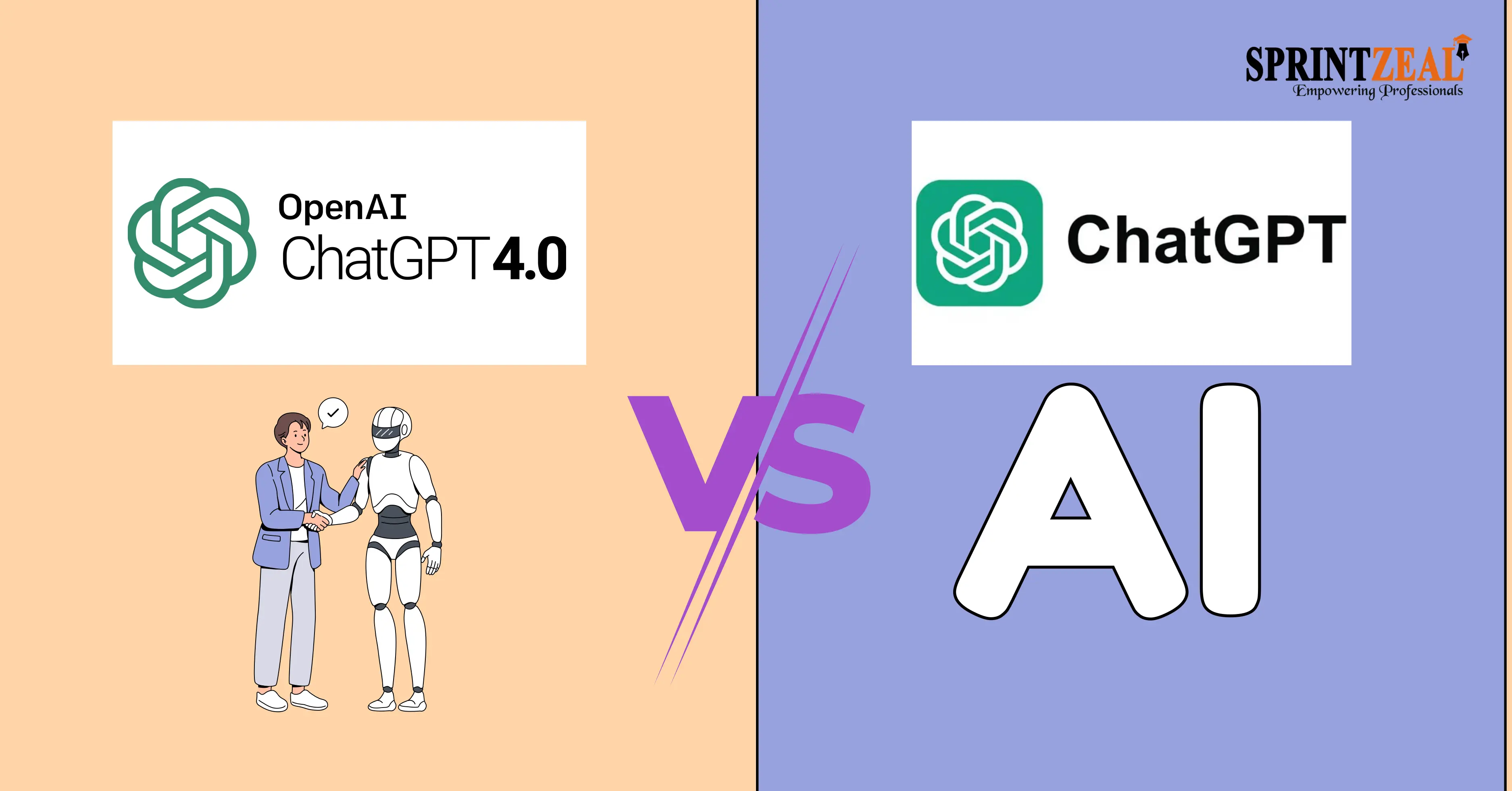
GPT-4 vs ChatGPT: In this comparison, it is important that we understand these two are two separate things, but they work together. While GPT-4 is a model by which a response is made possible, ChatGPT is an application, or call it an interface, where a user can chat with it to get the desired outcome. As OpenAI is focusing on improving its model, both GPT-4 and ChatGPT are expected to become faster, more accurate, and more capable.
Our organization, Sprintzeal, offers courses related to AI; one is: AI and Machine Learning Masters Program
FAQ’s Based On GPT-4 vs ChatGPT
1.Is GPT free of cost?
To get the benefits of GPT-4 features and its more advanced versions, like GPT-4o, a subscription is required, whether it is the Pro, Plus, or Team plan. There is another way that helps you access it: through the API.
2. In GPT-4 vs ChatGPT, will GPT-4 ever take the place of ChatGPT?
This scenario is never going to occur, as both are two different things. While GPT-4 is the reason, or call it the brain used to produce answers, ChatGPT is the chatting interface for doing question-and-answer back and forth.
3. Which one is best out of GPT-4 & GPT-4o?
GPT-4 can get slow at times due to its deep understanding of a text step-by-step. On the other hand, there is a balance when GPT-4o comes into the picture. GPT-4o is versatile in nature in being accurate as well as delivering with speed. Therefore, GPT-4o wins.
4. GPT-4 is powerful, but how?
GPT-4 is an advanced multimodal large language model (LLM) created by OpenAI. Why is it called multimodal? Because it is capable of handling different types of inputs. One type of input is writing a question, and the other is uploading an image; GPT-4 can scan the image, read it, and provide a response.
5. Does GPT-4 have any drawbacks?
GPT-4 provides an output, but it doesn’t really check its facts. So, as a human, you might have a task to go through the response provided because you can’t trust it blindly.
6. GPT-4 vs ChatGPT, which one is better?
There isn’t any such comparison to set them apart, as one is a brain or AI model and the other is used to chat and get answers. GPT-5 is the new model that ChatGPT runs on. GPT-5 is far more capable and advanced than GPT-4.
7. Does ChatGPT use GPT-4?
GPT-5 is the new model that ChatGPT uses. Hence, the existence of GPT-4 has vanished.
8. Is GPT -4 still in existence?
On April 30, 2025, GPT-4 officially marked its last day on ChatGPT. You can still find it in the APIs list for developers, but GPT-5 is the current model that is ruling.
9. GPT-4 vs ChatGPT, for coding, which one to choose?
I would recommend using ChatGPT with the GPT-5 model, as GPT-4 is now not that relevant.
10. GPT-4 vs ChatGPT, which one is best for content writing?
The answer remains the same, I would recommend using ChatGPT with the GPT-5 model, as GPT-4 is now not that relevant.




 USA : +1315-322-7821
 UK : +44 7700 174870
 IND : +919036108287
 AUS : +61 480 005 455