Top 3 AI Humanizers for Students
Tue, 22 September 2026

Inspirational journeys
Follow the stories of academics and their research expeditions

A Hugging Face: You don’t need to build an AI model from scratch. What if a platform provides pre-trained models? GitHub for machine learning, Hugging Face, as reported by contrary.com, has more than 13 million users; 2 million AI models have been made available to others; and the total number of databases people have uploaded has exceeded 1 million.
Machine Learning Engineers, Research Scientists, Software Engineers, Developer Advocates, and Product Managers are some roles that are hired to work for the platform. If you wish to expand your knowledge more on the topic, then consider reading this blog titled “What is Hugging Face?”
AI is somehow included in our daily work. Developers build AI-powered apps by writing code. Then there are data scientists whose job is to train AI models by analyzing data; researchers understand how AI works and help improve it. Lastly, it is us, the users, who use AI to simplify our tasks or just use artificial intelligence for fun.
So, this platform, Hugging Face, is like a big shared library where all the people mentioned above upload their models, datasets, or tools. Any person can get access to all these, download them, test them, and make their own AI models. This is a great platform for people building their own model without starting from scratch. They can use the models already present, test them, and add changes according to them.
It is a one-stop toolkit that is especially for AI dealing with human language (NLP: Natural language processing) and machine learning.
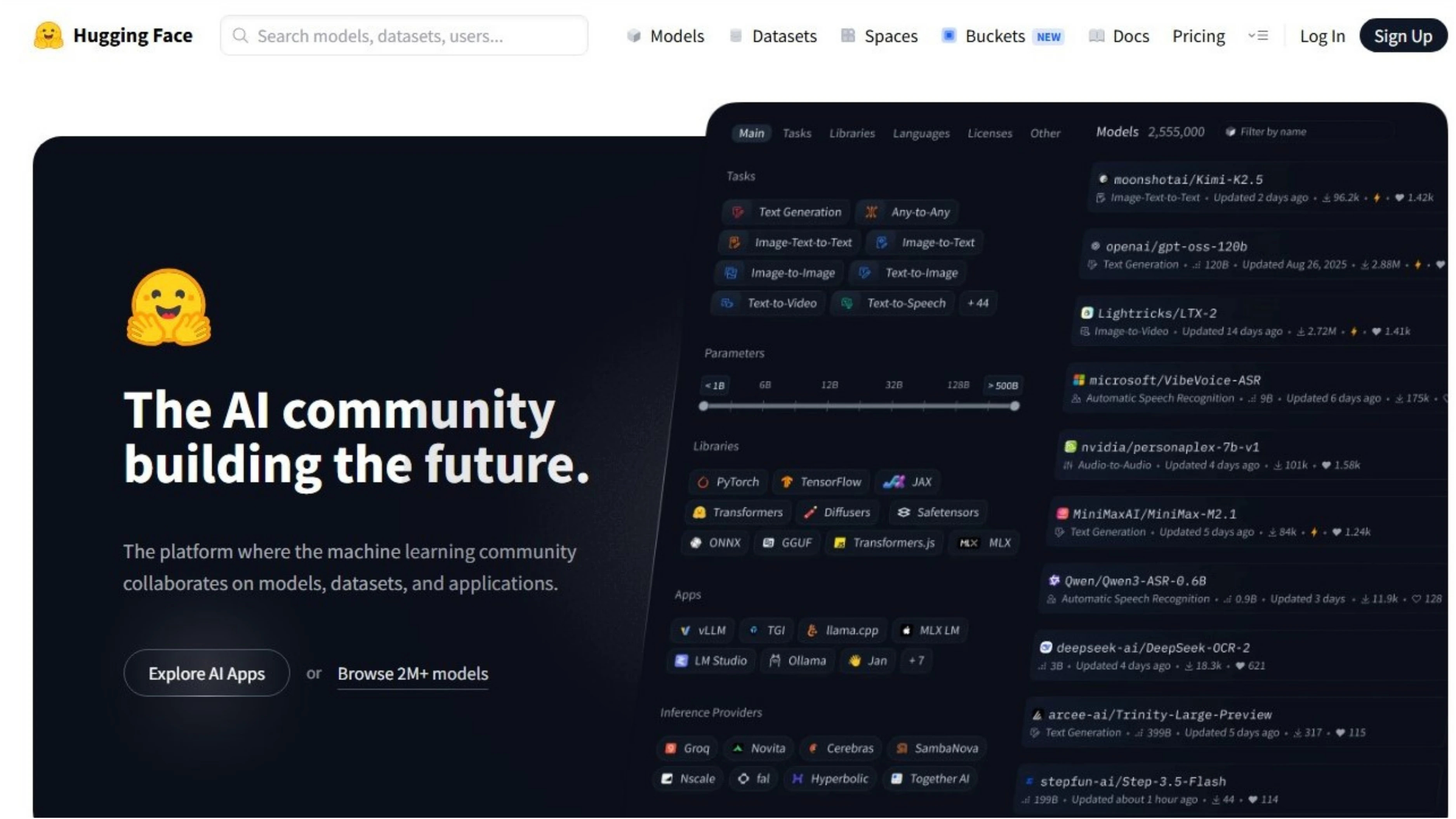 A Hugging Face website looks like this
RoBERTa, BERT, and GPT are the models that have already been trained and can be used immediately. The Transformers library allows users to access these models. BERT can read the emotional tone behind a sentence. Companies do not have to read every customer review, tweet, or feedback one by one. They can use an appropriate model to scan all of these and extract the useful information.
Next are the GPT-style models, which are especially designed to generate text. When you give a prompt, you get an answer from the AI that sounds natural and not copied from anywhere. Why? Because these models are trained in such a way that they can predict which word should be used next in the sentence.
These models also help in translating a language without heavily depending on grammar rules and dictionaries. Example: If I say to an AI to translate this English idiom “it’s raining cats and dogs,” it won’t translate to another language word by word, as it won’t make any sense. Instead, the model understands that the idiom means it’s raining heavily and translates it to another language.
Lastly, Meta AI trained the RoBERTa model to guess the missing words from a sentence by reading the words nearby. This model is good at understanding grammar, meaning, and how every word in a sentence is related to the others.
Want to train and test your AI model, and don’t want to do everything from scratch? Datasets has got you covered. If you try to collect data on your own, it is a lengthy process. Therefore, with the help of Datasets, which is like a big online library, you can choose what data you need. The data available in the library is already cleaned up and is ready to use.
The AI models that developers and researchers have built, they upload them to this online storage space called Model Hub. Not only models, but people also get access to instructions and tools to make the models work. Not only developers and researchers, but the platform also has models built and trained by the Hugging Face community.
People can look at different models and make small changes depending on the type of project they are working on.
Pre-trained models, pipelines, schedulers, and utility tools are the building blocks that Diffusers provide to developers. These building blocks help developers create AI models that can generate images, audio, and videos. For example, Stable Diffusion is the AI that creates images by reading text; Diffusers provide the code/instructions to load and run it.
Developers can get access to the latest AI generation technology, which is ready to be used without building anything from scratch.
If you enter a prompt as “I love cricket,” AI reads it in pieces called tokens with the help of a process called tokenization. Why? Because AI can only understand numbers and not words directly.
“I love cricket”: AI breaks it down into three tokens: “I”, “love”, “cricket”
Each token is converted into a number (token ID) right after the process of tokenization. Example: “I” -40, “love”-1842, and “cricket”- 7213
Don’t assume these numbers to be as it is, as the real ones depend on the specific tokenizer’s vocabulary.
If a developer is training an AI model on a single chip/computer, it can take days or weeks, and the timeline can stretch to months. The process can become faster only if multiple chips are used at once. But it is the headache of complex coding that Acceleration removes. Accelerate makes the process faster for running AI models on multiple computers/chips. Developers don’t have to write complicated code.
Evaluation metrics are ready-made scoring methods that developers use to check how well the AI model they have built is performing. The performance is checked across machine learning tasks such as translation, classification, summarization, and many more. Evaluate is the tool that provides these scoring methods to check the performance of AI models.
Hugging Face can be used by everyone from data scientists to researchers and learners. From curious people interested in learning about new technologies or trying out fun demos to professionals who need AI tools to do work, Hugging Face offers something to everyone.
Hugging Face provides data scientists with tools to clean their data as well as organize it. It also helps data scientists build a pipeline through which data moves. A trained model is put into a real project with the help of Hugging Face.
Machine Learning Engineers
Machine learning engineers teach AI by feeding it data until it recognizes the patterns, with the help of Hugging Face’s tools. Then the machine learning engineers take the trained models and apply them in the real world, like in an app, website, or service. The tools can also help evaluate the performance(does it have errors) of AI models.
NLP Researchers
To understand and generate human language, researchers explore the latest and most advanced AI models using Hugging Face. There are several AI models present, such as text-analysis tools, translation systems, and chatbots, that researchers use to test their theories. After this, the researchers also publish their work to the Hugging Face community.
Software Developers
Software developers connect a trained AI model to an app or website rather than building anything from scratch. After the AI model is plugged in, apps and websites are capable of performing tasks like AI, such as giving responses, translating text, and understanding the emotional tone behind a text.
Academic Researchers
Hugging Face is a free tool for teachers and students who are learning about AI, as they can gain knowledge about artificial intelligence. In addition, they can also conduct research on how the AI models work, test new ideas, and make an existing AI model and teach it more using their own data, making it better for a specific task.
Learners
Lastly, Hugging Face is not just for professionals; people can also use the tools present on this platform for their hobbies. Beginners interested in pursuing AI can connect with the community and learn new things. In addition, they can also build their own projects using ready-made AI models. If they find themselves in a situation where they get stuck, they can connect with experts for help.
You might have come across Siri and Alexa that chat and converse with people, exchanging messages and dialogues. These two are known as virtual assistants, which people use to play music, set alarms, and ask questions. AI is used to build these virtual assistants and customer support bots (that help you with order issues, refunds, or queries related to products).
There are tons of reviews that customers post every day on e-commerce platforms, shopping/food delivery apps, and social media. The comments fall into three categories: negative, positive, and some are neutral as well. Here, AI models can be helpful to identify the type of comment without humans reading them and analyzing them one by one.
AI models such as mT5 and MarianMT present on the Hugging Face platform, are used to shorten a long text into a summary. In addition, text can also be translated into many other languages with the help of these AI models.
If the job is to identify what an image is showing, what objects are present in the image, and also to create a brand new image using AI, Hugging Face can be used just as humans would understand an image or create an image.
NLP helps a computer understand human language. So this field of AI is now increasingly used in the healthcare sector. Hugging Face’s AI models can go through messy doctors’ prescriptions and notes that are hard to read. After this, it can extract useful information from them.
TRELLIS (Image-to-3D Asset Generation)
This tool generates high-quality 3D objects from a single 2D image. 3D game designers and digital artists get help to work faster by using the special AI technology available on the platform.
FLUX Style Shaping
Using FLUX AI models, this tool was created. This tool will help you customize your image. It is a user-friendly website that lets you add effects to an image, create an image in a new style, and adjust settings without needing any technical skills.
Fire Red ImageEdit & OCR
These AI tools are fast and easy to use. ImageEdit is a tool through which you can edit an image very quickly by giving a prompt in simple language. On the other hand, Fire Red OCR is the tool used to read text from an image and turn it into clean, organized text that can be easily used later.
Vibe Voice ASR & Lux TTS
Vibe Voice is built using Microsoft’s Technology. It can listen to audio that is up to 60 minutes and convert it into text. For even longer recordings as well, Vibe Voice can convert audio to text. On the other hand, Lux TTS can clone someone’s voice using a short audio clip so realistically that no one can identify any difference.
SmolAgents
Hugging Face itself has created this lightweight tool. With the help of this tool, developers can build smart AI helpers that can write and run their own Python code to solve tricky, multi-step math or logical problems by themselves.
The first step is that you should sign up on the Hugging Face website. There are models, datasets, spaces, and buckets to explore. You just have to download a tool called transformers using a simple tool/command called pip to use AI models in your own code. After this, you can download the AI model, run it on your computer, or use it online through the cloud.
For Example: I generated an image through the Hugging Face website. These are the steps it required to generate the image:
Step 1: Click on Spaces and then Image Generation
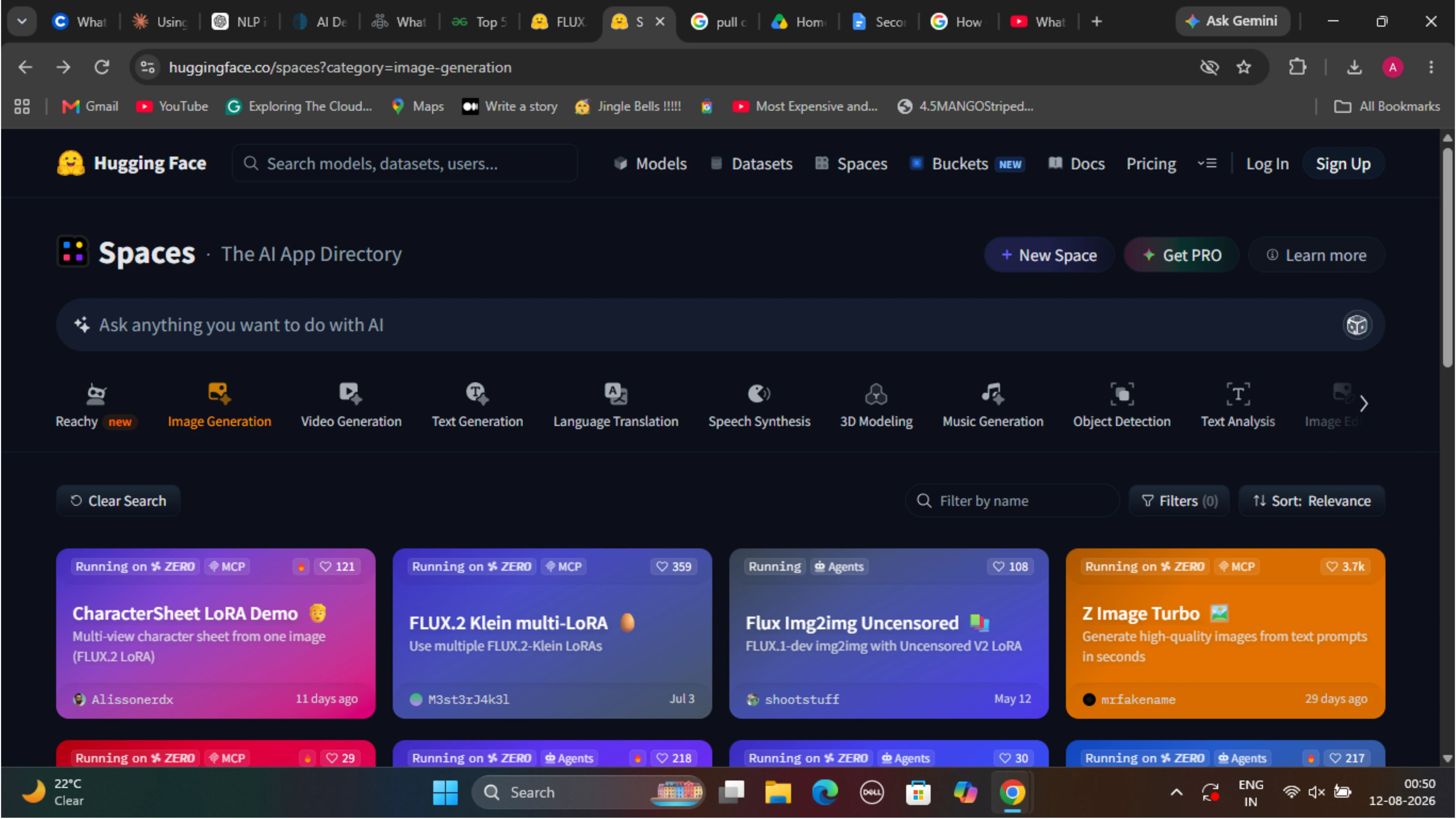 Step 2: Select any of the image generation model and open it
 Step 3: Upload an image, reference image, and give a prompt and click on generate
 Step 4: You will get the final image (the final result)

 Hugging Face, is like a big shared library where all the people mentioned above upload their models, datasets, or tools. Any person can get access to all these, download them, test them, and make their own AI models. This is a great platform for people building their own model without starting from scratch. They can use the models already present, test them, and add changes according to them.
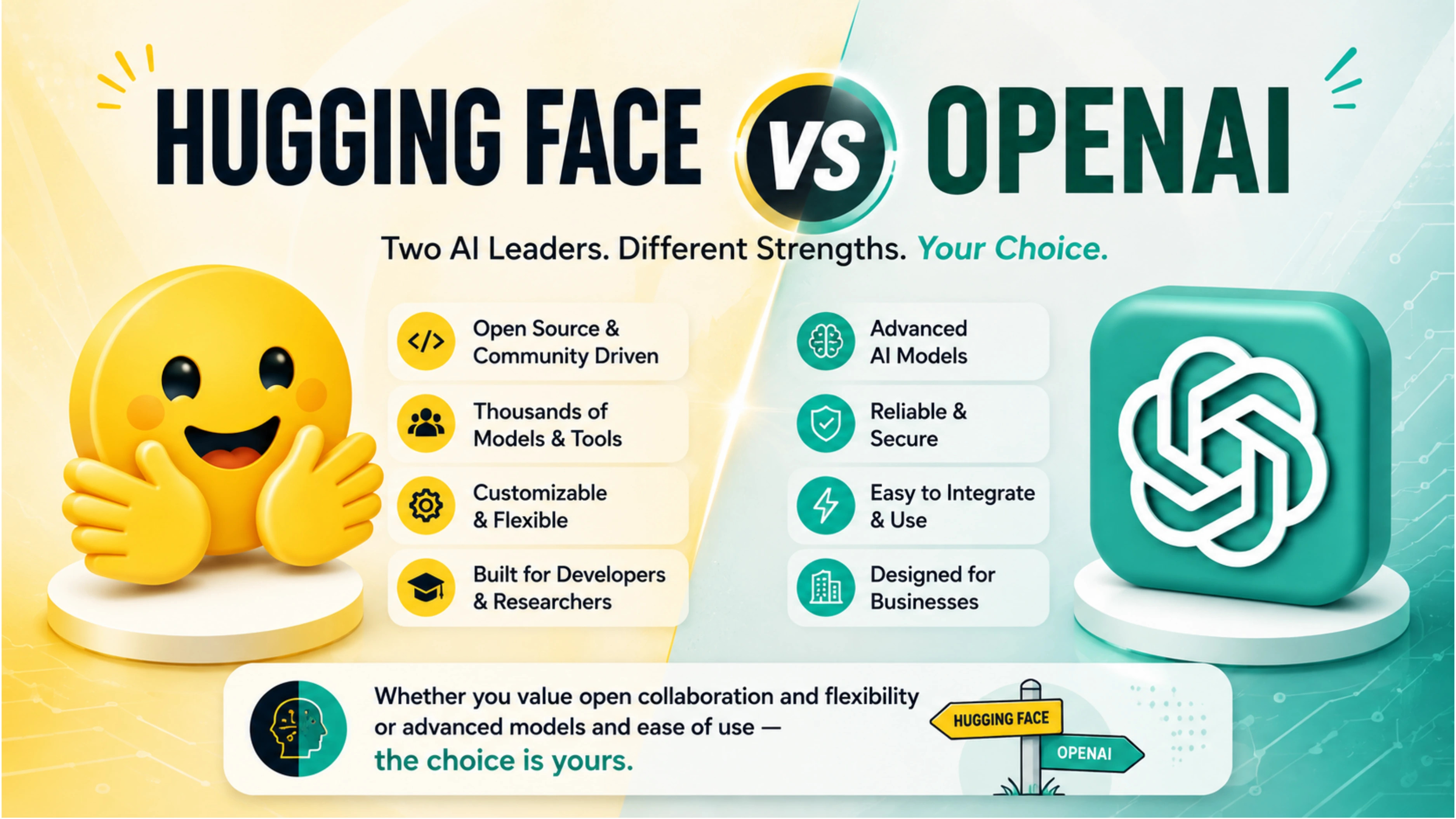
On the contrary, the AI models on a platform like OpenAI are kept private. No one can see how they are created or change them. ChatGPT is the AI created by OpenAI, which can be accessed by everyone using the internet. You can sign up and use it, and for advanced features, you can buy a subscription.
|
Feature |
Hugging Face |
OpenAI |
|
Model Type |
Open-source and open-weight models (e.g., Llama, Mistral, Gemma) |
Proprietary, closed-source models (e.g., GPT-4o, o1) |
|
Access Method |
Download weights, run locally, or use Inference APIs |
Managed cloud API and consumer chat interfaces only |
|
Customization |
Full control; deep fine-tuning, quantization, and architecture edits |
Limited to prompt engineering and fine-tuning via their API |
|
Pricing Model |
Free open models; paid server hosting, storage, and managed endpoints |
Pay-per-token usage pricing for API calls |
|
Data Privacy |
High data sovereignty if self-hosted on private infrastructure |
Data sent to third-party servers governed by OpenAI policy |
|
Ease of Use |
Steeper learning curve requiring setup and infrastructure knowledge |
Instant plug-and-play via consumer apps and simple API endpoints |
Hugging Face is a platform that offers various resources that are open to all of us. However, if you are just beginning to use the platform, it will take time to get used to it.
AI is somehow included in our daily work. Hugging Face is like a big shared library where all the models, datasets, or tools are uploaded. Any person can get access to all these, download them, test them, and make their own AI models. However, there are cons as well. If you are just beginning to use the platform, it will take time to get used to it. Nonetheless, Hugging Face is a great platform to explore.
1. Are Hugging Face and ChatGPT the same?
ChatGPT is a chatbot developed by OpenAI, which is used to get responses, generate images, generate code, and many other things. On the contrary, Hugging Face is an online community where developers, researchers, and beginners share their work (pre-trained AI models, datasets, and other tools), which can be accessed by everyone.
2. Is Hugging Face free of cost?
Yes, it is free if you just want to explore the AI models and try out some of them, like image generation, translating languages, or generating images. You can also download models for free, but for serious computing tasks and extra business-level features, it will cost you money.
3. Who is the CEO of Hugging Face?
Clément Delangue (also known as Clem Delangue) is the CEO and co-founder of Hugging Face. It is independent and owned by a private group of people. It was founded in January 2016 in New York.
4. What programming language is Hugging Face?
Python is the main language that is used to build Hugging Face, and Python is also the main language that people use to work on the platform.
5. How good is Hugging Face for NLP?
Hugging Face is the top name and leader when it comes to NLP (Natural Language Processing). NLP means making a computer understand what human language is and work with it.

Tue, 22 September 2026
Tue, 08 September 2026

Mon, 24 August 2026

Wed, 19 August 2026

Mon, 17 August 2026
Mon, 17 August 2026

Thu, 13 August 2026
Mon, 24 August 2026

Tue, 28 July 2026


© 2026 Sprintzeal Americas Inc. - All Rights Reserved.

 USA : +1315-322-7821
 UK : +44 7700 174870
 IND : +919036108287
 AUS : +61 480 005 455