Inspirational journeys
Follow the stories of academics and their research expeditions
SQL vs NoSQL: Understanding the Key Differences and Use Cases
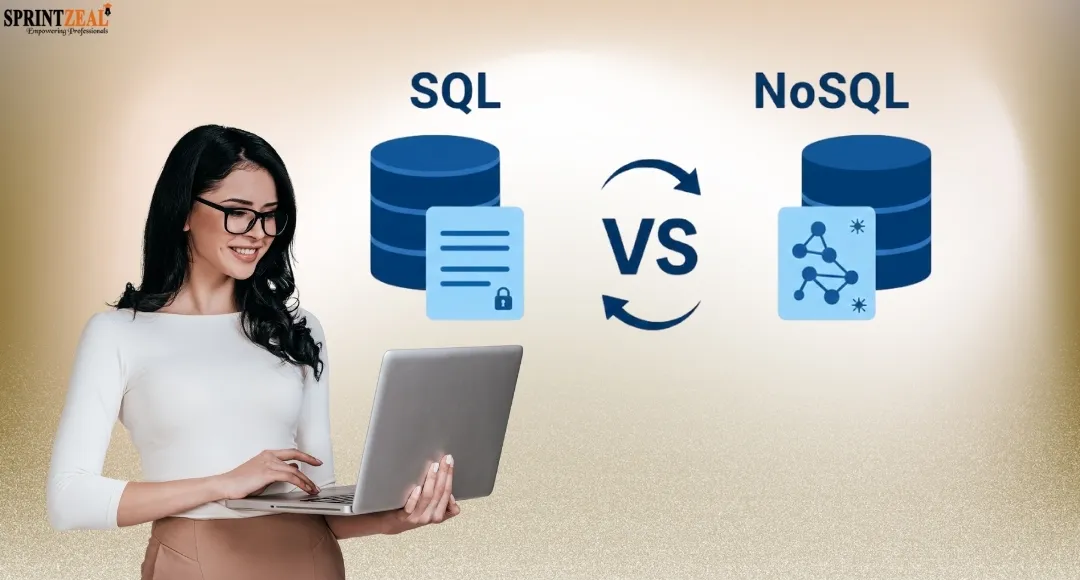
Some of the most prevalent SQL Databases, such as MySQL, PostgreSQL, and SQL Server, can be found within banking systems, online retail sites, Enterprise Resource Planning Software, and analytics programs, wherever consistency within data structure exists and is critical. But does it mean that you will always select SQL? Or does the choice between SQL versus NoSQL rely upon how the application is scaling, developing, or changing?
Before proceeding to blog, if you aspire to become a SQL developer you should definitely check out the top interview questions asked in any SQL interview.
What is SQL ?
Structured Query Language (SQL) represents a relational database technology where data is housed in a structured table system comprised of multiple columns and rows. All tables, which share the same characteristics, follow a predefined structure, which is then enforced and governed by the table schema. The main reason SQL is relied on is that because of its established relationships between different databases, many organizations have required the accuracy and reliability of their data to make informed business decisions.
A good example of industries that use SQL today would be those in the banking, CRM, and inventory management sectors, where the need for structure and control is paramount. These types of products require strict structure to function properly; therefore, it is hopefully easy to see why these products function using an established database and maintain the integrity of the data. SQL Databases utilize primary keys, foreign keys, and constraints to ensure the connection of your data and that it remains accurately linked throughout its lifetime.
Do you know SQL is ranked among the top 5 programming languages in 2026, make sure to get familiar with it through this blog.
CREATE TABLE users ( |
What is NoSQL?
The idea behind NoSQL is that it means "Not Only SQL" and it represents a new way to search data through a database which increases the flexibility in comparison with traditional databases (e.g., SQL databases). NoSQL databases, in contrast to relational databases, offer various formats for storing data aside from tables, thus, they can be utilized even if speed, scale, and adaptability are the main requirements.
NoSQL database systems can store and access data in different formats such as JSON documents, key/value pairs, column, family databases, and graph, based databases. This feature gives developers the ability to rapidly deal with semi, structured and unstructured data without always having to change data schemas before they can add a new field. NoSQL databases provide horizontal scaling, which makes them great performers even in the case of very heavy workloads.
{ |
Some key/value databases, such as Redis and DynamoDB, are great for caching data and locating pieces of data very quickly. As an example, wide, column family databases like Cassandra are very good for supporting extremely frequent write operations. Graph, based databases (e.g., Neo4j) are ideally used for storing fields of complicated relational databases such as social networks.
SQL vs NoSQL — Key Differences
SQL databases store information in rigid tables made of rows and columns | NoSQL databases let you keep the same information as documents, key value pairs, graphs or wide columns |
SQL demands that you design the layout beforehand and change it only with effort | NoSQL lets the layout shift whenever you need. |
SQL speaks one standard language - SQL itself for difficult questions and joins | NoSQL speaks a dialect that belongs to each engine. |
SQL grows - buying a bigger box | NoSQL grows - adding more ordinary boxes side by side |
SQL shines when the question is intricate but also the work must be transactional | NoSQL shines when the task is a flood of rapid reads or writes |
SQL promises the safety of ACID | NoSQL often trades that for the looseness of BASE |
SQL resists last minute change | NoSQL welcomes it. |
SQL suits ledgers, ERP, CRM and analytic warehouses | NoSQL suits real - time feeds, massive data, sensor streams and social graphs |
Database Architecture & Data Models
Database design and data models are usually the major points of the first argument when comparing SQL to NoSQL. While NoSQL database systems use various flexible non, relational data models, SQL databases mostly stick to a relational model. But in terms of building or scaling an app, is the difference really that big?
Data is kept in tables with rows and columns in SQL databases, and each table's schema is always known beforehand. Primary and foreign keys are used to clearly show relationships between tables. As a result, SQL is ideal for applications requiring complicated join operations, dependable transactions, and the highest degree of data consistency. Relational database systems are frequently the default option in discussions between SQL and NoSQL for sectors like banking, ERP, and reporting platforms, where correctness is crucial and therefore more significant than flexibility.
On the other hand, NoSQL databases differ considerably in their approach. They don't try to fit data into a tabular format but rather provide multiple data models that are more in line with the needs of contemporary applications. Document databases organize data in the form of JSON, like documents, making them very easy to understand and develop. Key, value stores are designed for extremely fast retrievals and thus are ideal for caching and session management.
Scalability and Performance: SQL vs NoSQL
Scalability and performance are really the exciting parts of the SQL vs. NoSQL debate.Conventional SQL databases have been optimized, by convention, for vertical scaling-meaning increased performance realized by upgrading the server with more CPU, additional RAM, or faster storage. This works really well for organized workloads and predictable traffic, thus setting SQL as an excellent choice for transactional systems where consistency and reliability are paramount. However, the scaling of one machine can only be taken so far.
On the other hand, NoSQL databases have adopted a different strategy. Since they are built for horizontal scaling, they distribute data over several servers, thus enabling systems to grow to an almost unlimited extent. With such a setup, NoSQL is very good at handling huge datasets, real, time usage, and sudden traffic spikes. This part of the SQL vs NoSQL debate is usually where NoSQL comes out on topparticularly for the new, age apps that require speed and global access.
How well a database performs also depends on the method of data accessing. SQL is great for intricate queries and joining, whereas NoSQL focuses on the speed of reads and writes on a large scale. So, what will your app prioritizestructured accuracy or scalable performance? By identifying the trade, offs in the SQL vs NoSQL debate, youll be able to pick a database that is a good match for your business growth.
When to Use SQL
Where data structure and integrity are the most relevant.
In SQL vs NoSQL, SQL is the go-to choice of applications that believe in highly structured data. Fixed schemas come with primary keys and constraints to assure data consistency and accuracy, hence making SQL ideal for finance, healthcare, and enterprise systems.
When there are transactions with the need for reliability
Relational databases support ACID-compliant transactions, meaning that data is treated safely and predictably. This reliability is critical in systems for payment processing, inventory management, and booking; this is why SQLs have an edge in the SQL versus NoSQL debate.
When there is a need to perform complex queries and relationships
SQL is particularly good at multi-table joins, aggregations, and complex queries. If an application requires detailed reporting or data sets to be interrelated, then SQL is incomparable for querying. Decision-making empowered by reporting and analytics Business intelligence and analytics applications work in complete harmony with SQL databases, making structured reporting easier and more accurate.
When to Use NoSQL
When high-speed performance is your requirement
In the SQL vs NoSQL comparison, NoSQL is often favored for real-time applications like chat systems, live streaming, and online gaming. These systems need high-speed reads and writes with minimum latency, and NoSQL databases are optimized to provide raw speed without heavy query overhead.
When the data is unstructured or continually changing.
SQL databases cannot cope with unstructured and semi-structured data such as logs, clickstream, text files, and IoT sensors easily. he ease of schema modification without any interruption or migration is one such benefit that gives SQL/NoSQL a competitive edge in SQL vs NoSQL comparison.
When you expect massive growth and scale
NoSQL databases are designed to scale horizontally-that is, you just add more servers as traffic and data grow. It makes NoSQL appropriate for Big Data, distributed systems, and worldwide applications where scaling is important. When Rapid Development Counts If your product is rapidly changing, NoSQL empowers teams to move quicker.
SQL vs NoSQL: Pros and Cons
Let us take a quick look at how they differ:
SQL Databases – Advantages & Disadvantages
Highly reliable and accurate in every piece of data they provide
Extremely consistent and ACID compliant, ensuring safe and predictable transaction processing
Mature, stable, and well-supported ecosystem with broad tooling
Excellent support for reporting and analytics use cases
More difficult to scale horizontally compared to NoSQL
Less flexible schema design
Schema changes often require complex and time-consuming migrations
Not suitable for rapidly changing or dynamic data models
NoSQL Databases – Advantages and Disadvantages
Flexible, schema-less data models that support rapid development
Easy horizontal scaling across distributed systems
Efficient handling of massive data volumes
Optimized for high-speed read and write operations
Eventual consistency in some NoSQL systems
Complex or non-standard query patterns
Not ideal for strict transactional processing applications
Requires sophisticated data modeling to maintain performance and consistency
SQL vs NoSQL: Examples & Popular Database Systems
Netflix (NoSQL – Cassandra)
Utilizes NoSQL databases such as Cassandra to manage a large number of events that are processed in the order of billions per year. Here, high availability and high write throughput capabilities of NoSQL databases are essential to manage events in a timely manner.
Banking Systems (SQL)
Use SQL databases for data accuracy, consistency, and support for atomic transactions. Data loss or inconsistencies can result in catastrophe, which is what makes the need for SQL so paramount in the banking sector.
Amazon (Hybrid Approach)
Uses NoSQL databases for product catalogs, SQL for payment processing as both need reliability, and graph databases for recommendation systems that deal with complex relationships. Polyglot Persistence This approach to employing multiple database technologies in one system is known as polyglot persistence. This is rapidly becoming more common in new systems.
Conclusion
SQL vs NoSQL is not a matter of which is better—it’s about which is right for your workload. SQL remains the gold standard for structured data, transactional systems, and consistency. NoSQL is the champion for horizontal scaling, big data, and flexible schema needs.In reality, most modern systems use both. This hybrid approach ensures maximum performance, reliability, and scalability.Kickstart a high-paying career with our Data Science Master Program or build the engines that process massive data with Big Data Hadoop and Spark Developer Training.
FAQ's on SQL vs NoSQL
1. SQL and NoSQL: What is the key difference?
SQL is relational and structured(RS). While NoSQL is non-relational and flexible(NF).
2. SQL vs. NoSQL Which is better?
SQL vs. NoSQL: it depends on use cases - SQL for consistency and NoSQL for scalability.
3. Is NoSQL faster than SQL?
For big data and distributed systems, NoSQL is always faster.
4. Can SQL and NoSQL databases work side by side?
Yes—most large companies use a hybrid (polyglot) approach.
Table of Contents
- Introduction
- What is SQL ?
- What is NoSQL?
- SQL vs NoSQL — Key Differences
- Database Architecture & Data Models
- Scalability and Performance: SQL vs NoSQL
- When to Use SQL
- When to Use NoSQL
- SQL vs NoSQL: Pros and Cons
- SQL vs NoSQL: Examples & Popular Database Systems
- Conclusion
- FAQ's on SQL vs NoSQL
Introduction
Some of the most prevalent SQL Databases, such as MySQL, PostgreSQL, and SQL Server, can be found within banking systems, online retail sites, Enterprise Resource Planning Software, and analytics programs, wherever consistency within data structure exists and is critical. But does it mean that you will always select SQL? Or does the choice between SQL versus NoSQL rely upon how the application is scaling, developing, or changing?
Before proceeding to blog, if you aspire to become a SQL developer you should definitely check out the top interview questions asked in any SQL interview.
What is SQL ?
Structured Query Language (SQL) represents a relational database technology where data is housed in a structured table system comprised of multiple columns and rows. All tables, which share the same characteristics, follow a predefined structure, which is then enforced and governed by the table schema. The main reason SQL is relied on is that because of its established relationships between different databases, many organizations have required the accuracy and reliability of their data to make informed business decisions.
A good example of industries that use SQL today would be those in the banking, CRM, and inventory management sectors, where the need for structure and control is paramount. These types of products require strict structure to function properly; therefore, it is hopefully easy to see why these products function using an established database and maintain the integrity of the data. SQL Databases utilize primary keys, foreign keys, and constraints to ensure the connection of your data and that it remains accurately linked throughout its lifetime.
Do you know SQL is ranked among the top 5 programming languages in 2026, make sure to get familiar with it through this blog.
|
CREATE TABLE users ( |
What is NoSQL?
The idea behind NoSQL is that it means "Not Only SQL" and it represents a new way to search data through a database which increases the flexibility in comparison with traditional databases (e.g., SQL databases). NoSQL databases, in contrast to relational databases, offer various formats for storing data aside from tables, thus, they can be utilized even if speed, scale, and adaptability are the main requirements.
NoSQL database systems can store and access data in different formats such as JSON documents, key/value pairs, column, family databases, and graph, based databases. This feature gives developers the ability to rapidly deal with semi, structured and unstructured data without always having to change data schemas before they can add a new field. NoSQL databases provide horizontal scaling, which makes them great performers even in the case of very heavy workloads.
|
{ |
Some key/value databases, such as Redis and DynamoDB, are great for caching data and locating pieces of data very quickly. As an example, wide, column family databases like Cassandra are very good for supporting extremely frequent write operations. Graph, based databases (e.g., Neo4j) are ideally used for storing fields of complicated relational databases such as social networks.
SQL vs NoSQL — Key Differences
|
SQL databases store information in rigid tables made of rows and columns |
NoSQL databases let you keep the same information as documents, key value pairs, graphs or wide columns |
|
SQL demands that you design the layout beforehand and change it only with effort |
NoSQL lets the layout shift whenever you need. |
|
SQL speaks one standard language - SQL itself for difficult questions and joins |
NoSQL speaks a dialect that belongs to each engine. |
|
SQL grows - buying a bigger box |
NoSQL grows - adding more ordinary boxes side by side |
|
SQL shines when the question is intricate but also the work must be transactional |
NoSQL shines when the task is a flood of rapid reads or writes |
|
SQL promises the safety of ACID |
NoSQL often trades that for the looseness of BASE |
|
SQL resists last minute change |
NoSQL welcomes it. |
|
SQL suits ledgers, ERP, CRM and analytic warehouses |
NoSQL suits real - time feeds, massive data, sensor streams and social graphs |
Database Architecture & Data Models
Database design and data models are usually the major points of the first argument when comparing SQL to NoSQL. While NoSQL database systems use various flexible non, relational data models, SQL databases mostly stick to a relational model. But in terms of building or scaling an app, is the difference really that big?
Data is kept in tables with rows and columns in SQL databases, and each table's schema is always known beforehand. Primary and foreign keys are used to clearly show relationships between tables. As a result, SQL is ideal for applications requiring complicated join operations, dependable transactions, and the highest degree of data consistency. Relational database systems are frequently the default option in discussions between SQL and NoSQL for sectors like banking, ERP, and reporting platforms, where correctness is crucial and therefore more significant than flexibility.
On the other hand, NoSQL databases differ considerably in their approach. They don't try to fit data into a tabular format but rather provide multiple data models that are more in line with the needs of contemporary applications. Document databases organize data in the form of JSON, like documents, making them very easy to understand and develop. Key, value stores are designed for extremely fast retrievals and thus are ideal for caching and session management.
Scalability and Performance: SQL vs NoSQL
Scalability and performance are really the exciting parts of the SQL vs. NoSQL debate.Conventional SQL databases have been optimized, by convention, for vertical scaling-meaning increased performance realized by upgrading the server with more CPU, additional RAM, or faster storage. This works really well for organized workloads and predictable traffic, thus setting SQL as an excellent choice for transactional systems where consistency and reliability are paramount. However, the scaling of one machine can only be taken so far.
On the other hand, NoSQL databases have adopted a different strategy. Since they are built for horizontal scaling, they distribute data over several servers, thus enabling systems to grow to an almost unlimited extent. With such a setup, NoSQL is very good at handling huge datasets, real, time usage, and sudden traffic spikes. This part of the SQL vs NoSQL debate is usually where NoSQL comes out on topparticularly for the new, age apps that require speed and global access.
How well a database performs also depends on the method of data accessing. SQL is great for intricate queries and joining, whereas NoSQL focuses on the speed of reads and writes on a large scale. So, what will your app prioritizestructured accuracy or scalable performance? By identifying the trade, offs in the SQL vs NoSQL debate, youll be able to pick a database that is a good match for your business growth.
When to Use SQL
- Where data structure and integrity are the most relevant.
In SQL vs NoSQL, SQL is the go-to choice of applications that believe in highly structured data. Fixed schemas come with primary keys and constraints to assure data consistency and accuracy, hence making SQL ideal for finance, healthcare, and enterprise systems.
- When there are transactions with the need for reliability
Relational databases support ACID-compliant transactions, meaning that data is treated safely and predictably. This reliability is critical in systems for payment processing, inventory management, and booking; this is why SQLs have an edge in the SQL versus NoSQL debate.
- When there is a need to perform complex queries and relationships
SQL is particularly good at multi-table joins, aggregations, and complex queries. If an application requires detailed reporting or data sets to be interrelated, then SQL is incomparable for querying. Decision-making empowered by reporting and analytics Business intelligence and analytics applications work in complete harmony with SQL databases, making structured reporting easier and more accurate.
When to Use NoSQL
- When high-speed performance is your requirement
In the SQL vs NoSQL comparison, NoSQL is often favored for real-time applications like chat systems, live streaming, and online gaming. These systems need high-speed reads and writes with minimum latency, and NoSQL databases are optimized to provide raw speed without heavy query overhead.
- When the data is unstructured or continually changing.
SQL databases cannot cope with unstructured and semi-structured data such as logs, clickstream, text files, and IoT sensors easily. he ease of schema modification without any interruption or migration is one such benefit that gives SQL/NoSQL a competitive edge in SQL vs NoSQL comparison.
- When you expect massive growth and scale
NoSQL databases are designed to scale horizontally-that is, you just add more servers as traffic and data grow. It makes NoSQL appropriate for Big Data, distributed systems, and worldwide applications where scaling is important. When Rapid Development Counts If your product is rapidly changing, NoSQL empowers teams to move quicker.
SQL vs NoSQL: Pros and Cons
Let us take a quick look at how they differ:
SQL Databases – Advantages & Disadvantages
- Highly reliable and accurate in every piece of data they provide
- Extremely consistent and ACID compliant, ensuring safe and predictable transaction processing
- Mature, stable, and well-supported ecosystem with broad tooling
- Excellent support for reporting and analytics use cases
- More difficult to scale horizontally compared to NoSQL
- Less flexible schema design
- Schema changes often require complex and time-consuming migrations
- Not suitable for rapidly changing or dynamic data models
-
NoSQL Databases – Advantages and Disadvantages
- Flexible, schema-less data models that support rapid development
- Easy horizontal scaling across distributed systems
- Efficient handling of massive data volumes
- Optimized for high-speed read and write operations
- Eventual consistency in some NoSQL systems
- Complex or non-standard query patterns
- Not ideal for strict transactional processing applications
- Requires sophisticated data modeling to maintain performance and consistency
SQL vs NoSQL: Examples & Popular Database Systems
- Netflix (NoSQL – Cassandra)
Utilizes NoSQL databases such as Cassandra to manage a large number of events that are processed in the order of billions per year. Here, high availability and high write throughput capabilities of NoSQL databases are essential to manage events in a timely manner.
- Banking Systems (SQL)
Use SQL databases for data accuracy, consistency, and support for atomic transactions. Data loss or inconsistencies can result in catastrophe, which is what makes the need for SQL so paramount in the banking sector.
- Amazon (Hybrid Approach)
Uses NoSQL databases for product catalogs, SQL for payment processing as both need reliability, and graph databases for recommendation systems that deal with complex relationships. Polyglot Persistence This approach to employing multiple database technologies in one system is known as polyglot persistence. This is rapidly becoming more common in new systems.
Conclusion
SQL vs NoSQL is not a matter of which is better—it’s about which is right for your workload. SQL remains the gold standard for structured data, transactional systems, and consistency. NoSQL is the champion for horizontal scaling, big data, and flexible schema needs.In reality, most modern systems use both. This hybrid approach ensures maximum performance, reliability, and scalability.Kickstart a high-paying career with our Data Science Master Program or build the engines that process massive data with Big Data Hadoop and Spark Developer Training.
FAQ's on SQL vs NoSQL
1. SQL and NoSQL: What is the key difference?
SQL is relational and structured(RS). While NoSQL is non-relational and flexible(NF).
2. SQL vs. NoSQL Which is better?
SQL vs. NoSQL: it depends on use cases - SQL for consistency and NoSQL for scalability.
3. Is NoSQL faster than SQL?
For big data and distributed systems, NoSQL is always faster.
4. Can SQL and NoSQL databases work side by side?
Yes—most large companies use a hybrid (polyglot) approach.

Categories
Related Posts

Fundamentals of Data Visualization Explained
Tue, 16 April 2024

What is Data Visualization? A Comprehensive Guide
Mon, 08 April 2024

Top 10 Data Visualization Tips for Clear Communication
Fri, 31 May 2024

Data Visualization Strategy and its Importance
Wed, 10 April 2024

Top 10 Best Data Science Frameworks: For Organizations
Thu, 11 April 2024

Data Science Frameworks: A Complete Guide
Mon, 15 April 2024

How to Create Data Visualizations in Excel: A Brief Guide
Wed, 11 September 2024

How to repair a crashed MySQL table?
Wed, 13 August 2025
5 Popular Data Science Careers That Are in Demand
Fri, 29 August 2025



 USA : +1315-322-7821
 UK : +44 7700 174870
 IND : +919036108287
 AUS : +61 480 005 455