Excel vs Power BI: Which Is Better?
Thu, 16 July 2026

Inspirational journeys
Follow the stories of academics and their research expeditions
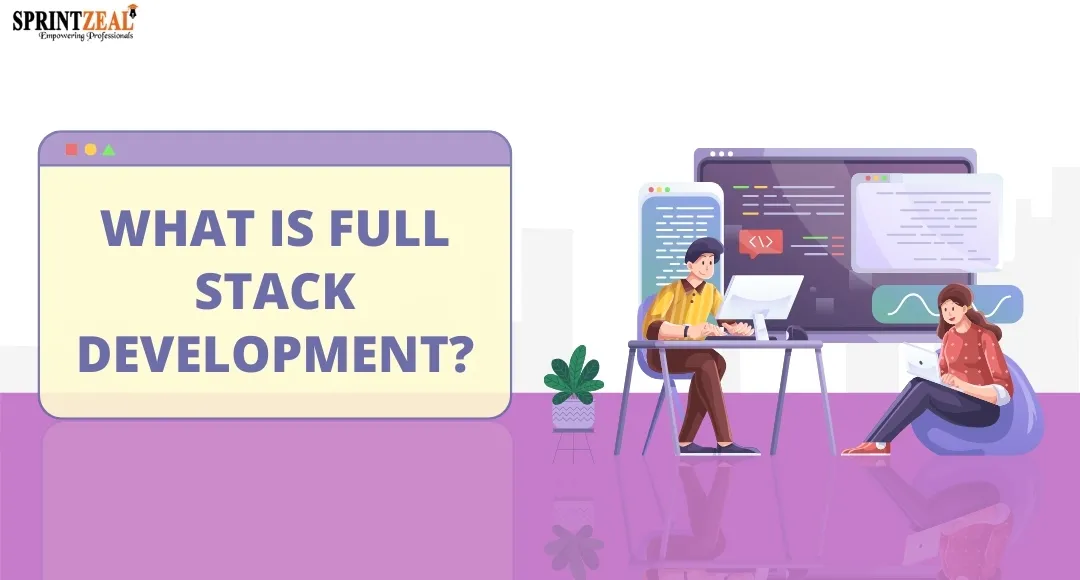
In this modern era, everyone must have heard about Full Stack web development but do we really know exactly what it is? Full Stack Development is the core of every successful web application in the modern digital era, where online experiences are seamless in defining business success. Full stack development bridges the two worlds between the visually appealing interfaces that users would be interacting with and the powerful backend systems that would handle the data and the performance.
A full stack developer is literally a one-man army who is able to take on both front-end and back-end developmental issues. They are the most flexible professionals in the technology sector today because they design, develop and implement the complete web solutions.
The demand for skilled full stack developers is skyrocketing as organizations prefer hiring professionals who can understand the bigger picture—someone who can bridge the gap between client-side and server-side logic efficiently. According to top job portals and industry studies, roles in full stack development are among the top 10 most in-demand tech careers worldwide.
This blog dives deep into what full-stack development is, what technologies power it, and how you can become a full-stack developer ready to thrive in 2026 and beyond.
The front end or client side, is everything that customers visually perceive and interact with in a web browser or application. Its primary concern is to provide a user-friendly, visually attractive, and quick-response user experience. The essential task of the front end is to display the data in a user-friendly way and get the user feedback efficiently.
HTML (HyperText Markup Language) is the fundamental element of the internet. It is used to build the framework and the inclusion of new data like words, pictures, interface elements, and links. In other words, HTML is the website's skeletal system—it binds all the visible elements in one single unit.
CSS (Cascading Style Sheets) determines a website's visual representation. The main features introduced by CSS are color, layout, font, and graphics besides these it also takes care of spacing and other design aspects. With the help of CSS, developers can maintain the interface's visual appeal and consistency across different devices or screen sizes.
JavaScript is the energiser that makes the web pages interactive and allows for the on-demand features and varied dynamic content. It is a command that reacts to the user's request; for example, if the user pushes a button, fills a form or scrolls. Moreover, it supports content updates without reloading the page, various visual effects, and input validation.
So, on their own, HTML, CSS, and JavaScript are different levels of the technology stack. When used together, these technologies ensure a complete front-end solution that is both functional and visually pleasing to users. This trio not only lets the users find the data they want quickly but also makes the users want to interact with the app.
The back end or the back office, of the application is the part that is responsible for the processes which are not visible to the front end. Users have an interface through which they can send requests, whereas the back end is the one that makes sure that their requests are executed—logging in, saving data, or processing an order—securely and fast. It not only implements the business logic but also is in command of the data flow and makes sure that the user interface and the server communicate without any problems.
The server is the core of the application where the logic is stored. The server is obliged to carry out the instructions of the program that is written in languages like Python, Node.js, Java, or PHP. This is the code that describes how the system ought to react to requests made by users, how it takes care of data coming from forms, how it does mathematical tasks, and how it follows the business regulations. So if a person submits the login form, the server will confirm their credentials and authorise or deny access. The server is like a decision-making machine that not only recognises defined logic but also makes sure that the tasks which are dependent on it have been completed.
At the heart of data storage and management is the database. It is the place where all the structured and unstructured data that the application is using is saved, such as user profiles, transaction records, or inventory lists. Databases can either be relational (SQL) or non-relational (NoSQL) depending on the services that the project demands. They enable the web app to store and retrieve up-to-date data very fast, thus making information accessible anytime it is requested by the front end
APIs (Application Programming Interfaces) are what allow the front end and the back end to cooperate. APIs enable client-side operations to send various requests, such as asking for a list of products or filling out user details, and then the server returns the processed responses. Developers can work on smooth, up-to-the-minute interactions by the use of APIs without revealing the server’s internal parts. This communication layer is the one that permits users’ actions to bring about the desired responses while it also takes care of data security and performance efficiency.
These three elements, i.e., the server, the database, and the APIs, act as a single unit to ensure the security, dynamism, and reliability of the user experience. This is the back end that not only allows the front end to be a mere display of the information but also turns it into a fully interactive system that can intelligently react to the behaviour of the users.
A professional in full stack development has the knowledge to manage the entire "stack" of technologies, from designing the database to writing the user interface code. This versatility allows them to build a complete feature independently, making them highly valuable in the development process.
One of the main functions of a full-stack developer is to accompany a web application throughout its life cycle, i.e., from the very first idea to its actual live deployment. This expert is equipped with front-end skills that deal with how users interact with the app and back-end-related ones that are concerned with the management of data and the business logic. The whole approach of full stack developers to the issues in question is through making use of their creativity, problem-solving skills, and technical knowledge in the app-building process so that the apps become fast, safe, and user-friendly.
Full stack developers, without a doubt, occupy the turning-idea-into-action notch of the responsibility ladder. They not only write the code but also design and weld the different layers of the app together, thereby ensuring that all the elements work harmoniously. In fact, this step comprises building the front end, which is the user interface, and the back end, which is the data processing as well as the business logic management unit of the app. Their major aim is to come up with a working and flawless product that will, on the one hand, satisfy the business needs and, on the other, delight the users.
Making the user interface appealing, user-friendly, and adaptive to any changes is just one of the many responsibilities of a full stack developer. By employing such technologies as HTML for markup, CSS for design, and JavaScript (together with libraries such as React, Angular, or Vue) for giving the pages interaction, they guarantee that the final product is visually attractive and that it is capable of performing well on various gadgets. What is more, the primary focus is not solely on the appearance but also on the ease with which users can find their way around the app and carry out their planned operations.
Every time a user has a good experience with an app, there is a well-structured logic and data-handling mechanism behind it to thank. Full stack developers accomplish this by writing server-side code with the aid of Node.js, Python, Java, or PHP. Once on this path, they execute business rules, user input processing, and database interaction for effective storing and fetching of data. Such an operation ensures, for instance, that services like authentication, data processing, or security checks go on smoothly and accurately.
Software quality assurance should be treated as a non-stop, continuous, and ongoing process. Full stack developers regularly check their software so as to detect bugs and malfunctions which then, through their fixing, bring about the feature's functional perfection. Apart from this, they actively employ various debugging instruments, testing suites, and enhancement methods in order to, on the one hand, speed up the performance and, on the other, shorten the loading time. Applying such meticulousness will ultimately bring about user satisfaction through a top-notch app experience that is fast, stable, and reliable.
Apart from full stack developers, the day when the code is checked off the list usually means the beginning of hard work for the rest of the team and the company—the launch! What these full stack developers do before the big unveiling is stage the app with all the necessary arrangements. They put the software on the different hosting sites or cloud servers, set up the needful services, and, in general, make the app ready for user access. Thus, this is not the end of the story! After the go-live, regularly checking the system, installing the security updates, and providing the new versions, along with any maintenance duties, are the full-stack developers' ongoing to-do list to ensure a hassle-free service.
CSS (Cascading Style Sheets)
After the HTML has done its job of forming a solid base, CSS steps in to visually spruce it up. It dictates the design, the colour combinations, the font choices, the spaces, and the alignment, etc., thereby making sure that every single page is visually cohesive and up to the mark. Web developers employ CSS to determine the way a particular site will be presented on different kinds of devices, ranging from large desktop monitors to tiny mobile screens.
Advanced Features:
Flexbox and Grid help you to manage complex page layouts and make you more flexible in terms of design.
Animations and Transitions: Provide methods for seamless user interface changes that can delight the user and enhance usability.
Media Queries: Help in making a website responsive by adjusting the layout depending on the screen size.
CSS Preprocessors: Such as SASS and LESS, they give developers features like variables, nesting, and modular style sheets, which significantly simplify the maintenance of large projects.
JavaScript is the language that makes the web pages interactive and provides the dynamic tertiary functionality. It handles user interactions, performs form validation, modifies content, and fetches new data in the background without the user having to reload the page. Simply put, JavaScript is what makes the web the real web and not just an application for reading a book.
Illustration: The moment you 'like' a post on a social media platform or hit the submit button on a form and you see the feedback instantly and there is no need to refresh the page; it is JavaScript that is working behind the scenes.
Contemporary Features (ES6+):
The latest versions of JavaScript have brought into the world features such as arrow functions, promises, async/await, and modules. These changes serve the purpose of making the code neater, less labour-intensive for updates, and more scalable when the project is big.
Front-end developer has significantly changed to the point where it is not possible anymore to do it just by using the HTML, CSS, and JavaScript. Developers nowadays take advantage of libraries and frameworks to shorten the development time and guarantee scalability as well as keep the code consistent. They can also use ready-made Tailwind CSS components to build responsive interfaces faster, reduce repetitive styling work, and maintain a consistent design system across modern web applications.
One of the most popular user interface libraries that helps the construction of component-based UIs is React, which is a product of Meta (Facebook). With the help of tools like React Hooks, developers can quickly and effortlessly update the UI components and manage the state using the library.
Positioning: Virtual DOM for faster rendering, a huge resource base and support from the community of users and developers.
Applications: Dashboards, social platforms, and interactive web apps.
React is one of the crucial skills needed in full stack development which will help in landing a job with higher packages. You can check out some of the questions you might get asked in the full stack development interview: React Interview Questions
Google Angular is a complete Model-View-Controller (MVC) framework with a wide range of tools for creating large-scale, enterprise-level web applications. It allows the use of TypeScript, supports two-way data binding, and has dependency injection.
Positioning: routing, form handling and modular features are deeply integrated.
Applications: Enterprise dashboards, single-page applications (SPAs).
You can explore a curated list of common MVC interview questions to boost your confidence and sharpen your responses: MVC Interview Questions
Vue.js is a lightweight framework designed for easy understanding and has flexible features. It combines the best of both worlds for the developers, i.e., from React they get the flexibility, and from Angular, the structure, thus making it perfect for small and medium projects.
Positioning: Reactive data binding, easy learning curve, and progressive integration.
Applications: Interactive websites, prototypes, and smaller-scale web apps
Back end is like a secret weapon that makes sure everything is cool and smooth on a website. In fact, it’s an invisible engine that still needs to be there. It keeps on running the show as it processes data, carries out commands and allows users and servers to interact with each other.
When a website is powered by a solid back-end infrastructure, it is able to provide three main features: reliability, performance and scalability. These three features form the foundation of a web product capable of succeeding.
Server-side programming:
The back end is the one actually doing the work; the operations are carried out on the server. The front end is just the interface in which users can submit forms, log in, and access data; however, it is the back end that will process all of these operations.
To clarify, it’s the back end which checks the database for the right credentials when you’re typing in your username and password to log in to a social media account. The front end just takes the info and passes it on.
Some of the major topics include:
Database Management:
API Development (Application Programming Interfaces):
REST (Representational State Transfer):
If you want to be proficient in backend, you need to be familiar with Node.js interview questions to excel in the interview through this guide we have created.
Back-end coding signifies the selection of a language and framework that are compatible with the project's size, its demand for performance, and the business logic. Which are the most used ones? Let's find out:
Node.js, which is based on Chrome’s V8 JavaScript engine, allows developers to write server-side code in JavaScript. The asynchronous, non-blocking I/O model of its event loop makes the tool perfect for the creation of certain types of fast and scalable applications, such as real-time collaborations or chat apps.
Python (Django, Flask):
In the area of back-end programming, python is the one and only due to its simple syntax, huge library ecosystem, and excellent integration of AI, and data analytics, which is supported by libraries and packages.
Java (Spring Boot):
Java still holds its position among the top picks of enterprises for reasons like the scalability feature, the type safety system, and the strong and reliable ecosystem.
The front end of an e-commerce site takes the user credentials when logging in, the back end, however, is the one that checks the database for verification, gets the user profile, and shows the personalised content. Full-stack development is, therefore, the technology that makes it possible.
"Technology stack", or just "stack", commonly refers to the group of frameworks, languages, and tools which are used together to build a full application. Every stack is composed of technologies that manage not only the storage and retrieval of data but also the devices and platforms from which users can interact with the application. Below you will find a simplified explanation of those popular technology stacks which every full-stack developer should know and which have been presented in a very understandable manner:
Popular Technology Stacks
Full-stack developers cannot do without an effective toolset with which they can build, test, and deploy applications.
Knowing how to use these tools effectively is a great productivity enhancer and real-world training for the developers to be ready to handle the challenges of projects.
An asset may be the earning of a degree for full stack developers. In most cases, it is not mandatory, but a lot of full stack developers have at least a bachelor’s degree, mainly in computer science, software engineering, or related fields. A formal education programme in the tech industry helps to develop the technical as well as the social side necessary for a full stack engineer to be able to grow in the job environment.
How to get into the industry with little or no experience? Look up vacancies for junior or entry-level full-stack positions. It gives you the possibility to fathom what the qualifications, skills, and experiences employers are demanding of applicants starting their careers.
The honing of coding skills should not be overlooked. Meditate on building a thorough knowledge of languages and tools that have a broad application, and keep your knowledge up to date as the technological world changes. Enrolling in online courses specially designed for language learning, such as Python, HTML, CSS, and JavaScript will be very beneficial in making you comfortable and keeping you current.
The path towards the creation of a broad portfolio is just as significant. Why just mention the skills you have on your resume if you can demonstrate your capabilities by collating works that you have done—the latter can be your own projects, school assignments, or freelance jobs. Point out pictures, and give the rationale of your contributions and the technologies you used.
In conclusion, get yourself ready for the technical part of the interview. In most of the technology-related employments, there is a short segment where applicants are asked to solve real-time coding issues, create programs on the spot, or work on take-home challenges. Running through these situations will surely increase your courage and will make you successful when interviewing.
An updated summary of the career scope and salary figures of full-stack developers is presented here, based on the most recent data from Glassdoor, Indeed, and Naukri. You can find reference links for further investigation.
Full stack developers are a group of professionals whose need is very high and they are constantly being searched for in all parts of the planet. Especially as more enterprises and startups are recognising the importance of online presence. A team member who is capable of building, integrating, and managing front-end as well as back-end technologies is a person who is highly valued by the employer.
|
Country |
Average Annual Salary |
|
India |
₹600,000 – ₹1,800,000 |
|
United States |
$82,679 – $213,057 (average: $132,723) |
|
United Kingdom |
£52,870 – £60,000 (median: ~£60,000) |
Full stack development is not just about writing code. It's about knowing how each layer of a web application works together to create a smooth user experience. As companies keep on depending more and more on digital systems that are integrated, full stack developers will be still among the top most demanded professionals in the tech industry. If you are a tech and problem-solving lover, there couldn't be a better time than now to embark on your journey.
Why settle for being half a developer? Front-end, back-end—why not own it all? The best opportunities go to the coders who can build the whole solution. Level up your coding career with our Full Stack Developer Master Program. Build better, build faster, and get hired.

Thu, 16 July 2026
Fri, 31 January 2025

Tue, 18 February 2025

Thu, 24 September 2026

Fri, 30 May 2025
Wed, 28 May 2025

Fri, 23 May 2025
Wed, 18 June 2025

Fri, 18 July 2025

Wed, 30 July 2025


© 2026 Sprintzeal Americas Inc. - All Rights Reserved.

 USA : +1315-322-7821
 UK : +44 7700 174870
 IND : +919036108287
 AUS : +61 480 005 455