From AI Theory to Practice: Building a Local LLM Workflow for Developers (2026)
Tue, 13 October 2026

Inspirational journeys
Follow the stories of academics and their research expeditions
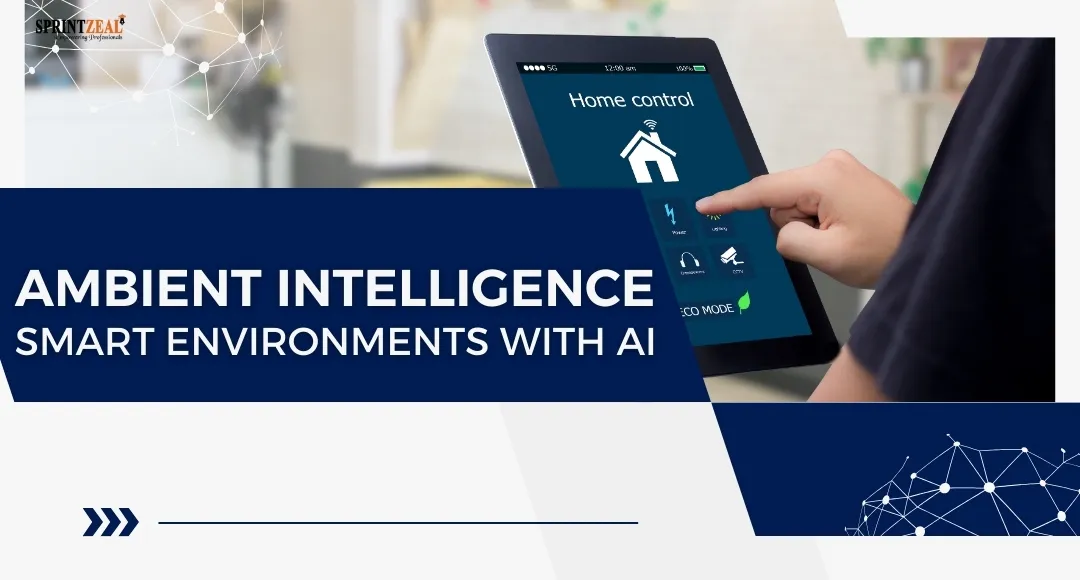
Just think of being in a room where lights adjust on their own, the temperature feels perfect, and the technology surrounding you is silently responding. Ambient intelligence is the less visible, nearly magical, experience, that makes all this possible.
Well, what is ambient intelligence if not? Ambient intelligence (most times referred to as AmI) stands for digital surroundings which are sensitive, adaptive, and responsive to the presence of humans. Instead of accommodating users with screens or commands, an ambient intelligence technology just mixes with daily routine life. This technology incorporates sensors, artificial intelligence, machine learning, and connected devices to grasp context—your identity, your activity, and the fact that you might need something next.
The concept of ambient intelligence was already there before. It can be traced back to Mark Weiser's idea in the 1990s of ubiquitous computing, which would be less obtrusive and more integrated into people's lives. If we look at the situation now, modern AI has made that dream come true. With advanced algorithms, on-demand data handling, and edge computing, the ambient intelligence system is very efficient in learning, adapting, and evolving continuously.
One of the most human aspects of ambient intelligence, actually, is what makes it so powerful. The question is not about the success of the machines but rather about human experiences getting better. Ambient intelligence is a tool that silently performs its duties behind the scenes, whether it be a smart home predicting your daily habits, healthcare systems keeping an eye on patients in a non-intrusive manner, or offices changing to make workers more productive.
Do you realize that your gadgets nowadays are more "understanding" of you than in the past? This is a typical example of ambient intelligence. As tech gets ever more intuitive and less conspicuous, the distinction between digital and real worlds is getting less and less, which in turn makes the interaction natural, effortless, and surprisingly human.
People mix up ambient intelligence with AI (artificial intelligence), IoT (Internet of Things), or ambient computing in that they think these are the same technologies. But the reality is that ambient intelligence does not substitute them. It merges them.
Basically, ambient intelligence is a convergence layer where AI, IoT, and computing environments are in a harmony resulting in experiences that are natural and human-centric. The AI can be compared to the brain, IoT to the senses, and ambient intelligence to the experience that users actually feel.
Here is a table that clearly demarcates each of these technologies:
Technology | What It Focuses On | How It Works | User Experience |
Artificial Intelligence (AI) | Intelligence & decision-making | Learns from data to predict or automate tasks | Often visible (chatbots, recommendations) |
Internet of Things (IoT) | Connectivity of devices | Sensors collect and share data | Device-driven interactions |
Ambient Computing | Computing everywhere | Systems embedded into environments | Passive background computing |
Ambient Intelligence (AmI) | Human-centric experiences | AI + IoT + context awareness Seamless, adaptive, invisible | Seamless, adaptive, invisible |
When individuals put ambient intelligence and AI in contrast, the major difference they pinpoint is the purpose. The main focus of AI is intelligence whereas that of ambient intelligence is the one that makes the intelligence work in a covert manner for the betterment of human life. Likewise, the difference between ambient intelligence and IoT is not just about connectivity; it is more about understanding the context and acting on it intelligently.
Have you ever thought that your smart devices are way more intuitive now than maybe five years ago? That is ambient intelligence changing - the point where technology does not ask for your attention but instead works with you, not at you.
Ambient intelligence is a perfect example of an advanced technology that operates very quietly in the background, but the technology behind it follows a straightforward and logical path.
The whole thing starts with sensation.If we go through the technologies, we will see that the sensors are almost everywhere: in the devices, in the rooms, or even on the wearable gadgets. These sensors are always looking for information—motion sensors detect presence, microphones pick up voice commands, cameras observe activity, and biometric sensors track health signals. All these access points simply provide ambient intelligence with the means of staying in touch with the outer world without the necessity of direct user intervention.
Even though in the modern world of big data, raw data are considered as the new oil, they still mean nothing on their own unless they are processed. This is exactly the point where context-aware systems enter the game. Machine learning models scrutinize patterns, user behavior, location, time of day, and historical data for the purpose of figuring out the intended meaning. Is the user relaxing or working? Is this a normal routine or an anomaly? The context is what endows ambient intelligence with its so-called “awareness.”
After interpretation, ambient intelligence reacts automatically—modifying lighting, suggesting activities, giving warnings, or managing energy consumption. For example, a smart home that dims the lights when you start a movie or a healthcare system that notifies the staff when the patient's vital signs change.
This technology is becoming more accurate and more personalized with the next interaction. After all, isn’t it that we expect from truly intelligent environments—systems which change according to our needs, instead of us having to adapt to them?
Artificial Intelligence (AI) & Machine Learning (ML)
AI and ML serve as the central reasoning units of ambient intelligence technologies. They track trends, continuously monitor data sources, and gradually adjust to user behaviour. For instance, intelligent assistants like Alexa or Google Assistant customise your daily routines by, for instance, providing news in the morning or turning down lights at night without constant supervision. Have you ever pondered how the more you use a system, the more accurate the ideas become? That is machine learning working quietly in the background.
Internet of Things (IoT) & Sensor Networks
The Internet of Things (IoT) devices along with sensor networks establish the different realizations layer through their data capturing segments from the surroundings. Motion detectors, temperature sensors, cameras, and wearable devices are always on and sending data to the core of the system. One practical example can be a smart thermostat such as Nest, that notices human presence in the room and changes the temperature automatically. Without sensors, how would a system know when someone enters a room or leaves the house?
Edge Computing
With edge computing, one can perform data processing very close to the data source rather than always uploading it to a central cloud storage. The outcome of that is that latency is decreased tremendously and it also speeds the response time. For example, in health monitoring systems, wearable devices can locally detect if a heart rate is unusually high and they can take the action of alarm without needing confirmation from the cloud. Would such life-critical systems work effectively if every decision had to travel to a distant server?
Ubiquitous Computing
One of the major features of ubiquitous computing is that it enables tech to be totally integrated into our usual surroundings and thus the interaction with them becomes very natural and even invisible sometimes. An example can be smart work buildings which adjust on their own the lighting, fresh air, and free rooms for meetings by sensing employees’ presence. People do not use screens for interaction—the environment does it by itself.
How These Technologies Work Together
AI is responsible for analyzing the data, In the meanwhile, IoT instruments locate the precise spots in the real world where the work has to be done by AI; edge computing is used when quick actions are needed while ubiquitous computing is there to make life easier. Smart home security system is an ideal case—motion is detected, faces that the system knows are identified, alerts are processed at once, and actions are taken without any human help.
These are arguably the most visible examples of ambient intelligence in daily life. Based on their learned user habits and preferences, such systems automatically handle lighting, security, and energy consumption. Smart homes, therefore, don't just adjust a room temperature according to the presence of people but also send out alerts if they detect a rare activity. In this way, they develop an environment that is very responsive, yet it is a quiet background process, thus improving the overall comfort and efficiency.
These are a good example of the use of ambient intelligence in creating more natural human–technology interaction. They go beyond the idea of simple direct commands by grasping context, routines, and preferences. Voice assistants by managing schedules, controlling smart devices, and offering timely suggestions not only save time but also make a user's life much more convenient as they are always ready to communicate seamlessly in a hands-free manner without any interruption.
These are a great example of the application of ambient intelligence where the focus is on the individual. The trendsetting watches and health monitors are always on the lookout for changes in heart rate, activity levels, and sleep patterns. Such continuous monitoring opens the door for them to provide on-the-spot insights and even to issue health salvation warnings well ahead of time, thus empowering users to make the right decisions without the need to be constantly checking their data.
These react automatically and locally to movement, time of day, or weather conditions. The lighting hugs you with less intensity in the dark hours of the day, air temperatures change to suit your needs, and the use of energy is made most efficient without the intervention of a human being. The rationale behind using intellect to adapt to your presence in your environment is that you do not have to do it yourself by switching on and off lights and controlling thermostats.
Key Benefits of Ambient Intelligence
One of the largest advantages of ambient intelligence is the invisibility of it. The systems evolve with the users in a natural way—without the need for constant manual input. For example, if it is smart lighting that adjusts itself or healthcare systems that monitor patients in real-time, AmI is there but you don’t see it, and it makes the life more comfortable, convenient, and personalized.
Ambient intelligence (AmI) is the technology that largely enables intelligent automation. AmI is a system that is constantly aware of, studies, and reacts to changes in the environment. Consequently, decision-making is improved across the board, resource utilisation is made more efficient, and the need for human interventions is decreased. The retail, healthcare, and smart city sectors benefit from such a development in that their operations become more rapid, they incur lesser costs, and their productivity grows.
Major Challenges of Ambient Intelligence
As ambient intelligence heavily depends on continuous data collection, the privacy of the users is one of the most significant concerns. The always-on sensors and monitoring systems can be perceived as intrusive if the use of the data is not transparent or properly regulated.
It is absolutely necessary to protect data that is highly contextual and personal, coming in large volumes from different sources and flows, to prevent it from going to the wrong hands. At the same time, if security is not well thought out, there will always be ways for hackers to get into a system and breach the data, misuse it, or launch cyberattacks.
Ambient systems making decisions—most of the time without asking the user—lead to numerous ethical questions. Such as, who has control over the data? And if decisions are made, how are they communicated? Besides this, ensuring that the system is fair, accountable, and trustworthy for the user is another big challenge.
The next step for ambient intelligence is shifting very quickly towards AI-first environments. Basically, intelligence will be a natural part of the environment and not a separate program.
To the people living, working, or simply passing by homes, offices, and public spaces will be able to sense, learn, and adapt to their behavior in real time more and more, anyhow. In fact, as users will be less and less required to interact with screens or commands, systems will be able to anticipate needs—thus, they will be able to change lighting, temperature, security, or even workflows silently and automatically. The intangible, human-focused approach to the design of ambient intelligence is what actually makes it a real revolution rather than just "smart".
The rise of Edge AI is the major factor that changes the future of ambient intelligence very radically. Data processing is done quite close to the source—on devices and sensors—thus, the time between the data request and the data delivery is shortened, the system becomes more reliable, and user privacy is better protected. Hence, ambient systems are granted the freedom to make local solutions without the need for cloud connection. As far as edge technology is concerned, it will not only be able to become more powerful but more energy-efficient as well which will contribute to a quicker roll-out of ambient intelligence in households, industrial areas, and urban centers.
The first industries that will soak up most of the ambient intelligence technology are healthcare and smart infrastructures. In fact, one of the most convincing examples of enviromental intelligence is the use of ambient clinical intelligence which is capable of real-time insight generation thus enabling rapid decision making for doctors. On the other hand, the scope of the implementation of AI in urban management with a view towards traffic, energy, and safety optimization is equally wide-ranging. The necessity of systems that could predict situations and be conscious of the context will be the main reason for sustained market growth.
AI, sensors, and context awareness are all combined to create ambient intelligence, which is gradually altering our way of life and workplace culture. The settings that come from the integration of these technologies are thought to be human-centric, intuitive, and adaptable. AmI is the next big thing in the technological revolution that is going to affect everything from smart homes to healthcare and cities. The only question left is whether you want to live in such spaces that think along with you?AI isn't science fiction anymore; it’s your co-worker. The question is, are you going to master it, or let it master you? Get ahead of the biggest tech wave in history. Learn how to build and deploy intelligent systems with Sprintzeal’s Artificial Intelligence Certification Training
Answer: Ambient intelligence is a concept of a smart digital environment that can perceive, adapt, and respond to the presence of humans. It is a mix of artificial intelligence, sensors, and context awareness that result in systems that do not require user intervention to the extent that they even predict the needs of the users and enhance their daily experiences without the users having to interact all the time.
Answer: In general, artificial intelligence is about the creation of algorithms that have the capability of analyzing data, learning from it, and making decisions. Ambient intelligence makes use of AI as a mere layer that enables intelligent environments. While AI is usually visible or command-driven, ambient intelligence is an invisible agent that adjusts to users based on their context, behavior, and surroundings without them knowing.
Answer: Ambient intelligence has infiltrated the modern homes of the future, health monitoring systems, smart cities, retail personalization, and progressive workplaces. Some of the cases are the voice-enabled help, ambient clinical intelligence in hospitals, energy-efficient smart buildings, and adaptive environments that automatically respond to human presence.
Just think of being in a room where lights adjust on their own, the temperature feels perfect, and the technology surrounding you is silently responding. Ambient intelligence is the less visible, nearly magical, experience, that makes all this possible.
Well, what is ambient intelligence if not? Ambient intelligence (most times referred to as AmI) stands for digital surroundings which are sensitive, adaptive, and responsive to the presence of humans. Instead of accommodating users with screens or commands, an ambient intelligence technology just mixes with daily routine life. This technology incorporates sensors, artificial intelligence, machine learning, and connected devices to grasp context—your identity, your activity, and the fact that you might need something next.
The concept of ambient intelligence was already there before. It can be traced back to Mark Weiser's idea in the 1990s of ubiquitous computing, which would be less obtrusive and more integrated into people's lives. If we look at the situation now, modern AI has made that dream come true. With advanced algorithms, on-demand data handling, and edge computing, the ambient intelligence system is very efficient in learning, adapting, and evolving continuously.
One of the most human aspects of ambient intelligence, actually, is what makes it so powerful. The question is not about the success of the machines but rather about human experiences getting better. Ambient intelligence is a tool that silently performs its duties behind the scenes, whether it be a smart home predicting your daily habits, healthcare systems keeping an eye on patients in a non-intrusive manner, or offices changing to make workers more productive.
Do you realize that your gadgets nowadays are more "understanding" of you than in the past? This is a typical example of ambient intelligence. As tech gets ever more intuitive and less conspicuous, the distinction between digital and real worlds is getting less and less, which in turn makes the interaction natural, effortless, and surprisingly human.
Ambient intelligence is a perfect example of an advanced technology that operates very quietly in the background, but the technology behind it follows a straightforward and logical path.
The whole thing starts with sensation.If we go through the technologies, we will see that the sensors are almost everywhere: in the devices, in the rooms, or even on the wearable gadgets. These sensors are always looking for information—motion sensors detect presence, microphones pick up voice commands, cameras observe activity, and biometric sensors track health signals. All these access points simply provide ambient intelligence with the means of staying in touch with the outer world without the necessity of direct user intervention.
Even though in the modern world of big data, raw data are considered as the new oil, they still mean nothing on their own unless they are processed. This is exactly the point where context-aware systems enter the game. Machine learning models scrutinize patterns, user behavior, location, time of day, and historical data for the purpose of figuring out the intended meaning. Is the user relaxing or working? Is this a normal routine or an anomaly? The context is what endows ambient intelligence with its so-called “awareness.”
After interpretation, ambient intelligence reacts automatically—modifying lighting, suggesting activities, giving warnings, or managing energy consumption. For example, a smart home that dims the lights when you start a movie or a healthcare system that notifies the staff when the patient's vital signs change.
This technology is becoming more accurate and more personalized with the next interaction. After all, isn’t it that we expect from truly intelligent environments—systems which change according to our needs, instead of us having to adapt to them?
AI and ML serve as the central reasoning units of ambient intelligence technologies. They track trends, continuously monitor data sources, and gradually adjust to user behaviour. For instance, intelligent assistants like Alexa or Google Assistant customise your daily routines by, for instance, providing news in the morning or turning down lights at night without constant supervision. Have you ever pondered how the more you use a system, the more accurate the ideas become? That is machine learning working quietly in the background.
The Internet of Things (IoT) devices along with sensor networks establish the different realizations layer through their data capturing segments from the surroundings. Motion detectors, temperature sensors, cameras, and wearable devices are always on and sending data to the core of the system. One practical example can be a smart thermostat such as Nest, that notices human presence in the room and changes the temperature automatically. Without sensors, how would a system know when someone enters a room or leaves the house?
With edge computing, one can perform data processing very close to the data source rather than always uploading it to a central cloud storage. The outcome of that is that latency is decreased tremendously and it also speeds the response time. For example, in health monitoring systems, wearable devices can locally detect if a heart rate is unusually high and they can take the action of alarm without needing confirmation from the cloud. Would such life-critical systems work effectively if every decision had to travel to a distant server?
One of the major features of ubiquitous computing is that it enables tech to be totally integrated into our usual surroundings and thus the interaction with them becomes very natural and even invisible sometimes. An example can be smart work buildings which adjust on their own the lighting, fresh air, and free rooms for meetings by sensing employees’ presence. People do not use screens for interaction—the environment does it by itself.
How These Technologies Work Together
AI is responsible for analyzing the data, In the meanwhile, IoT instruments locate the precise spots in the real world where the work has to be done by AI; edge computing is used when quick actions are needed while ubiquitous computing is there to make life easier. Smart home security system is an ideal case—motion is detected, faces that the system knows are identified, alerts are processed at once, and actions are taken without any human help.
These are arguably the most visible examples of ambient intelligence in daily life. Based on their learned user habits and preferences, such systems automatically handle lighting, security, and energy consumption. Smart homes, therefore, don't just adjust a room temperature according to the presence of people but also send out alerts if they detect a rare activity. In this way, they develop an environment that is very responsive, yet it is a quiet background process, thus improving the overall comfort and efficiency.
These are a good example of the use of ambient intelligence in creating more natural human–technology interaction. They go beyond the idea of simple direct commands by grasping context, routines, and preferences. Voice assistants by managing schedules, controlling smart devices, and offering timely suggestions not only save time but also make a user's life much more convenient as they are always ready to communicate seamlessly in a hands-free manner without any interruption.
These are a great example of the application of ambient intelligence where the focus is on the individual. The trendsetting watches and health monitors are always on the lookout for changes in heart rate, activity levels, and sleep patterns. Such continuous monitoring opens the door for them to provide on-the-spot insights and even to issue health salvation warnings well ahead of time, thus empowering users to make the right decisions without the need to be constantly checking their data.
These react automatically and locally to movement, time of day, or weather conditions. The lighting hugs you with less intensity in the dark hours of the day, air temperatures change to suit your needs, and the use of energy is made most efficient without the intervention of a human being. The rationale behind using intellect to adapt to your presence in your environment is that you do not have to do it yourself by switching on and off lights and controlling thermostats.
Key Benefits of Ambient Intelligence
One of the largest advantages of ambient intelligence is the invisibility of it. The systems evolve with the users in a natural way—without the need for constant manual input. For example, if it is smart lighting that adjusts itself or healthcare systems that monitor patients in real-time, AmI is there but you don’t see it, and it makes the life more comfortable, convenient, and personalized.
Ambient intelligence (AmI) is the technology that largely enables intelligent automation. AmI is a system that is constantly aware of, studies, and reacts to changes in the environment. Consequently, decision-making is improved across the board, resource utilisation is made more efficient, and the need for human interventions is decreased. The retail, healthcare, and smart city sectors benefit from such a development in that their operations become more rapid, they incur lesser costs, and their productivity grows.
Major Challenges of Ambient Intelligence
As ambient intelligence heavily depends on continuous data collection, the privacy of the users is one of the most significant concerns. The always-on sensors and monitoring systems can be perceived as intrusive if the use of the data is not transparent or properly regulated.
It is absolutely necessary to protect data that is highly contextual and personal, coming in large volumes from different sources and flows, to prevent it from going to the wrong hands. At the same time, if security is not well thought out, there will always be ways for hackers to get into a system and breach the data, misuse it, or launch cyberattacks.
Ambient systems making decisions—most of the time without asking the user—lead to numerous ethical questions. Such as, who has control over the data? And if decisions are made, how are they communicated? Besides this, ensuring that the system is fair, accountable, and trustworthy for the user is another big challenge.
The next step for ambient intelligence is shifting very quickly towards AI-first environments. Basically, intelligence will be a natural part of the environment and not a separate program.
To the people living, working, or simply passing by homes, offices, and public spaces will be able to sense, learn, and adapt to their behavior in real time more and more, anyhow. In fact, as users will be less and less required to interact with screens or commands, systems will be able to anticipate needs—thus, they will be able to change lighting, temperature, security, or even workflows silently and automatically. The intangible, human-focused approach to the design of ambient intelligence is what actually makes it a real revolution rather than just "smart".
The rise of Edge AI is the major factor that changes the future of ambient intelligence very radically. Data processing is done quite close to the source—on devices and sensors—thus, the time between the data request and the data delivery is shortened, the system becomes more reliable, and user privacy is better protected. Hence, ambient systems are granted the freedom to make local solutions without the need for cloud connection. As far as edge technology is concerned, it will not only be able to become more powerful but more energy-efficient as well which will contribute to a quicker roll-out of ambient intelligence in households, industrial areas, and urban centers.
The first industries that will soak up most of the ambient intelligence technology are healthcare and smart infrastructures. In fact, one of the most convincing examples of enviromental intelligence is the use of ambient clinical intelligence which is capable of real-time insight generation thus enabling rapid decision making for doctors. On the other hand, the scope of the implementation of AI in urban management with a view towards traffic, energy, and safety optimization is equally wide-ranging. The necessity of systems that could predict situations and be conscious of the context will be the main reason for sustained market growth.
AI, sensors, and context awareness are all combined to create ambient intelligence, which is gradually altering our way of life and workplace culture. The settings that come from the integration of these technologies are thought to be human-centric, intuitive, and adaptable. AmI is the next big thing in the technological revolution that is going to affect everything from smart homes to healthcare and cities. The only question left is whether you want to live in such spaces that think along with you?AI isn't science fiction anymore; it’s your co-worker. The question is, are you going to master it, or let it master you? Get ahead of the biggest tech wave in history. Learn how to build and deploy intelligent systems with Sprintzeal’s Artificial Intelligence Certification Training
Answer: Ambient intelligence is a concept of a smart digital environment that can perceive, adapt, and respond to the presence of humans. It is a mix of artificial intelligence, sensors, and context awareness that result in systems that do not require user intervention to the extent that they even predict the needs of the users and enhance their daily experiences without the users having to interact all the time.
Answer: In general, artificial intelligence is about the creation of algorithms that have the capability of analyzing data, learning from it, and making decisions. Ambient intelligence makes use of AI as a mere layer that enables intelligent environments. While AI is usually visible or command-driven, ambient intelligence is an invisible agent that adjusts to users based on their context, behavior, and surroundings without them knowing.
Answer: Ambient intelligence has infiltrated the modern homes of the future, health monitoring systems, smart cities, retail personalization, and progressive workplaces. Some of the cases are the voice-enabled help, ambient clinical intelligence in hospitals, energy-efficient smart buildings, and adaptive environments that automatically respond to human presence.

Tue, 13 October 2026
Fri, 09 October 2026

Mon, 28 September 2026

Tue, 22 September 2026

Tue, 08 September 2026

Mon, 24 August 2026

Wed, 19 August 2026
Mon, 17 August 2026
Mon, 17 August 2026
Thu, 13 August 2026


© 2026 Sprintzeal Americas Inc. - All Rights Reserved.

 USA : +1315-322-7821
 UK : +44 7700 174870
 IND : +919036108287
 AUS : +61 480 005 455